


The Altai Mountains deserve a dedicated block of days, not a detour squeezed into a general Mongolia loop. As a planning rule, we suggest allowing roughly six days inside the western range itself, reached by flying from Ulaanbaatar to Bayan-Ulgii, within a trip of about eleven days or more. This guide explains that logic: where the Altai sits in Mongolia's geography, how the gateway works, how many days the mountains alone reward versus a wider western loop, which valleys and lakes to prioritise, and how seasons and road realities shape the pace. By the end you will know what to ask for when you design your journey — no trekking technique required.
Altai planning at a glance
- The Altai anchors Western Mongolia, roughly 1,700 km from Ulaanbaatar — distance is the single biggest planning factor.
- Most mountain-focused travellers fly to Bayan-Ulgii, then drive about 220 km into the high valleys near Khoton and Khurgan lakes.
- Allow around six days in the range; our published Altai trekking tour runs 11 days, and the full western overland loop 14 days.
- Combining the Altai with another distant region works best at 12–14 days minimum, with a flight segment between regions.
- Summer is the window with the fewest compromises; a supported private journey with 24-hour assistance keeps remote-road travel comfortable.
Where do the Altai Mountains sit in Mongolia's geography?
The Altai range runs along Mongolia's far-western frontier, forming the mountainous spine of Western Mongolia — a region of five provinces (Zavkhan, Khovd, Gobi-Altai, Uvs and Bayan-Ulgii) that remains the least travelled part of the country and home to more than ten ethnic groups. Where the Gobi is open desert basin and the north is forested lake country, the Altai is genuinely alpine: glacier-capped summits rising above 4,300 metres, larch-forested valleys, and freshwater lakes held between the ridges.
Two facts should govern your planning:
- Distance. Western Mongolia lies about 1,700 km from Ulaanbaatar. That is not a day trip, and it is why we treat the Altai as a destination in its own right rather than a stop on a central-Mongolia circuit.
- Concentration. The scenery most travellers come for — the twin lakes, the sacred summits of Altai Tavan Bogd National Park, the high valleys — clusters in Bayan-Ulgii province. Once you reach the gateway, the rewards are close together. The effort is in getting there, not in moving around once you have arrived.
In our experience designing western routes, travellers who accept that structure — one decisive transfer, then several unhurried days in the range — come home far happier than those who try to "touch" the Altai between other regions.
Should you fly or drive from Ulaanbaatar?
For most travellers drawn specifically to the mountains, we recommend flying one leg. On our Altai Tavan Bogd itineraries, guests fly Ulaanbaatar–Bayan Ulgii, then drive roughly 220 km to the Tsagaan Us valley near Khoton and Khurgan lakes. You trade several long driving days for a morning in the air, and spend the saved time in the landscape you came for. We coordinate domestic flight legs through our partnership with MIAT Mongolian Airlines, aligning them with your itinerary dates — and where it suits the route, flying one way and driving back so you still see the country transition from steppe to mountains.
The fully overland approach is a different product, not a worse one. Our Standard Collection Western Mongolia Overland Tour runs 14 days / 13 nights from Ulaanbaatar via Elsen Tasarkhai, Terkhiin Tsagaan Lake, Khyargas Lake, Khoton Lake and Altai Tavan Bogd, with a minimum of eight travellers. Choose it if the journey across Mongolia is itself part of your goal and you have two full weeks. If your holiday is shorter and the mountains are the point, flying in is usually the more sensible allocation of your days — a judgement we make route by route, not a fixed rule.
Flight details are confirmed at design time
Domestic schedules to Bayan-Ulgii vary by season. We confirm the current timetable and hold the flight leg against your itinerary dates when we build your journey, rather than asking you to guess at connections yourself.
How many days does the Altai deserve?
Here is the honest arithmetic we use when travellers ask "can we fit the Altai into ten days?" The answer depends on what surrounds it.
| Journey shape | Total duration | What it covers | Verified anchor |
|---|---|---|---|
| Altai-focused journey, flying in | 11 days / 10 nights | Ulaanbaatar bookends, flight to Bayan-Ulgii, high valleys and Tavan Bogd high country | Explorer Collection Altai Tavan Bogd Trekking Tour (camel-supported, minimum 4 travellers) |
| Full western overland loop | 14 days / 13 nights | Ulaanbaatar overland via Elsen Tasarkhai, Terkhiin Tsagaan Lake, Khyargas, Khoton Lake, Altai Tavan Bogd | Standard Collection Western Mongolia Overland Tour (minimum 8 travellers) |
| Altai combined with a second region | 12–14 days minimum | Roughly six days in the western Altai, one transit day, six days in the second region, Ulaanbaatar bookends | Our Altai + Khuvsgul two-region framework |
Three planning rules sit behind that table:
- Give the range about six days. In our two-region frameworks we allocate roughly six days to the western Altai. Fewer, and you are mostly looking at the mountains through a windscreen; the valleys reward staying put.
- Treat an Altai extension as a two-week decision. Our season-by-season planning guide is explicit: an extension into Western Mongolia and the Altai suits itineraries of two weeks or more, and a full two-region journey typically needs 12 to 14 days.
- Never stack long transit days. When we combine the Altai with another distant region — the northern lake country, for instance — we use a flight segment and allow no more than one long transit day between regions. Our 14-day Altai and Khuvsgul routing shows exactly how that accounting works.
If you have under two weeks and the mountains are your priority, the cleanest answer is an Altai-focused journey with Ulaanbaatar bookends — not a compressed grand loop. For a scenic, driving-based stay rather than a trekking itinerary, we shape the day count around your pace and interests through a bespoke design; tell us your dates and we will tell you honestly what fits.
See the mountains up close
Our Explorer Collection includes the 11-day Altai Tavan Bogd journey — camel-supported, with the high country reached on foot and Malchin Peak (4,050 m) among its highlights.
Explore the Explorer CollectionWhich valleys, lakes and high country should you prioritise?
You do not need to choose between "scenery" and "activity" here — much of the Altai's reward is simply being in place. These are the landscapes we build days around, and how to weigh them.
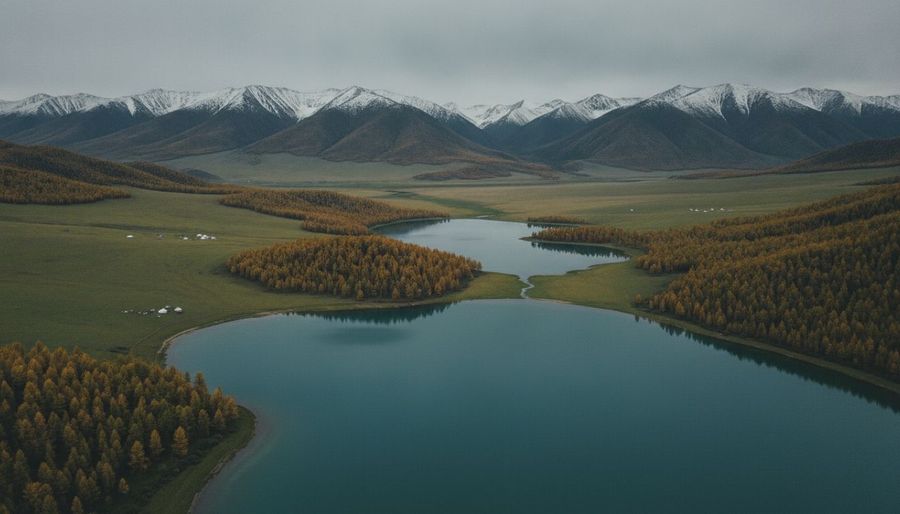
The lake valleys: Khoton and Khurgan
The twin freshwater lakes sit at the foot of the range, framed by larch forests and dotted with Kazakh summer camps. This is the natural base for a scenic stay: gentle shoreline walks, valley drives, and long evenings watching light move across the water. If your group wants mountain atmosphere without sustained climbing, anchor your days here.
The high country: Altai Tavan Bogd and the Kharkhiraa massif
Altai Tavan Bogd National Park holds five sacred summits and glaciers — the dramatic, vertical Altai. The neighbouring Kharkhiraa massif offers a quieter high-mountain counterpart. Reaching the glacier viewpoints involves real walking days; our Explorer itineraries are built for exactly this, while a scenic journey can approach the park's edges and viewpoints by vehicle and short walks. Be honest with us about your group's appetite for effort, and we will grade each day accordingly.
The wider western lakes: Uvs, Ulaagchiin Khar and Khyargas
If your route loops through the broader west, three lake landscapes stand apart from the alpine valleys: Uvs Lake, a UNESCO World Heritage site spanning over 3,000 km²; Ulaagchiin Khar Lake, a Strictly Protected Area since 2010; and Khyargas Lake with its striking Khetsuu Khad cliff. These suit the overland traveller threading the west together — they are steppe-and-basin scenery rather than high mountains, and worth distinct days rather than roadside pauses.
Wildlife threads through all of it. The region is home to snow leopards, Argali wild sheep, ibex, golden eagles and snowcocks, and its lakes serve migratory birds travelling between Siberia and Southeast Asia. Sightings are never promised — but patient days in the valleys, binoculars ready, are how encounters happen. The eagle-hunting culture of Bayan-Ulgii deserves its own reading; our Golden Eagle Festival guide covers what you are actually watching in the Altai.
When should you go, and what are the roads really like?
Summer is the window with the fewest compromises. Our season guide lists every region — Gobi, north, steppe and Altai extensions — for the summer months, and the long daylight hours make the west's distances feel generous rather than grinding. Outside that window, weather and road conditions increasingly constrain what we can responsibly route in the high valleys, so shoulder-season plans need a conversation rather than a template.
The roads themselves are unpaved for much of the approach and within the range. That is the reality of Mongolia's far west, and it is manageable — not because the roads improve, but because the support around you is designed for them:
- Local drivers who know the tracks, the river crossings and the weather patterns of each valley.
- Pacing built into the itinerary — we balance driving distance against the moments you came for, and keep buffer in the schedule so a slow track does not cost you a lake evening.
- 24-hour trip assistance throughout your journey, with on-the-ground coordination behind every transfer.
As a women-led local team with over ten years of experience designing these routes, we plan the west the way we would for our own families: unhurried days, honest transfer accounting, and support that does not clock off when the tarmac ends.
Pack for four seasons in one week
Even in midsummer, high valleys can turn cold quickly when weather moves over the ridges. Layers matter more than specialised gear for a scenic stay — we send a tailored packing list with every confirmed itinerary.
Is the Altai right for you — and which journey covers it?
The Altai suits travellers who want scale and quiet: photographers chasing alpine light, nature enthusiasts content with patient wildlife hours, returning visitors who have seen the Gobi and the north and want Mongolia's wildest corner, and families whose children are comfortable with long, beautiful driving days. It asks less of your fitness than people assume — a scenic, vehicle-based stay is well within reach of non-expedition travellers — and more of your calendar.
How the journey is covered depends on your style:
- Explorer Collection — the active end: the 11-day camel-supported Tavan Bogd trekking journey, including Malchin Peak at 4,050 m, for groups of four or more.
- Standard Collection — the 14-day overland crossing of the west, for travellers who want the whole arc from central Mongolia to the far frontier.
- Bespoke design — for hiking-intensive plans we build multi-day walking routes with local guides, camp support and vehicle rendezvous points, grading each day's effort to your group; for scenic stays we shape valley-based days at your pace. If you are weighing collections against each other, our Explorer vs Standard comparison lays out the differences.
Frequently asked questions
Can I visit the Altai Mountains on a one-week trip?
A week is tight once Ulaanbaatar arrivals and departures are counted. Flying both ways to Bayan-Ulgii makes a short mountain-focused visit possible, but you will see less of the range than the roughly six days we prefer to allocate. If a week is all you have, tell us — we will design honestly around it or suggest a region that fits better.
Do I need to be a trekker to enjoy the Altai?
No. The lake valleys, scenic drives and park viewpoints reward travellers who simply want to be in high landscape. Sustained walking is only needed for the glacier viewpoints and summit approaches, and we grade every day's effort to your group when designing bespoke routes.
Is it safe to travel the unpaved roads of the far west?
With a supported private journey, remote-road travel is manageable for non-expedition travellers: experienced local drivers, paced itineraries with schedule buffers, and 24-hour trip assistance throughout. The roads are demanding; the support model exists precisely for that.
Can I combine the Altai with Khuvsgul Lake in one trip?
Yes — at 12 to 14 days minimum, with a flight segment between regions and no more than one long transit day. Our published two-region framework gives roughly six days to each region plus Ulaanbaatar bookends.
The next step
The Altai rewards travellers who give it room: fly to the gateway, settle into the valleys, and let the range unfold over several unhurried days. Whether that means an Explorer trekking journey, the full western overland arc, or a scenic bespoke stay shaped around your pace, the planning logic is the same — honest distances, a dedicated block of days, and support at every turn. Tell us your dates and what drew you to the mountains, and we will design the route that fits.
Let's design your time in the range
Share your travel window, group and interests through our inquiry form — the Travel Design Team will map the days, the gateway and the valleys around you.
Start planning your Altai journey


