


Mongolianstar Adventures Travel Design Team — itinerary architects · Published 20 October 2026 · Last reviewed 20 October 2026
Yes — you can see Khuvsgul Lake and the Gobi Desert in one private journey, but plan for roughly two weeks rather than a standard week. Our Design Team recommends allowing at least two weeks — 14 days for the flight-assisted shape, 16–18 for the full overland loop — and usually one domestic flight leg rather than whole days spent backtracking between opposite ends of the country. This Khuvsgul Lake travel guide explains how we join Mongolia's north and south: the two routing shapes we use, why Ulaanbaatar works as the hinge, which season lets both landscapes show well, and when we suggest two separate journeys instead. By the end you will know which shape fits your dates — and what to tell us to design it.
The north–south combination at a glance
- Budget 14 days for the flight-assisted shape; 16–18 for the full overland loop — a single week cannot do both regions justice.
- A domestic flight leg usually makes the combination more comfortable — the full overland loop works too, with more days.
- Two routing shapes: a full overland loop through Central Mongolia, or a flight-assisted route that skips the long middle.
- July–August is our most reliable window for both regions; September can work beautifully with care.
- Sometimes the better answer is two separate journeys — we will tell you when.
Khuvsgul Lake travel guide: why combine the lake and the desert, and what does it demand?
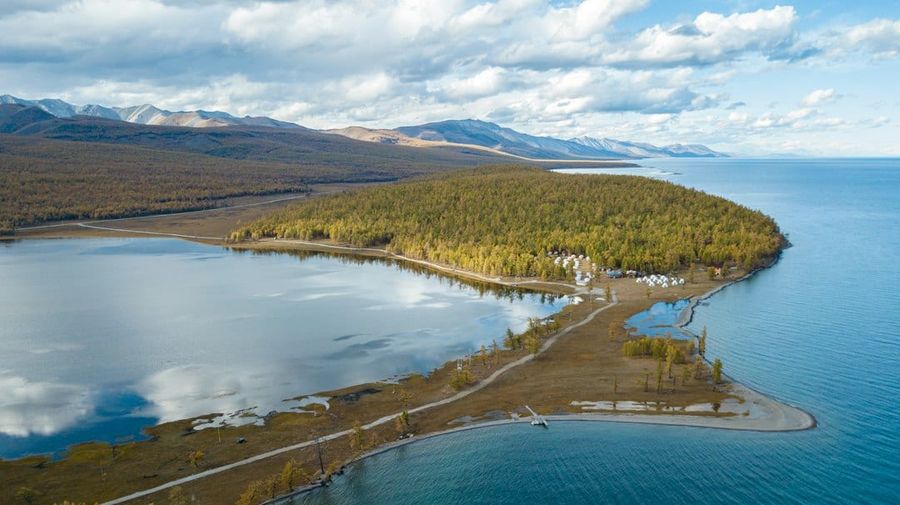
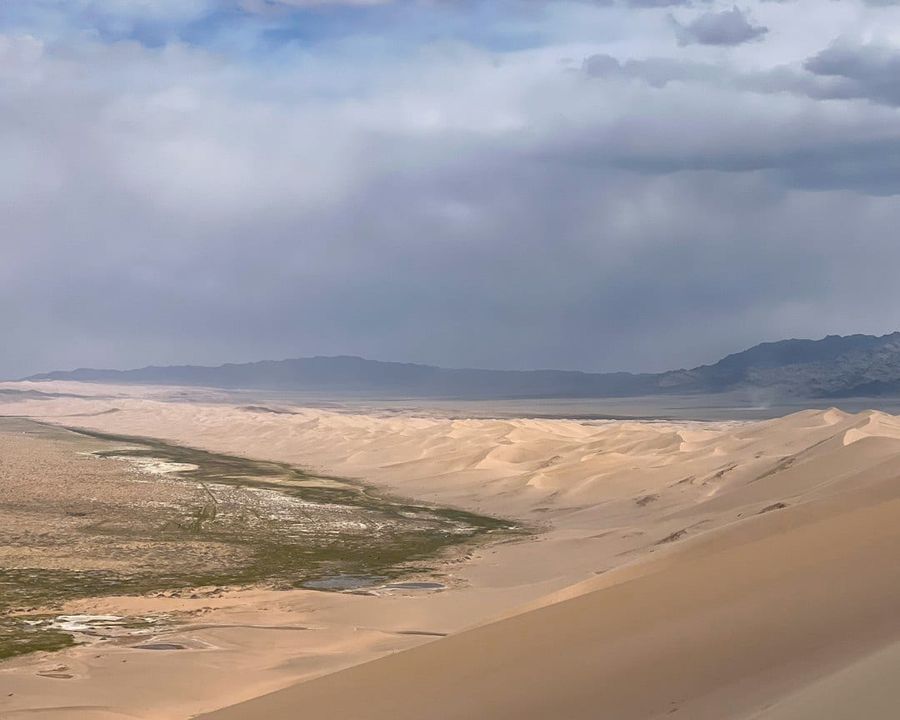
The appeal is contrast. In the north, Khuvsgul sits among forested mountains — larch taiga, cool clear water, mornings that smell of pine and woodsmoke. In the south, the Gobi opens into dunes, wind-carved canyons and horizons with nothing on them but light. These are two utterly different Mongolias, and travellers who have seen one often find the other completes the picture.
What the combination demands is time, and honesty about driving. Mongolia is vast, and its road network is thin: most of it unpaved, according to the OECD. That is the physical reason a flight leg matters — the backtrack between north and south is not a motorway transfer you can shrug off.
In our routing practice we budget roughly six to eight hours for a 300-kilometre day on unpaved roads. So we design around a simple rule: never two consecutive 300-kilometre days on a first-timer itinerary. Heavy driving days (250–380 km) are followed by lighter days or a two-night stay, so the driving never crowds out the moments you came for — a slow evening on the dunes, an unhurried morning with a herding family. For segment lengths, our standard combined routings give the Gobi five to six days and the north six to eight days well-paced, including shoreline time, a nomadic family visit and a weather-and-road buffer. If you want the northern half explored in depth on its own terms, our Northern Mongolia region guide and the companion Khuvsgul Lake travel guide cover that ground — this article is about the join.
Which routing shape fits: overland loop or flight-assisted?
There are two ways to stitch north and south together, and the choice is mostly about how you feel about long driving days.
The full overland loop through Central Mongolia
The overland route from Ulaanbaatar to Khuvsgul passes through Arkhangai and Bulgan — which means the "long middle" of a loop is not empty transit. It overlaps Central Mongolia's highlights: the Orkhon Valley, Erdene Zuu and Kharkhorin, open steppe in every direction. Threaded deliberately, the connector becomes a third landscape rather than a cost. That middle section works as a journey in its own right.
The trade-off is arithmetic: more consecutive driving days, more nights spent moving between regions, and less slack if weather softens a road. This shape suits travellers who enjoy the road itself and have 16–18 days rather than a fortnight.
The flight-assisted route
The alternative is to fly one or both of the long legs. Domestic flights to Mongolia's regional gateways can remove the longest driving days. In our own routings, the overland transfer between Ulaanbaatar and Dalanzadgad takes a full driving day each way, so flying gives those days back to the dunes. We coordinate flight legs through our MIAT Mongolian Airlines partnership and confirm the route, schedule and fare for your dates at design time.
Here is the routing we recommend for a flight-assisted combination, south first:
- 1
Days 1–5 — Gobi Desert — flaming cliffs, dunes and camel trekking, reached by air rather than a long drive out.
- 2
Day 6 — Ulaanbaatar hinge — return to the capital for a rest night, then the flight north.
- 3
Days 7–12 — Northern Mongolia — Lake Khuvsgul, taiga walks and a nomadic family visit, with two nights at the lake so the pace can breathe.
- 4
Days 13–14 — return and departure buffer — back to Ulaanbaatar, with a final buffer day before your flight home. Returning overland through Central Mongolia instead adds days: that is the 16–18 day loop.
| Consideration | Full overland loop | Flight-assisted route |
|---|---|---|
| Central Mongolia scenery | Included — Arkhangai, Bulgan, Orkhon Valley on the way | Optional on the return leg only |
| Long driving days | More, spread across the connector | Fewer — long legs flown rather than driven (our estimate: about a driving day each way) |
| Northern leg (Ulaanbaatar–Khuvsgul area) | Two driving days each way in our routings | Flown via the northern gateway; schedule confirmed at design time |
| Time needed | 16–18 days | 14 days |
| Weather exposure | Higher — more unpaved-road days | Lower — long legs flown, not driven |
| Best suited to | Travellers who enjoy the road and want three landscapes | First-timers and families prioritising time at the lake and dunes |
Whichever shape you lean toward, the segments themselves stay constant: five to six days in the southern desert, six to eight in the north. The flight decision changes the joins, not the destinations.
| Segment | Flight-assisted route | Full overland loop |
|---|---|---|
| Gobi segment | 5 days (Days 1–5) | 5 days |
| Ulaanbaatar hinge | 1 rest night (Day 6) | 1 rest night |
| Northern segment | 6 days (Days 7–12), two nights at Khuvsgul | 6 days, two nights at Khuvsgul |
| Return and departure buffer | 2 days (Days 13–14) | 4 days, overland via Central Mongolia |
| Total | 14 days | 16 days |
These are the minimums we design to. The longer segment lengths — six days in the Gobi, eight in the north — add days to either shape, which is why most overland loops we design run 16–18 days.
What the buffer day protects
A buffer day is what absorbs a softened road, a shifted flight or a morning of rain without costing you the trip's best hours. On a two-landscape route it is the difference between rescheduling a transfer and losing a lake morning or a dune evening — so we build it in rather than leave it to chance.
Should you fly or drive between Khuvsgul Lake and Ulaanbaatar?
In our routings the overland run between Ulaanbaatar and the Khuvsgul area is split over two driving days each way; flying via the northern gateway removes the longest of them. We confirm the current schedule at design time. Driving keeps the Arkhangai and Bulgan scenery in the trip; flying banks those days at the lake instead.
How does Ulaanbaatar work as the hinge?
Every combined route pivots on the capital, because both flight gateways and both overland corridors radiate from it. We treat Ulaanbaatar not as a sightseeing stop but as the route's shock absorber.
- Arrival stays gentle. In the 14-day routings we design, day one is a short airport transfer and an easy afternoon — a city hotel or a Terelj resort — never a long drive on landing day. Jet lag should never collide with your longest transfer.
- The hinge night is deliberate. In the routing above, Day 6 exists so the Gobi segment closes cleanly before the flight north. A rest night in the middle of a two-landscape trip is a feature, not lost time.
- Departure stays gentle too. The final day is a buffer, not a sprint to the airport.
North-first or south-first?
Both directions work, and we choose based on your dates and temperament. Our standard combined routing runs south-first: the Gobi's shorter segment builds momentum, the capital rest night resets the pace, and the journey ends in the cooler, greener north — a soft landing after the desert's intensity. There is also a natural sequencing logic when Central Mongolia is involved: for Orkhon plus Gobi, our usual shape is Ulaanbaatar to the Gobi, five to six days in the south, then a return through the Orkhon Valley on the way back to the capital. South-first keeps the scenery contrast rising rather than fading.
North-first suits travellers arriving early in the season, when northern roads are still firming up and the south is already dependable — or anyone who wants the desert as the finale. Whichever order we choose, two-night stays anchor each region's scenic centre, so neither landscape becomes a drive-through. Our northern Mongolia week itinerary shows how a well-paced northern segment fits together.
Which season lets both regions show well?
This is where a combined trip is more demanding than a single-region one: you need one window that flatters both a northern lake and a southern desert. Here is the seasonal picture we design from for the north:
| Window | Northern Mongolia conditions |
|---|---|
| Late May–June | Roads improving with soft sections; an extra buffer day advised |
| July–August | Most reliable — dry, firm roads; camps fully operational |
| September | Good roads, early frost, larch forests turning gold |
| October–April | Variable; snow and ice possible, limited lake access |
In our experience, mid-summer is the safest single window for the combination: the north's roads and camps are at their most dependable, and the Gobi delivers its full dune-and-canyon programme. September is the connoisseur's option — golden larch around Khuvsgul, quieter Gobi roads in the September departures we run, and roads that are usually still good in the first weeks of the month. From October, northern conditions turn variable — snow and ice are possible — so we normally recommend a single-region journey instead. The caveat is timing: southern ger camps close for the season at different points in autumn, and we confirm each camp's dates when we design your route. The north's early frost means a September combination should keep its buffer day intact. Our Southern Mongolia region guide covers the southern half in detail.
Outside these windows, we usually steer travellers toward a single-region journey rather than force the combination — a winter lake trip or an autumn desert trip can each be superb on their own terms.
Should you combine — or split into two journeys?
We like this combination, and we also decline to force it. Some considerations from the design table:
- You have ten days or fewer. A bare-bones northern round trip from Ulaanbaatar can be done in four to five days, but we recommend six to eight for a lake stay that feels unhurried — and the Gobi deserves five to six. Compressing both into one short trip means driving through the landscapes instead of being in them. One region, done properly, beats two regions skimmed.
- Long driving days wear your group down. If children or fellow travellers struggle with six-hour transfers, the flight-assisted shape helps — but two separate, shorter journeys may serve you better still.
- Your dates fall outside the shared season. Rather than compromise both regions, we would rather design one of them at its best and keep the other for a return visit.
- You want depth, not breadth. Photographers, wildlife seekers and slow travellers often get more from two focused trips than one wide loop.
None of this is a refusal — it is the same pacing logic, applied to your dates. As a women-led Mongolian team with more than ten years of local routing experience, we would rather tell you the comfortable answer than sell you the ambitious one. Every journey we design is private and all-inclusive, and we prioritise locally owned ger camps, drivers, guides and suppliers, and backed by 24-hour trip assistance — so whichever shape you choose, the support system travels with you.
The question resolves quickly in a tailor-made conversation: tell us your dates, your group's tolerance for driving, and which moments matter most, and we will map the shape — or recommend the split — with reasons. Those three details — dates, driving tolerance and priorities — are exactly what we need.
Can I really see Khuvsgul Lake and the Gobi in one trip?
Yes — allow at least 14 days for the flight-assisted shape, and 16–18 for the full overland loop. Our standard combined routing gives the Gobi five to six days and the north six to eight, with Ulaanbaatar as the rest-and-transfer hinge between them. We usually include one domestic flight leg, unless you choose the full overland loop, which needs longer.
Do I need to fly, or can the whole trip be overland?
Both shapes work. A full overland loop threads Central Mongolia between the regions and suits travellers who enjoy the road. Domestic flights to Mongolia's regional gateways can remove the longest driving days. We coordinate flight legs through our MIAT Mongolian Airlines partnership and confirm the route, schedule and fare for your dates at design time.
Which direction should the route run — north-first or south-first?
Our standard combined routing runs south-first, ending in the cooler northern lake country after a rest night in Ulaanbaatar. North-first suits early-season arrivals. We choose the order around your dates, road conditions and pacing.
Which month suits a combined north–south trip?
July and August are the most reliable, with firm northern roads and fully operational camps. September is a strong alternative — golden larch in the north, quieter Gobi roads — provided you keep a buffer day and we confirm camp operating dates for your window.
Which collection fits a north–south combination?
Because a north–south combination runs longer than a single-region trip, the collection you start from matters more than usual. For the full overland loop, where the Central Mongolia connector is part of the journey, we usually begin with the Explorer Collection. For the flight-assisted shape, with its lake stay and the rest night in Ulaanbaatar, the Signature Collection is the closer fit. Travelling with children, the Family Collection is the one we reach for: slower pacing, shorter transfers and two-night stays in each region. The Deluxe, Standard and Festival collections can all be adapted to a combined route too, and any of them can be tailored to your dates. Our comparison of the Explorer and Standard collections explains how they differ, so you can see which starting point suits your group.
The next step
Two Mongolias in one journey is entirely achievable — with two weeks, a flight leg where it counts, and rest built into the route rather than squeezed out of it. Tell us your dates and the pace your group travels at, and our Design Team will shape the loop, the flight-assisted route, or the split that serves you best.
Design your north–south journey with us
Share your travel window, group and priorities, and we will reply with a routing proposal — overland, flight-assisted, or two journeys done properly.
Start your itinerary inquiry


