


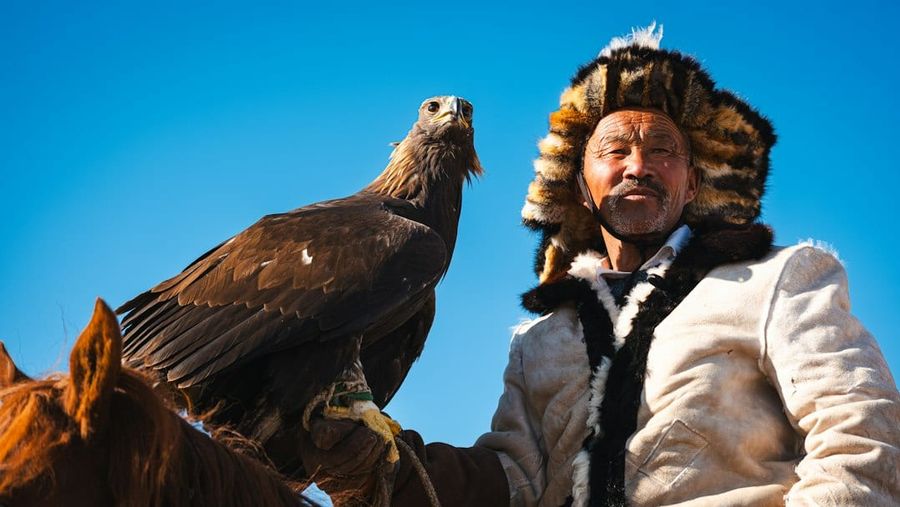
The Golden Eagle Festival is a two-day gathering held each autumn — the main event in October — in Bayan-Ulgii, Mongolia's far western province, where Kazakh eagle hunters ride into the Altai foothills with their birds and compete in front of their own communities. If you have seen a photograph of a fur-hatted hunter with a golden eagle on his arm and wondered what you would actually be looking at, this guide is for you. We run festival journeys here every autumn, and the thing we most want travelers to understand is this: you are not watching a show about hunting. You are watching hunters.
The short version
- The festival celebrates the living Kazakh eagle-hunting tradition of the Altai, in and around Ulgii, Bayan-Ulgii's cultural hub.
- The main festival runs two days in October, with smaller gatherings in September; the grounds lie a short drive (7–14 km) from Ulgii town.
- The heart of it is the eagle-to-lure trials: judges score the bond between hunter and bird, alongside dress, horse ornaments, archery and agility events.
- The eagle is a temporary partner — trained for years, then released back to the wild to breed.
- You are a guest at a community event, not an audience at a performance. Ask before photographing people, give the eagles space, and let your hosts lead.
What does the Golden Eagle Festival actually celebrate?
It celebrates berkutchi — the Kazakh art of hunting with trained golden eagles — as a working tradition that families in the Altai still practice, not a costume revival. Bayan-Ulgii is the one province of Mongolia where Kazakh language, music and custom shape daily life, and Ulgii city is its cultural hub. When the festival comes around, hunters travel from across the region — some, by our tour account, as far as 200–300 km — to measure their birds and their craft against their peers.
That distance matters more than any program detail. A hunter who rides two or three hundred kilometres to compete is not performing for visitors; he is showing his eagle to the people whose opinion he lives among. According to our own tour description, the festival has been celebrated since 2000, which makes it a young event built on a much older practice. The gathering is new; the partnership between hunter and eagle is not. For the wider landscape this tradition belongs to — the Altai range, which rises to 4,374 m at Mongolia's highest point — see our guide to Western Mongolia and the Altai.
What happens at the festival, event by event?
The two days open with a parade of roughly 70–80 eagle hunters on horseback, dressed in traditional Kazakh clothing and carrying their eagles on their right arms, followed by judged competitions and a program of horseback games and music. Here is what you are actually watching, in the order it tends to unfold.
The opening parade
This is the moment most photographs come from, and it is worth reading slowly. Each hunter's turnout — the cut and embroidery of his coat, his fur hat, the ornament on his horse's tack, the condition of the eagle on his arm — is a statement made to his own community. Judges score the hunters' clothing and horse ornaments as part of the competition, so the finery is not decoration for tourists; it is being assessed by people who know what good work looks like. Watch the crowd watching the horses as much as the eagles.
The eagle-to-lure trials
This is the heart of the festival. A hunter's eagle is carried out to a release point while the hunter waits at a distance, often on horseback, swinging a lure — a stuffed bait dragged behind a horse. The bird is released, and what everyone waits for is her decision: does she recognize her hunter's call and swing, fold her wings and come straight to him? Judges score the bond between eagle and hunter, and separately the eagles' agility in chasing the dragged bait. A fast, willing flight to the arm draws the loudest reaction from the crowd — not because it is dramatic, but because it is proof of years of daily trust. A hesitant bird is not a failure of entertainment; it is a bad day in a long relationship, and the crowd reads it that way.
Archery, races and horseback games
Between the eagle events, the program widens into the rest of Kazakh horsemanship: archery (also judged), camel and horse races, and a horseback coin-grabbing game where riders scoop coins from the ground at speed. Two traditional games usually draw the biggest local crowds:
- Kyz Kuar — a chasing game between a young man and woman on horseback, playful and fiercely ridden.
- Kykbar — a tug-of-war on horseback over a goat skin, closer to full-contact rugby at a gallop than to anything most visitors have seen.
A Kazakh concert rounds out the program. By the end of the second day you will have watched the same skills from three angles: in the air with the eagles, on the ground with the bow, and at full speed on horseback.
When exactly is it?
The main festival takes place in October and runs two days, with two smaller festivals held in September; the grounds lie 7–14 km from Ulgii town. Exact dates are set year by year — when you plan an autumn trip, confirm that year's dates with your operator rather than assuming a fixed weekend.
Why do hunters use female eagles — and why do they let them go?
Kazakh berkutchi hunt foxes with wild-caught female golden eagles, train them for five to ten years, and then release them back to the cliffs to breed — a documented cycle described in a 2016 study from the SIT Graduate Institute Digital Collections. Our own event listing describes the females chosen as larger and bolder, and puts the ceremonial release after six or seven years of hunting together.
Sit with that arrangement for a moment, because it reframes everything you will see at the festival. The eagle is not livestock and not a pet. She is a wild animal who spends a portion of her life in partnership with a family, and the partnership ends with her return to the wild so she can raise the next generation of eagles on the same cliffs. Whatever you may have read about "taming," the tradition's own logic runs the other way: the hunter's skill is measured partly by how well he prepares her to leave. When you watch an eagle come to the lure, you are watching a chapter of a relationship that both parties will eventually walk away from — and the crowd knows it.
What do the eagle's hood and handling tell you?
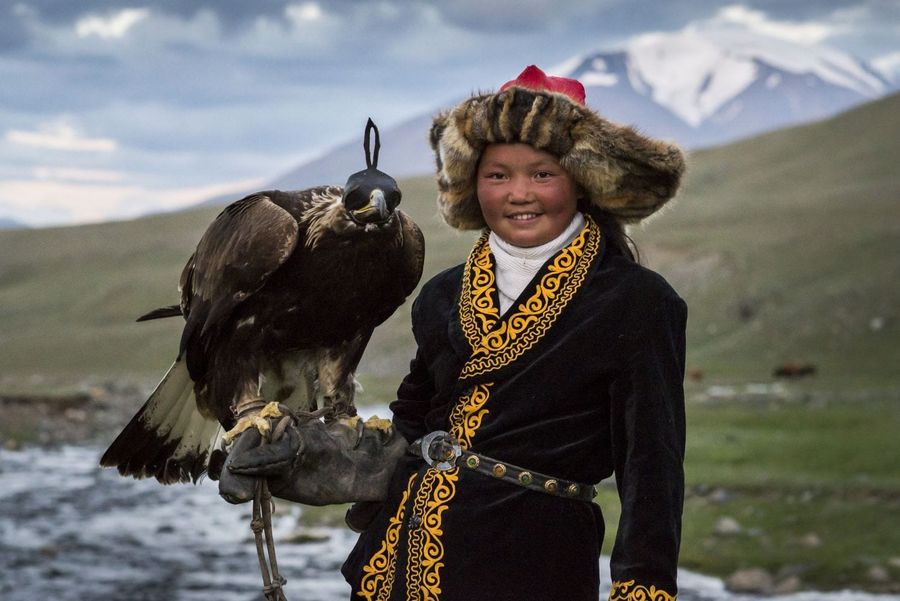
The leather hood you will see on many eagles — the tomaga in Kazakh falconry — is a calming tool, not a costume piece: covering the eyes removes visual stimulation and keeps a powerful bird settled in a loud, crowded place. Beyond that general principle of falconry, we would be cautious about reading too much into any single detail. A hooded bird at a festival is usually simply a bird being kept calm among horses, speakers and spectators; an unhooded bird scanning the valley is comfortable enough to watch it.
What tells you more is the handler. Notice how the hunter carries the eagle — steady on the right forearm, glove taking the weight of the talons — and how he speaks to her, moves her, settles her. Experienced handlers are unhurried. The bird's calm is borrowed from the person holding her, and after a while you will find yourself watching the man's hands as much as the eagle's head. That quiet competence, rather than any single piece of equipment, is the real signal of a well-trained partnership.
What does the festival mean to the people celebrating it?
For Kazakh families in Bayan-Ulgii, the festival is best understood as a community measuring itself — a place where a young hunter's first public flight with his eagle happens in front of the elders whose tradition he is carrying. This is our reading as a team that brings travelers here, not a claim from a study, but it matches what the event's structure shows: the judging rewards dress, horsemanship and the hunter–bird bond together, exactly the bundle of skills a Kazakh family would want passed to its next generation.
The clearest way to feel this is to spend time with a family rather than only the festival field. On our Golden Eagle Festival & Central Mongolia journey, guests first visit a Kazakh family in Ulgii to meet eagle hunters at home, then stay two nights with a nomadic Kazakh family during the festival itself. Over those evenings the festival stops being an event you watched and becomes something your hosts are part of — you hear who is riding this year, whose eagle is new, which family's embroidery everyone admires. That conversation is the culture; the competitions are where it becomes visible.
How do you watch respectfully, without feeling like an intruder?
You are welcome here — the festival is a public community event and visitors attend every year — and the way to be a good guest is to behave like one at any local gathering: ask before photographing people, keep clear of working animals, and follow your hosts' lead. Concretely:
- Ask before portraits. A hunter in full dress at the parade is presenting himself publicly, but a close portrait — and especially any photo of his wife, children or home — deserves a direct ask first. A smile and a gesture toward your camera is usually enough; accept a no gracefully.
- Give the eagles a working radius. An eagle on the arm is a wild predator managing a noisy environment. Don't reach toward a bird, don't wave objects near her face, and don't step between a hunter and his bird's line of sight during a trial.
- Stay out of the flight path. During the lure events, stand where the marshals and locals stand, well off the line between release point and hunter. A spectator in the wrong place can spoil a flight that took years to build.
- Let the games have their space. Kykbar and the coin-grabbing happen at speed on unpredictable horses. Watch from the edges the local crowd uses, not from the middle of the field for a better angle.
- Dress warmly and modestly, greet before you shoot. Autumn in the Altai is cold; a greeting exchanged before a camera raised changes the whole interaction.
- Buy from the people who made it. Embroidery and craft sold at the festival come from the same families whose culture you came to see.
None of this is a minefield. In our experience the anxiety travelers arrive with — will I be intrusive? — dissolves the first time a host waves them closer to see the eagle properly. Curiosity, offered politely, is received as respect.
How does the festival connect to the wider Kazakh culture of Bayan-Ulgii?
The eagle is one thread in a fabric you can spend days exploring: Bayan-Ulgii's Kazakh heritage lives in intricate embroidery, in music, and in the hospitality of family homes as much as in the hunting field. The festival compresses all of it into two days — the costume contests are an embroidery exhibition, the concert is the musical tradition, the ger-restaurants around the grounds serve Kazakh home cooking to anyone who walks up.
If the festival is your reason for coming west, treat it as the doorway rather than the destination. The dombra-driven music you hear at the concert continues in living rooms; the patterns judged on a hunter's coat are the same ones stitched into wall hangings you'll see in a family ger. Travelers who pair the festival with a family stay consistently tell us the evenings, not the flights, are what they talk about afterward — which is exactly why we build the family visits into our festival journeys rather than treating them as an optional extra.
When and where is the Golden Eagle Festival held?
The main festival takes place in October in Bayan-Ulgii province, western Mongolia, running two days on grounds 7–14 km from Ulgii town, with two smaller festivals held in September. Exact dates are announced year by year, so confirm the current year's schedule when planning your trip.
Is the festival staged for tourists?
It is organized by and for the Kazakh eagle-hunting community — the Mongolian Eagle Hunters' Association runs it, hunters travel from across the region to compete, and judging covers dress, horsemanship and the hunter–eagle bond. Visitors are welcome spectators at a genuine community competition, not the audience it exists for.
Do the eagles get hurt or killed at the festival?
No hunting takes place at the festival — the eagles fly to a dragged stuffed lure, not live prey. In the wider tradition, Kazakh hunters work with wild-caught female eagles for five to ten years and then release them back to the cliffs to breed, as documented in a 2016 SIT Graduate Institute study.
Can I hold an eagle or take a photo with a hunter?
Often yes, if the hunter offers — many are happy to pose with their bird between events. Ask first, follow the handler's instructions exactly, and never touch or reach toward the eagle yourself; she is a working wild animal, not a prop.
Is the festival suitable for children?
Families attend and children are part of the community crowd, so it can be a wonderful experience for kids who are comfortable with noise, cold weather and large animals. The horseback games are fast and physical, so keep children at the spectator edges and plan warm layers for long stretches outdoors.
If reading this has moved the festival from a photograph to a place you want to stand, we would love to take you there. Our women-led local team has been designing private festival journeys for over ten years, with 24-hour assistance throughout — plan your trip with us and we will confirm this autumn's dates and build the family visits around them.
