


Yes — a Mongolia itinerary 14 days long can hold both the far-western Altai and northern Khuvsgul, but only if domestic flights carry you between them and every transfer day is counted honestly. This is not a route we would hand a first-time visitor. It is a routing framework for travellers who have already done the classic Gobi–central loop and now want the two landscapes that sit furthest from it: Mongolia's highest mountains in the far west, and the taiga-fringed lake country of the north. By the end of this guide you will know how the 14 days divide, what each region rewards on a second visit, when splitting the plan into two future trips is the wiser design, and which season protects the whole arrangement.
The routing logic in brief
- The Altai and Khuvsgul sit in opposite corners of the country — flight legs, not driving, must connect them.
- A workable 14-day split: Ulaanbaatar bookends, roughly six days in the western Altai, one honest transit day, and six days in the north.
- Our two-region rule: a minimum of 12–14 days with a flight segment, and never more than one long transit day between regions.
- July–August is the most reliable window for northern roads and lake access; September is a quieter shoulder with early frost. Western Altai camp openings and pass conditions are confirmed season by season, so both halves must be checked against your dates.
- If you want depth rather than a survey — reindeer-herder country or serious high-mountain time — two shorter future trips usually serve you better.
Why Is Combining the Altai and Khuvsgul a Routing Problem?
Because Mongolia's geography does not cooperate with wish lists. Western Mongolia lies roughly 1,700 km from Ulaanbaatar by road on our own routing measurements and takes in five provinces — Zavkhan, Khovd, Gobi-Altai, Uvs and Bayan-Ulgii. Northern Mongolia, centred on Khuvsgul Lake, sits at the southern edge of the Siberian Great Taiga Wilderness, almost due north of the capital. There is no fast road link between them: an overland stitch runs south through Khovd and Zavkhan before turning north again, costing several days of rough driving that a 14-day trip cannot absorb.
In our design work, unsustainable driving days are the main way multi-region itineraries fail. A route can look elegant on a map and still spend half its days behind a windscreen. That is why our standing rule for pairing two distant regions is a minimum of 12 to 14 days with a flight segment, and no more than one long transit day between regions, with a rest or activity day on either side.
For this combination, the flights do the heavy lifting:
- Ulaanbaatar–Bayan-Ulgii puts you at the doorstep of the Altai. On our Altai Tavan Bogd Trekking Tour, travellers fly this leg and then drive roughly 220 km to the Tsagaan Us valley near Khoton and Khurgan lakes — a full but manageable day.
- Ulaanbaatar–Mörön shortens the northern approach sharply: when the current timetable offers a morning departure, the lake is reachable the same afternoon. We confirm actual flight days and times against the live schedule before we fix your day order. For northern segments of six to seven days we typically recommend flying one way and driving the other, so you see the landscape transition without paying for it twice in time.
Ulaanbaatar becomes the hinge, not a detour. You return to it once, mid-journey, and pivot from west to north. We treat that pivot day as a real day of the trip — never as free time smuggled between regions.
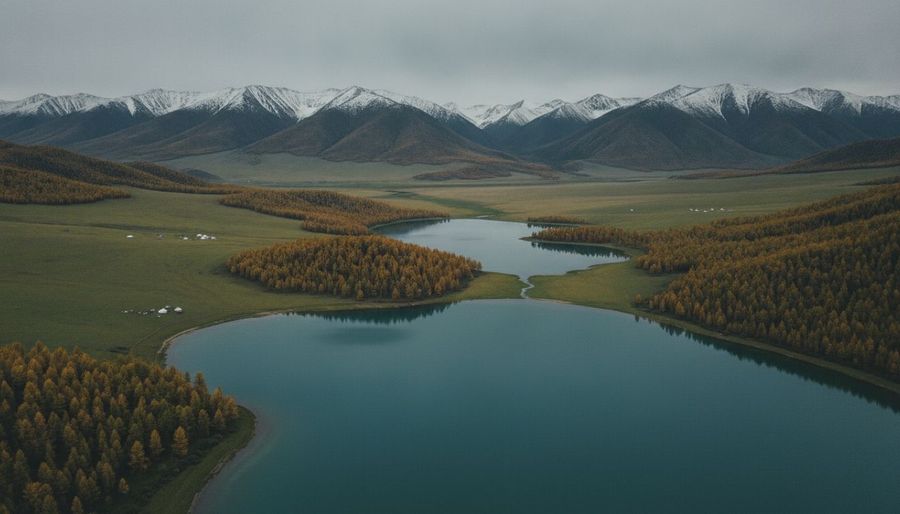
Mongolia Itinerary 14 Days: How Do the Days Actually Divide?
Here is the framework we sketch when a returning traveller asks for both regions in two weeks. It is a design framework, not a published route — the exact shape shifts with your dates, pace and interests, and we build the final version as a bespoke journey. What does not shift is the arithmetic: transfers are counted, and buffers are built in.
| Days | Segment | What the days are doing |
|---|---|---|
| Day 1 | Ulaanbaatar arrival | Recovery night, route briefing, gear and pacing check |
| Day 2 | Fly to Bayan-Ulgii, drive west | Flight leg plus the ~220 km drive toward the Khoton–Khurgan lake area |
| Days 3–6 | Western Altai segment | Four unhurried days based in the high valleys — the heart of the western half |
| Day 7 | Drive out, fly to Ulaanbaatar | Return drive and flight; overnight in the capital |
| Day 8 | Ulaanbaatar pivot | The one permitted long-transit buffer: rest, resupply, absorb any delay from the west |
| Day 9 | Fly to Mörön, drive to Khuvsgul | Morning flight, early-afternoon lake arrival — subject to the seasonal flight timetable |
| Days 10–12 | Northern lake segment | Three full days at Khuvsgul and its surrounding forest country |
| Day 13 | Full day at Khuvsgul | Shoreline and forest, no transfer |
| Day 14 | Fly Mörön–Ulaanbaatar, final night in the capital | Flight back to Ulaanbaatar; buffer night before your international departure |
A few honest notes on this table:
- The western segment gets four full days on the ground. That is enough to settle into the high valleys and let the mountains reveal themselves — but it is a focused visit, not the deep traverse of our 11-day trekking itinerary or the province-hopping breadth of the 14-day Western Mongolia Overland Tour. We flag that trade-off openly in every design conversation.
- Day 8 is not padding. Our default design keeps one to two nights in Ulaanbaatar at the start and one final night before departure, and buffer nights matter most on routes with domestic flights. On a two-flight-leg journey like this one, the mid-route pivot day is what keeps a delayed western flight from cascading into your northern segment.
- The northern segment runs six days door to door (Day 9 to Day 14), four of them full days at the lake. That is our own design standard for a solid northern round trip, set out in our northern Mongolia planning guidance. It comfortably covers the lake and its shores.
Prefer to drive back? The overland return needs two driving days with an overnight en route, which means one day less in the west or the north.
On drive days themselves, expect the same loads we plan on any standard adult routing: five or six hours between ger camps is a normal day. Those bands are our own published pacing standard rather than an industry rating: 2–4 driving hours = Gentle, 4–6 = Moderate, the same standard we apply in our northern Mongolia planning. If you want the whole journey kept Gentle, tell us early — it changes which valleys and shorelines we base you in, not just the timetable.
One trip or two? The combined framework side by side with the two single-region alternatives:
| Combined 14 days | West-only trip | North-only trip | |
|---|---|---|---|
| Anchor experience | A survey of both extremes | Serious high-mountain time: the 11-day Altai Tavan Bogd trek or the 14-day overland route | The reindeer-herder taiga and the lake country |
| Days on the ground per region | 4 full days in the western Altai, 4 full days at Khuvsgul | The whole itinerary stays in the west | The whole itinerary stays in the north |
| Days in motion | Roughly 4 of the 14 days | Fly in and out; the overland route adds inter-province driving | Fly one way, drive the other on a six-to-seven-day segment |
| Pace band | Gentle to Moderate (2–4 driving hours Gentle, 4–6 Moderate) | Gentle to Moderate | Gentle to Moderate |
| Best season | July–August for the north; western camps and passes confirmed per season | Camp openings and pass conditions confirmed season by season | July–August most reliable; September a quieter shoulder with early frost |
What Does Each Region Reward on a Second Visit?
A returning traveller reads these landscapes differently, and the routing should reflect that. You are not collecting first impressions anymore; you are choosing where to slow down.
The western Altai: altitude and cultural texture
The Altai is Mongolia's highest range — a wall of glaciated peaks along the western frontier, with alpine lakes like Khoton and Khurgan pooled at its feet. After the Gobi's open horizontality, the verticality alone recalibrates your sense of the country. As a routing consideration, the west rewards staying put: one well-chosen valley base, several days radiating from it, rather than a chain of one-night stops chasing viewpoints.
The human landscape is distinct too. Bayan-Ulgii's Kazakh communities and the herding cultures of the western provinces give this half of the journey a texture you will not have met on the central steppe. We route western segments through locally owned camps and family connections so those encounters happen at a natural pace — a morning that runs long because the conversation did, not because the schedule slipped.
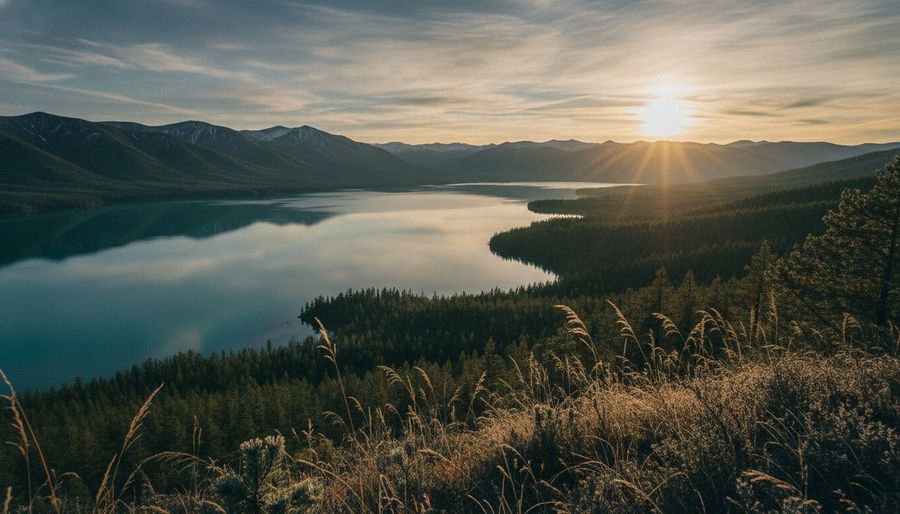
Northern Khuvsgul: water, forest and a slower clock
Khuvsgul Lake — the "Blue Pearl of Mongolia" — anchors a region that feels like a different country from the one most first-time itineraries show. Larch forest climbs the shoreline mountains, the Darkhad Tsenkher Depression opens to the west of the lake, and further north the Tsaatan reindeer herders live in urts tents at the taiga's edge. The main northern towns are linked to Ulaanbaatar by road, and the rail network reaches Darkhan and Erdenet. Flying to Mörön is a time choice rather than a necessity — it is what makes a short northern segment viable inside a two-region trip.
As a routing consideration, the north rewards shoreline time over distance covered. Two or three nights at one lakeside base, with short exploratory days, absorbs more of what the region offers than a fast circumnavigation. And here is the honest constraint again: the reindeer-herder areas are a deeper commitment than this combined framework allows: our design standard for them is seven to eight days on their own. If they are your reason for returning, read the next section carefully.
If you are still weighing which corners of the country deserve your second trip, our destinations overview maps all six regions side by side.
Curious how the western half works on its own?
Explore the Western Mongolia destination page for the full regional picture — provinces, landscapes and the published routes that go deeper than a combined framework can.
See our Western Mongolia routesWhen Are Two Shorter Trips the Better Design?
Two separate trips are usually the better design if your anchor is the reindeer-herder taiga or serious high-mountain trekking. One combined 14-day trip works if you want a survey of both extremes and accept roughly four days primarily in motion. Here is how we help travellers choose:
- Name your anchor experience. If it is the taiga and the reindeer-herder country, the north alone deserves a complete trip of its own. If it is serious high-mountain time, our 11-day Altai Tavan Bogd itinerary exists precisely because the range cannot be rushed.
- Test the four-day question. Would four full days in the western valleys feel like a visit or a glance? Only you can answer, but answer it before booking, not on Day 6.
- Check your tolerance for transit. The combined framework spends roughly four of its fourteen days primarily in motion. Some travellers find that rhythm energising; others realise they came to Mongolia to stop moving.
- Consider the return-ticket logic. Two focused trips — a western journey one year, a northern journey the next — each run at a Gentle-to-Moderate pace with room for weather, conversation and detour. Our own view is the same from the other direction: an Altai extension really suits itineraries of two weeks or more, because the distances demand it.
Neither choice is wrong. The combined route gives a returning traveller the sweep of Mongolia's extremes in one sitting; the split gives each extreme the attention it earns. What we will not do is sell you a 14-day plan that quietly depends on ten-hour drives to hold together.
Which Season Protects This Combination — and How Do Buffers Help?
For a journey that leans on both mountain roads and lake access, our seasonal guidance for the north sets the tone: July–August rates most reliable for roads, with excellent lake access; September is good, with early frost on higher ground and the larch forests turning gold — a genuinely beautiful shoulder window for travellers who dress for it. From October through April, conditions turn variable, with snow and ice possible, and we would redesign rather than force this combination.
The western half runs on its own mountain calendar, and camp openings and pass conditions there are confirmed season by season — one of the first things we verify when you send us dates. That verification matters more on a two-region route, because both halves must be open and comfortable in the same fortnight.
Buffers are what make the seasonal bet safe:
- The Ulaanbaatar pivot day absorbs a late western flight without touching the northern segment.
- The final capital night stands between your last domestic movement and your international departure — the night we protect first on any flight-dependent route we design.
- Flexible day order within each segment lets your guide swap a shoreline day and a forest day around weather without breaking the plan.
Behind all of it runs our 24-hour trip assistance and on-the-ground coordination: a women-led local team with over ten years of routing experience, re-sequencing days and rebooking legs when the weather changes the plan.
Can this combination work without domestic flights?
Not honestly, in 14 days. Western Mongolia lies around 1,700 km from Ulaanbaatar, and the northern lake country sits in the opposite direction. Without flight legs, the transfers alone would consume the trip. If you prefer to travel fully overland, choose one region per journey instead.
Is 14 days enough to include the Tsaatan reindeer herders?
Not alongside the Altai. Our northern routing guidance allocates seven to eight days to a northern segment that includes the reindeer-herder areas — which leaves no room for a western half. If the taiga is your priority, design the north as its own trip.
How is this different from your first-timer 14-day advice?
First-trip itineraries earn their keep on the classic Gobi–central arc, where distances are kinder. This framework assumes you have done that arc and deliberately spends its flight budget on the two regions a first loop cannot reach. If you have not visited before, start with our first-visit itinerary guidance instead.
Do you publish this exact route as a set tour?
No — it is a design framework we adapt per traveller. The published building blocks are the 11-day Altai Tavan Bogd Trekking Tour and the 14-day Western Mongolia Overland Tour in the west, and our northern lake itineraries in the north. Your combined version is drawn up as a tailor-made journey with its own pacing, bases and dates.
Ready to Draw Your Own Two-Corner Map?
Fourteen days can hold both the Altai and Khuvsgul — if the flights carry the distance, the transfer days are counted, and the season cooperates. Whether you choose the combined sweep or two deeper journeys, the decision starts with an honest conversation about your pace and your anchors. Tell us what your first trip taught you, and we will design the second around it.
Let's design your return to Mongolia
Share your dates, your first-trip highlights and the landscapes you are missing. Our Travel Design Team will reply with a routing proposal — combined or split — built entirely around you.
Start your itinerary inquiry


