


By the Mongolianstar Adventures Travel Design Team — itinerary architects for our northern routes.
Plan Khuvsgul Lake as a region, not a photo stop: allow six to eight days for a well-paced Northern Mongolia segment, decide early whether you will drive north or fly toward Mörön (also written Murun), and keep three to five unhurried days for the lake itself. That is the short answer we give travellers who ask how to plan this journey. This Khuvsgul Lake travel guide walks you through the decisions in order — what the north rewards, how routing changes your day count, realistic durations, season windows, ger-camp standards, and how the region pairs with Central Mongolia — so you can arrive at a route that fits your dates and your pace.
What Does Northern Mongolia Reward Beyond the Lake?
Northern Mongolia is where the Siberian taiga reaches its southern edge — a landscape of forest and mountain that feels distinct from the open steppe most visitors picture. The region takes in Bulgan, Darkhan, Erdenet, Mörön, Sukhbaatar and Selenge, framed by the Khangai and Sayan mountains and the Darkhad Tsenkher Depression. Most of the northern towns are reached by paved road and rail; Mörön, the furthest north, is the one most travellers reach by air when the seasonal service is operating.
The lake earns its nickname, the "Blue Pearl of Mongolia." According to NASA Earth Observatory, Lake Khuvsgul (also spelled Hövsgöl/Hovsgol) sits at 1,645 meters (5,397 feet) at the foot of the eastern Sayan Mountains near the Russian border, its surrounding hills blanketed in Siberian larch (Larix sibirica) forest. It is one of the world's ancient lakes, and it holds a large share of Mongolia's freshwater — which is why the shoreline feels like an inland sea rather than a mountain pond. The lake also sits inside a substantial protected area, which NASA Earth Observatory features in its own look at the lake and its national park.
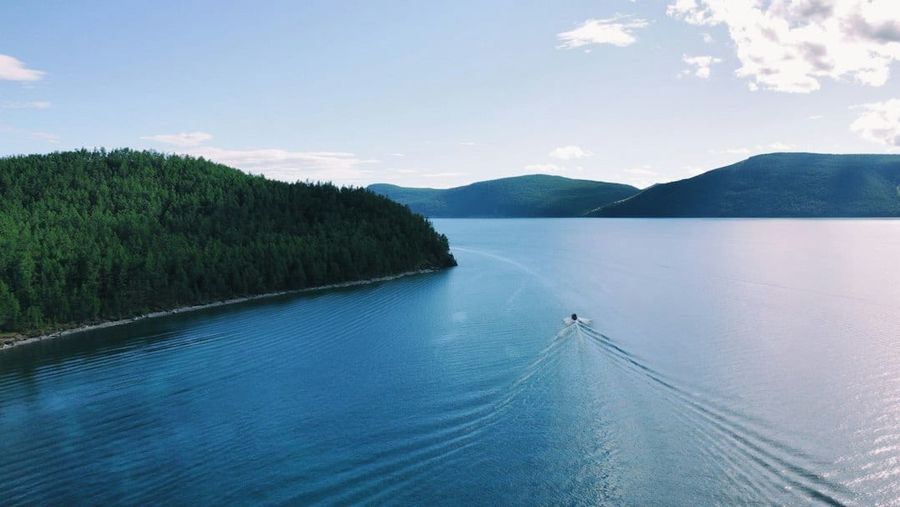
This is why we design the north as a landscape rather than a single viewpoint. Within one region you can move through:
- Khuvsgul Lake — a freshwater expanse best absorbed slowly, from one well-chosen shoreline base.
- The Khoridol Saridag ranges — mountain backdrops that shift character with the light.
- Siberian taiga forest — pine, larch and birch, turning gold in early autumn.
- The Uushigiin Uvur deer stones — a Bronze Age carved-stone complex near Mörön.
- The Darkhad Depression — the taiga homeland of the Tsaatan reindeer herders, who live in traditional urts tents.
Each of these asks for time. Rushing between them turns a rich region into a checklist.
Should You Drive North or Fly Toward Mörön?
This is the decision that shapes everything else. In our routing experience, the choice between overland and air materially changes how many days a northern trip needs — so make it before you fix your dates.
Overland via the northern towns
The road north from Ulaanbaatar passes through Bulgan and Arkhangai provinces, and typically takes a full day or more each way. Surfaces vary from paved sections to gravel and dirt tracks that slow after rain. Overland suits travellers with seven or more days who can break the journey with an overnight stop — and who enjoy watching the steppe gradually give way to forest. The drive is part of the experience, not dead time, but it must be budgeted honestly.
Flying toward Mörön
When the seasonal Mörön service is running, a morning departure can put you at the lake the same afternoon — we confirm the current schedule and the onward transfer time before we fix your route. For travellers with six to seven days, we typically recommend flying one way and driving the other, when the seasonal Mörön schedule allows — you keep the scenery of the overland leg without spending two full days on it. Flight schedules are seasonal, so we confirm current timings when we build your itinerary rather than promising a fixed departure.
| Decision point | Overland both ways | Fly one way, drive the other |
|---|---|---|
| Transit time each way | A full day or more by road | Morning departure, lake the same afternoon when the seasonal service runs (one leg) |
| Road character | Paved sections, gravel and dirt; slower after rain | One road leg still varies with weather |
| Days needed | Seven or more, with an overnight break | Six to seven, when the seasonal schedule allows |
| Best for | Travellers who want the full landscape transition | Tighter dates without losing the overland experience |
Why we rarely rush both legs
A four- to five-day round trip from Ulaanbaatar is the minimum viable option — and it carries no weather or road buffer. If your dates are that tight, we would rather adjust the route than compress the lake.
For a day-by-day view of the fly-one-way approach, see our seven-day northern Khuvsgul week.
Khuvsgul Lake Travel Guide: How Many Nights Do You Need?
Our guidance, drawn from years of designing northern routes: six to eight days is the sweet spot for a Northern Mongolia segment that includes the lake, shoreline activities, a nomadic family visit and a weather/road buffer. Within that, the lake itself rewards three to five unhurried days on its shores, plus travel time.
A pattern we return to again and again: two or three nights at one lakeside base absorb more than a fast circumnavigation. You settle in, learn the light on the water, walk or ride from the same ger each morning, and let the forest edge become familiar. On longer combined routes we stretch lake time to five or six nights, which is when the region truly opens up.
Here is how we route the north around the days you actually have:
| Days available | Recommended routing | Nights at the lake | What you must drop |
|---|---|---|---|
| 4–5 | Overland both ways, direct — the minimum viable option | Two, at one base | The weather buffer, the Darkhad/Tsaatan extension and any second region |
| 6–7 | Fly one way, drive the other, when the seasonal Mörön schedule allows | Three, at one base | The Darkhad/Tsaatan extension and Central Mongolia |
| 8 | Overland both ways with an overnight break, or fly one way | Three to four | A second region; a Darkhad/Tsaatan extension replaces lake time rather than adding to it |
| 10–12 | Northern + Central Mongolia overland, one long transit day between regions | Five to six | The Gobi — that pairing needs 12–14 days and a flight |
For the general lake overview — shoreline bases, activities and how many nights at the lake — see our Khuvsgul Lake travel guide; for the day-by-day version of this arithmetic, see our seven-day northern itinerary.
What does adding the Darkhad and Tsaatan area require?
The reindeer-herder areas of the Darkhad Depression are a planned extension, not a drop-in stop. Our design standard allocates seven to eight days to a northern segment that includes them. Access is seasonal and requires local coordination, so we treat a Tsaatan visit as a bespoke journey element from the first conversation — and we are candid about the limits: it does not fit alongside the Altai within a 14-day trip. If the herders are your priority, give the north its own week and design the rest of Mongolia around it.
Explore the north as a region
Browse the landscapes, highlights and routing options on our Northern Mongolia destination page.
See our Northern Mongolia routesWhen Should You Go, and What Are the Ger Camps Like?
Season windows
Our season guidance for Khuvsgul centres on a June–September window:
- July–August — camps and tracks fully open, with the most reliable dry, firm roads. Summer rain is possible, which is one reason we keep a buffer day in every northern route.
- September — golden larch and fewer travellers, a favourite of returning visitors. Camp closing dates need confirming, and nights turn cold with early frost on higher ground.
- Late May–early June — workable with an extra buffer day, as some tracks are still firming up.
- Outside the window — spring thaw can leave roads soft or impassable, and winter daylight is short. We plan around these realities rather than against them.
Ger-camp standards around the lake
Accommodation is where travellers most often ask for specifics, so here is how the collections we use most on northern routes differ:
| Collection | Bathroom arrangement | Common to all curated-route camps |
|---|---|---|
| Deluxe Collection | Camps offering en-suite gers prioritised, confirmed camp by camp | Proper beds with bedding; hot meals in dining gers |
| Standard / Explorer Collections | Camps typically with shared shower and toilet blocks | Proper beds with bedding; hot meals in dining gers |
We confirm en-suite availability camp by camp rather than assuming it — lakeside camps vary, and we would rather tell you precisely what your nights look like than oversell them. Whichever collection you choose, a private journey includes 24-hour trip assistance, which matters in a region where weather can reshape a driving day.
How Does the North Combine with Central Mongolia?
In our experience the north pairs most naturally with Central Mongolia, because the overland road passes through overlapping landscapes. A 10- to 12-day Northern + Central itinerary can include:
- Erdene Zuu and Kharkhorin — the historic heart of the Orkhon Valley.
- The Orkhon Valley waterfalls — a natural pause between culture and wilderness.
- Lake Khuvsgul with five to six nights — the unhurried core of the route.
- A buffer day — held in reserve for weather or simply for a morning you don't want to leave.
Our design rule for any multi-region route: no more than one long transit day between regions, with a rest or activity day on either side. In our experience, that single rule removes most of the fatigue we see in over-packed itineraries. Pairing the north with the Gobi is possible too, but it needs a minimum of 12 to 14 days with a flight segment — the two regions sit at opposite ends of the country, and honesty about that distance is part of good design.
Planning Khuvsgul Lake at a glance
- Allow six to eight days for the northern segment; four to five is the bare minimum with no buffer.
- Fly toward Mörön one way and drive the other if you have six to seven days and the seasonal schedule allows.
- Keep three to five unhurried days at the lake; two or three nights at one base beat a fast loop.
- The Darkhad/Tsaatan area needs seven to eight days and bespoke coordination — never a day trip.
- Travel June–September; July–August for the most reliable roads, September for golden larch.
- Combine with Central Mongolia in 10–12 days; the Gobi pairing needs 12–14 days and a flight.
Frequently Asked Questions About Visiting Khuvsgul Lake
Can I visit Khuvsgul Lake as a day trip from Ulaanbaatar?
No. The overland road north takes a full day or more each way, and even flying toward Mörön only puts you at the lake the same afternoon when the seasonal service is running and the onward transfer lines up. Plan the north as a multi-day segment with nights at the lake, not an excursion from the capital.
Is September a good time to visit Lake Khuvsgul?
It is one of our favourite windows: the larch forest turns gold and the shores are quieter. Two caveats — lakeside camp closing dates need confirming before you commit, and nights are cold with early frost possible on higher ground, so pack accordingly.
Do I need to fly both ways to save time?
Usually not. For travellers with six to seven days we typically recommend flying one way and driving the other, when the seasonal Mörön schedule allows. That usually frees up a day you would otherwise spend on the road, while keeping the landscape transition of the overland leg.
Mongolia's north is vast, but it is not complicated once the routing decision is made. Tell us your dates and we will hold the lake time you need. As a women-led Mongolian team with over ten years of local expertise, we design these routes so the driving feels balanced against the moments you came for.
Related planning reads
- Khuvsgul Lake travel guide — the general lake overview: shoreline bases, activities and how many nights at the lake.
- Seven-day northern itinerary — the fly-one-way, drive-the-other week, day by day.
- Northern Mongolia routes — the landscapes, highlights and routing options we run in the region.
- Bespoke journeys — where a Darkhad/Tsaatan extension or an unusual pace belongs.
Tell us your dates — we'll shape the route
Share your travel window, pace and interests, and our Travel Design Team will propose a Northern Mongolia itinerary built around them.
Start planning your northern journey


