


Five days is enough to see the Gobi properly — if you fly one leg, choose two anchor landscapes instead of five, and plan your driving in hours rather than kilometres. A five-day loop that starts and ends in Ulaanbaatar works as a bespoke short journey, not a checkpoint dash: one long overland leg out of the capital, a genuine stay in dune and camel country, and a flight home from Dalanzadgad. This guide gives you the day-by-day framework we use when designing that shape, the trade-offs the window forces, and how to decide whether five days is your trip — or whether you should ask for six.
The 5-day Gobi framework at a glance
- Five days works best with one domestic flight via Dalanzadgad; an all-overland loop needs more time.
- Plan in hours, not kilometres — track surface, sand patches and crossings set the length of a day.
- Two anchors beat five checkpoints: the Khongor Sand Dunes plus Bayanzag Flaming Cliffs, with camel-country time built in.
- Our design rule: never two consecutive 300-kilometre days on a first-timer itinerary.
- Autumn (September–October) is our recommended window for a short departure.
Can You Really See the Gobi in Five Days from Ulaanbaatar?
Yes — with honest arithmetic. For first-time visitors we recommend 5–6 days on the ground in Southern Mongolia; seven or more is relaxed, and three to four days is only realistic with flights both ways and a short target list. Five days sits at the workable edge of that range, which is why the routing decisions matter more here than on a longer tour.
The constraint is the drive out of the capital. On our published Gobi routes, Day 1 runs Ulaanbaatar to Baga Gazriin Chuluu — roughly 300 km, budgeted at six to eight hours depending on track conditions, river crossings and weather. Internal Gobi legs can reach around 380 km even on fly-in itineraries. If you spend two full days driving out and two driving back, you have one day left for the desert itself. That is the dash this framework exists to avoid.
The fix is structural: through our partnership with MIAT Mongolian Airlines, we can arrange one or both domestic legs via Dalanzadgad, the gateway town to the Gobi. The return flight on our published Gobi route is listed at roughly 1 hour 20 minutes, with schedules confirmed against your dates. Flying home converts a second long transit day into a full desert day.
There is a reason we protect those unhurried hours. Research on tourism fatigue published in 2021 found that the sequence in which travellers experience attractions plays an important role in preventing fatigue and increasing satisfaction (Journal of Destination Marketing & Management, via ScienceDirect). In our own design practice, fewer stops with longer stays consistently produce a calmer, more absorbing trip than a fast multi-checkpoint run — the study supports the sequencing principle, and our routing rules put it to work.
What Does the Day-by-Day Framework Look Like?
This is a design pattern we build bespoke journeys around, not a fixed departure — the exact camps, stop order and flight times are confirmed when we design your dates. The landmarks all come from our Southern Mongolia region page, which describes each in depth.
- 1
Day 1 — Ulaanbaatar to Baga Gazriin Chuluu. The classic first leg: about 300 km, six to eight hours across changing surfaces. Granite formations rise straight out of the steppe, so the reward begins the moment you arrive — an evening walk among the rocks, then an early night at a ger camp.
- 2
Day 2 — South through desert-steppe to Bayanzag. A moderate driving day with activity stops, ending at the Flaming Cliffs for sunset, when the red sandstone earns its name. One night here, timed around the light rather than the odometer.
- 3
Day 3 — Bayanzag to the Khongor Sand Dunes. An internal transit day toward the "Singing Dunes". We treat this as one of the heavier legs of the loop and keep the rest of the day deliberately empty — arrival, dinner, stars.
- 4
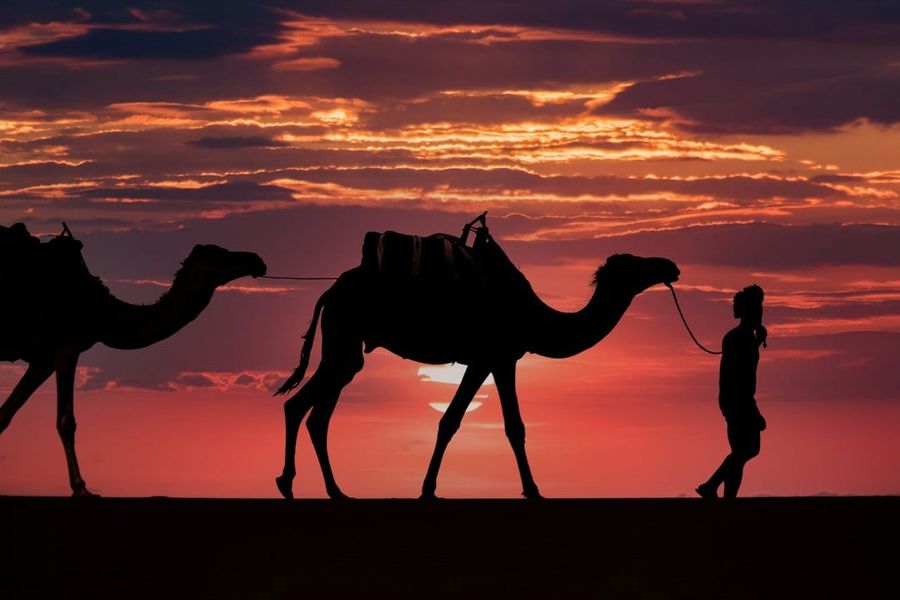
Day 4 — A full day in camel country. No transit at all. A morning camel trek atop a Bactrian camel following ancient nomadic routes, a visit with a camel-herding family who have herded for generations, and a second evening on the dunes as they shift from honey gold to burnt amber. This two-night stay is the heart of the framework.
- 5
Day 5 — Dalanzadgad and the flight home. A shorter run to the gateway town, then the roughly 1 hour 20 minute flight back to Ulaanbaatar — arriving with the desert still fresh, not exhausted.
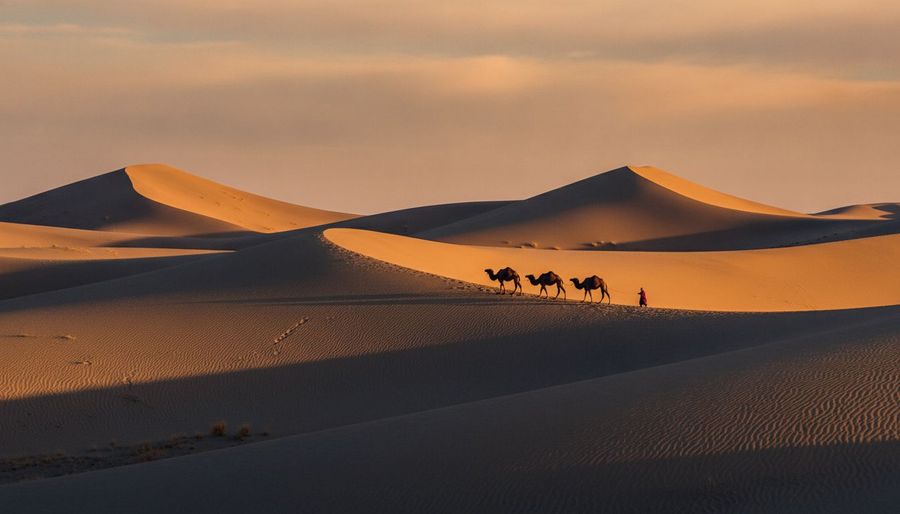
Notice what the shape obeys: a heavy day is followed by a lighter one or a two-night stay, and the longest drives never sit back to back. If your dates or the flight schedule don't cooperate, we mirror the pattern — fly down on Day 1, work north overland, and drive the single long leg back to the capital on the final day. Either way, you get one long leg, not two.
How Long Do the Drives Actually Take — and What Should You Skip?
Roads between Gobi landmarks are a mix of graded dirt tracks, gravel and occasional paved sections. Corrugated gravel, sand patches and unbridged crossings pull average speeds down, and conditions shift with season and recent weather. In our experience planning these routes, it is the surface and the crossings — not the distance on a map — that decide how long a driving day feels. That is why we publish hour budgets, not just kilometres.
Our pacing rules are explicit:
- Heavy days (250–380 km) are always followed by a lighter day or a two-night stay.
- Moderate days (130–200 km) include activity stops along the way.
- Rest days involve under 100 km of driving.
- Never two consecutive 300-kilometre days on a first-timer itinerary.
A five-day window cannot hold everything on the region page, and pretending otherwise is how rushed trips happen. Here is how we draw the line:
| Include comfortably | Skip on a 5-day loop | Why |
|---|---|---|
| Khongor Sand Dunes — two nights, sunset and sunrise on the sand | Khermen Tsav canyon | A remote western detour that adds major transit days |
| Bayanzag Flaming Cliffs — one night, timed for sunset | Eagle Valley (Yolyn Am) | Sits near Dalanzadgad; possible only if the flight timing leaves a genuine spare half-day |
| Camel trekking and a nomadic family visit in camel country | Ikh Gazariin Chuluu | A second rock-formation stop duplicates what Baga Gazriin Chuluu already gives you |
| Baga Gazriin Chuluu as the Day 1 overnight | A fully overland return to Ulaanbaatar | Repeats the longest leg and consumes your last desert day |
Bayanzag is worth its night for more than the colour. During the 1923 field season of the Central Asiatic Expeditions, George Olson found at the Flaming Cliffs what were quickly recognised as the first known dinosaur eggs (Columbia University LDEO course notes). Standing there at dusk, you are looking at one of palaeontology's landmark sites — a good reminder that the Gobi rewards lingering.
For the fuller picture of distances and drive-time budgets on the way out of the capital, see our guide to Ulaanbaatar–Gobi distance and smart pacing.
Want the full regional picture?
Explore the landmarks, published Gobi journeys and camp standards on our Southern Mongolia page — then come back to this framework when you're ready to compress.
See our Southern Mongolia routesWhich Collection or Bespoke Journey Fits a Short Loop?
Because no published five-day departure exists — our shortest published Gobi tours run eight and nine days — this framework is delivered as a tailor-made journey. That is an advantage for a short window: we design around your actual flight dates, your pace and your must-see list, rather than fitting you into a fixed departure.
Two collections inform how we build it:
- Signature Collection — our fullest Gobi immersion, designed around balanced pacing and premium ger camps. Its routing philosophy is exactly what a short loop needs, condensed.
- Deluxe Collection — higher camp standards with en-suite facilities and refined dining. On a compact itinerary where every night matters, comfort recovery after a long driving day is worth weighing carefully.
Accommodation expectations should be clear before you book. En-suite gers — a private bathroom within or immediately adjacent to your ger — are the standard on Deluxe routes. Shared-facility gers using central shower and toilet blocks are the norm on Standard and Explorer routes. Neither is wrong; they are different trips. Tell us which you expect, and we will confirm the specific camps available on your dates before anything is booked. If you are weighing the two styles, our Signature vs Deluxe comparison goes deeper.
Support works the same on a short loop as on a long one: every private journey includes our 24-hour trip assistance, backed by a women-led local team with over ten years of route-design expertise. On the ground, your driver-guide is your daily point of contact, and our coordination team remains reachable throughout — which matters most on the transit days, when plans occasionally flex with road conditions.
Is Autumn or Early Winter Better for a Short Departure?
For a five-day window, autumn (September–October) is the season we recommend. Crowds thin after the first week of September, road conditions remain excellent through October in most years, and the light on the dunes is at its warmest. One scheduling note shapes every autumn short loop: camps begin to close in late October, so we route departures to finish before the final shutdowns. If your Asia itinerary lands you in Mongolia mid-to-late October, tell us early — camp availability, not flights, becomes the binding constraint.
Early winter is possible, but it changes the trip's character. From November to March, nights often reach well below −20°C. We operate a smaller network of winter-ready camps with insulated gers and heated dining areas, vehicles equipped for frozen terrain, and drivers carrying satellite communication beyond mobile coverage — with 24-hour assistance year-round. Winter itineraries are deliberately compressed to fewer sites, which suits a short window in principle, but a first Gobi visit is gentler in autumn. For the month-by-month detail, read our Gobi season routing guide.
If your window shrinks below five days
Three to four days on the ground is only realistic with flights both ways and a short target list — typically the dunes plus one nearby landscape. Ask us honestly what fits; we would rather design a satisfying short trip than a exhausting one.
Is five days enough for the Gobi, or should I take six?
Five days works with one flight leg and two anchor landscapes. Six lets you add a second night somewhere or slow the internal transit — if your schedule can spare it, take it. We recommend 5–6 days on the ground for first-timers.
Do I have to fly, or can the whole loop be overland?
An all-overland loop spends two long days on the road out and back, leaving little desert time inside five days. We strongly suggest flying at least one leg via Dalanzadgad; the return flight is roughly 1 hour 20 minutes.
Can this framework include Eagle Valley or Khermen Tsav?
Khermen Tsav is a skip on any five-day loop — it adds major western transit. Eagle Valley can occasionally fit near the Dalanzadgad flight, but only when the schedule leaves a genuine spare half-day; we confirm it against your dates rather than promise it.
Is this a bookable five-day tour?
It is a bespoke design pattern, not a fixed departure. Our published Gobi tours start at eight days; a five-day journey is tailored to your dates, flights and camp preferences through the inquiry process.
Ready to Design Your Five Days?
Five days in the Gobi is not a compromise — it is a design problem with a good solution: one long leg, two anchors, real time in camel country, and a flight home. Bring us your dates and your must-see list, and we will shape the loop around them. Our local team responds to every inquiry within 24 hours.
Let's pace your five days properly
Tell us your travel window, your comfort expectations and the landscapes you care about most — we'll design the short Gobi journey that fits, and reply within 24 hours.
Start your trip inquirySources
- Journal of Destination Marketing & Management (ScienceDirect) — tourism fatigue and attraction sequence effects, 2021.
- Columbia University, Lamont-Doherty Earth Observatory course notes — the 1923 dinosaur-egg discovery at the Flaming Cliffs of Bayn Dzak.


