


Written by the Mongolianstar Adventures Travel Design Team — itinerary architects for our northern routes.
A Mongolia itinerary 7 days long is enough for a northern week centred on Khuvsgul Lake — if you shape the transfers deliberately. In our experience designing northern routes, the version that usually works best flies one way and drives the other — when the seasonal Murun schedule allows. If no flight operates on your dates, we would plan a longer overland week rather than compress this one. Flying back keeps the open steppe, monastery country and taiga edges of the overland approach, and you buy back the lake days that driving both directions would consume. This guide gives you a concrete day-by-day framework from Ulaanbaatar to the lake and back, explains the drive-versus-flight decision, and shows who this week suits better than a Gobi-based one. By the end you will know how to spend your seven days — and what to ask us to tailor.
The northern week at a glance
- Seven days works for Khuvsgul when one transfer leg is a domestic flight via Murun and the other is an unhurried overland drive.
- The framework below is a design pattern drawn from our published northern routing — not a fixed departure; every private journey is tailor-made.
- Expect two full lake days plus an arrival evening and a final shore morning: shoreline riding, a boat excursion, and a mountain excursion into the Khoridol Saridag range.
- July–August is the window we recommend for first-timers: our seasonal guidance rates these months the most reliable for roads on this route.
- Ger camps on curated northern routes offer proper beds, hot meals in a dining ger, and wood-stove heating in cooler months.
What does a northern week to Khuvsgul actually look like?
Northern Mongolia is where Siberia meets the steppe. Our Northern Mongolia region guide describes a land of pine, larch and birch taiga across Bulgan, Selenge and the towns of Darkhan, Erdenet, Murun and Sukhbaatar — most of them reached by paved road and rail; Murun is also the region's air gateway, which is what makes a fly-back week possible. At its heart lies Khuvsgul Lake, the "Blue Pearl of Mongolia", ringed by the Khoridol Saridag mountains. The lake and its watershed have been protected as Khuvsgul National Park since 1992, according to the European Commission's Digital Observatory for Protected Areas (2024) — one reason the shorelines still feel quiet and whole.
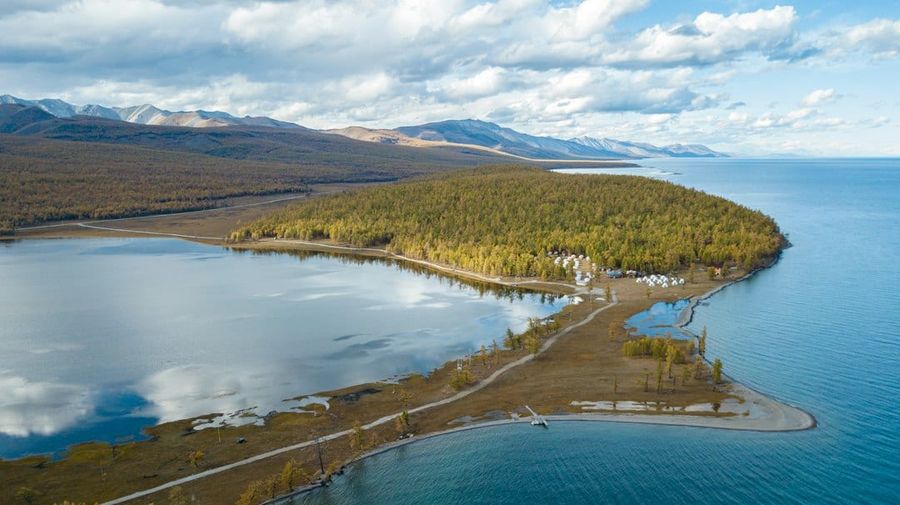
A week here rewards a different appetite than the desert does:
- Lake shorelines — clear water, gravel bays, and evenings where the light sits on the surface long after dinner.
- Taiga edges — larch and pine forest climbing toward the Khoridol Saridag ridgelines, cool air even in midsummer — in our experience the lake sits noticeably cooler than the Gobi in July.
- Open steppe on the way — the overland approach crosses working herding country, with monastery and deer-stone stops that break the drive into meaningful days.
The design principle we hold to: the lake is the destination, not a checkpoint. We would rather give you three unhurried days beside the water than five rushed ones scattered across a map.
How should this Mongolia itinerary 7 days be routed, day by day?
Our published reference for this region is the Northern Serenity journey in the Deluxe Collection — twelve days with four nights beside Khuvsgul and a domestic Murun–Ulaanbaatar flight included. Its northbound overnight sequence runs Mongol Nomadic ger camp (about 120 km from Ulaanbaatar), Eruu Lodge (about 300 km), Bugat Lodge via Amarbayasgalant Monastery (about 300 km), Baatarvan Resort in Bulgan with a nomadic family visit (about 180 km), then the lakeside Doublelake Camp via the Uushigiin Uvur deer stones (about 350 km).
A seven-day week cannot carry all of those overnight stops — that is precisely the trade-off. The framework below compresses the same corridor into one week by flying the return leg. It is a design pattern we use as a starting point for bespoke journeys, not a published departure; exact stops, distances and timing are confirmed when we build your private itinerary.
| Day | Shape of the day | Overnight | Why the day is shaped this way |
|---|---|---|---|
| 1 | Arrive Ulaanbaatar; settle in, short city orientation | Ulaanbaatar | No driving pressure on arrival day |
| 2 | Drive north through open steppe; a first ger-camp evening | En-route lodge or ger camp on the northern corridor | One substantial transit day, broken by landscape and a proper stop |
| 3 | Continue north via monastery or deer-stone country; reach the lake by late afternoon | Doublelake Camp, Khuvsgul | The longest leg, placed before any lake activity so nothing is rushed after it |
| 4 | Full lake day: shoreline horse riding and a boat excursion toward Khusliin Aral | Doublelake Camp | Minimal driving — the day belongs to the water |
| 5 | Khoridol Saridag Mountains excursion (about 120 km on the Northern Serenity lake days) | Doublelake Camp | A mountain day traded against a second rest day — your choice of pace |
| 6 | Morning at the shore; transfer to Murun for the domestic flight to Ulaanbaatar — exact distance and timing confirmed in your itinerary | Ulaanbaatar | A short, scenic transfer instead of two long overland days |
| 7 | Ulaanbaatar at leisure; departure | — | Buffer night between the domestic flight and your international departure, so a schedule change has room to be absorbed. |
The lake-day content — the boat excursion, the shoreline riding, the roughly 120 km mountain excursion — comes from the Northern Serenity route. The compressed transit days (Days 2–3) are where a design conversation matters most: which single overnight stop best breaks the drive depends on your dates, your party and road conditions that season, and we confirm it with you rather than promise it here.
Flights follow the operating schedule
Domestic flights between Murun and Ulaanbaatar are subject to the operating schedule. When we design a fly-back week, we place the flight with a buffer around it and keep 24-hour trip assistance active throughout, so a schedule change becomes a re-plan, not a crisis. If no flight operates on your dates, we would not compress the week: we would drive back with an extra night, or extend the journey to eight to ten days.
Should you drive both ways — or fly one leg?
This is the decision that defines your week, and there is no single right answer. Here is how we frame it with travellers.
Driving both ways
The overland corridor is genuinely rewarding: Amarbayasgalant Monastery, the Uushigiin Uvur deer stones, a nomadic family visit in Bulgan, and steppe that changes character hour by hour. Driving both directions lets you see more of that corridor — but the published corridor is broken into five northbound driving days; compressing it into two days each way is what eats the lake stay — in a seven-day week you would be left with roughly one full day at the water. If the journey is the point for you, we would gently suggest looking at whether eight to ten days is possible instead — our balanced 10-day Mongolia itinerary shows what the extra days buy you; our guide to how many days Northern Mongolia needs walks through that maths.
Flying one leg
Flying Murun–Ulaanbaatar on the return buys those transit days back as lake days. You still drive north through the corridor — monastery country, deer stones, herding landscapes — but the week ends with a short lake-to-airport transfer rather than two days of retraced road; exact distance and timing are confirmed in your itinerary. For exactly seven days, this is the shape we usually recommend, and it mirrors how the twelve-day northern loop already uses the flight.
- Choose drive-both-ways if: you love road days, want maximum cultural stops, and accept fewer hours at the lake.
- Choose fly-one-leg if: the lake is why you are coming, you are travelling with children, or you want rest days built into the week rather than spent in the vehicle.
Either way, the flight leg is confirmed against the current operating schedule when we cost your journey — we do not publish schedules we cannot verify.
Who does this week suit — and how does it compare with a Gobi week?
For the same seven days, the north and the south ask different things of you. Our published Gobi Highlights route (ten days) runs legs of roughly 300 km on arrival day, about 380 km to the Khongor dunes, and 130–180 km on other days, staying in deluxe lodges such as Gobi Caravanserai and Tegri Gobi alongside deluxe ger camps. Compressed into a week, a Gobi-based route keeps you moving between distant highlights; the northern week concentrates its driving up front and then settles.
| Consideration | Northern week (Khuvsgul) | Gobi-based week |
|---|---|---|
| Landscape | Lake, taiga forest, mountain ridges, steppe approach | Dunes, desert canyons, arid plains |
| Summer air | Cooler lake air in our experience; pack a warm layer for evenings | Desert heat can be intense in midsummer |
| Driving rhythm | Transit days front-loaded, then low-driving lake days | Longer legs spread across the whole route |
| Signature moments | Boat excursion, shoreline riding, Khoridol Saridag excursion | Khongor dunes, desert lodge evenings |
| Flight option | Domestic Murun leg used on our published routing, subject to the operating schedule. | Overland routing on our published Gobi itineraries |
This northern week tends to suit:
- Families with children — fewer vehicle hours after Day 3, a stable base for several nights, and gentle shoreline activities. Our Family Collection applies this logic across regions.
- Nature lovers and walkers — the ride-plus-hike lake day on the Northern Serenity route involves almost no driving at all (roughly 0–10 km).
- Summer travellers — our seasonal guidance rates July–August the most reliable months for this route's roads, and many travellers choose the north precisely to trade desert heat for lake air. September is also lovely, with golden larch and early frost, if you prefer quieter shores.
If dunes and desert silence are what you came for, the southern region deserves your week instead — the honest answer is that seven days serves one region well, not both.
How do we keep the drive days comfortable?
Pacing is a design discipline, not luck. Three habits shape every northern week we build:
- Front-load the transits. The long legs happen before the lake stay, never after a full activity day, so you arrive at the water rested rather than depleted.
- Bracket hard days with soft ones. A substantial drive is followed by a low-driving day — a shoreline morning, a boat excursion — so the week alternates effort and reward.
- Build the buffer where it matters. The final Ulaanbaatar night sits between the flight and your international departure, and our 24-hour trip assistance covers the whole journey.
Accommodation follows the same logic. On our curated routes, ger camps offer proper beds with bedding, central dining gers serving hot meals, shared or en-suite bathrooms depending on the camp tier, and wood-stove heating in cooler months — with locations chosen for views or trail access rather than convenience alone. Which bathroom standard your lakeside nights carry depends on the camp tier we select together; we explain what each camp tier means when we propose your lakeside nights, and we confirm the specifics for your dates before you commit. As a women-led, fully Mongolian team with more than ten years of local travel expertise and membership in the Mongolia Tourism Association, we choose locally owned camps and suppliers wherever the route allows — your week supports the communities whose landscapes you are crossing.
Start with the region overview
Read our Northern Mongolia guide for the full picture of the taiga, the lake country and the towns along the corridor — then bring us your dates.
See the Northern Mongolia regionFrequently asked questions about a seven-day northern week
Is seven days really enough for Khuvsgul Lake?
Yes, with the right shape. Expect two full lake days plus an arrival evening and a final shore morning: shoreline riding, a boat excursion, and a mountain excursion into the Khoridol Saridag range. Driving both directions in seven days is possible but leaves the lake feeling brief — we would usually suggest more days for that version.
Which months suit this northern week?
Our seasonal guidance rates July–August the most reliable for roads and camp operations on this route. Late May–June improves steadily with some soft road sections; September brings golden larch and early frost; October–April is variable with snow and ice and needs a different plan.
Do I need to be an experienced rider or hiker?
No. The lake days on our published northern routing — shoreline riding, a boat excursion, a mountain excursion — are designed for general travellers, and the pace is set with you. Tell us your comfort level and we shape the days around it.
Can this framework include the Tsaatan reindeer herders?
The Tsaatan are one of the north's named highlights, but their region sits beyond the lake and needs additional days. With exactly seven days we keep the week centred on Khuvsgul; if the reindeer herders are essential to you, ask us about a longer bespoke northern journey.
Ready to shape your northern week?
A week at Khuvsgul is not a compromise — it is a deliberate choice of forests, water and cool mountain air over distance-chasing. Decide first whether the lake or the road matters more to you, and the rest of the framework falls into place. When you know your dates, tell us: we will turn this pattern into a private itinerary with confirmed stops, camps and flight arrangements.
Let's design your seven days
Share your dates, your party and your pace, and our Travel Design Team will build your northern week — with every transfer, camp and lake day confirmed before you travel.
Start your trip inquiry


