


The Ulaanbaatar to Gobi Desert distance is not a day trip — it is an overland journey measured in hundreds of kilometres of steppe and desert track, and it deserves its own place in your itinerary. In our published Gobi Highlights route, the first day out of the capital alone covers approximately 300 km, and on Mongolia's unpaved roads we plan a 300-kilometre day as roughly six to eight hours of driving, depending on track conditions, river crossings and weather. This guide explains how we think about that transfer: realistic distance and time expectations, when to drive versus fly, and how many days to budget once you reach Southern Mongolia. By the end, you will know how to size your Gobi itinerary honestly — before you commit to dates.
Route distances and drive-time rules checked against our published Gobi Highlights itinerary by the Mongolianstar Adventures Travel Design Team.
Key planning points
- Plan by hours, not kilometres: track surface, crossings and weather — not distance — set the length of a driving day.
- The outbound transfer is best broken into stages, with granite formations like Baga Gazriin Chuluu as natural first stops.
- A domestic flight via Dalanzadgad can replace one or both driving legs where schedules allow.
- Budget 5–6 days on the ground in the Gobi as our balanced recommendation for first-timers; 7+ is relaxed, and 3–4 days is possible only with flights both ways and a short target list.
- Never stack two long driving days back to back — our design rule for first-time visitors.
Ulaanbaatar to Gobi Desert distance: how far is it, and how long does the drive really take?
There is no single honest answer in kilometres, because "the Gobi" is a region, not a point. Your camp's location, the stops you make and the state of the tracks all change the number. What we can give you are the real figures from our own routing. As a planning figure, our published Gobi Highlights route reaches the Khongor Sand Dunes only after several staged driving days: the first leg out of Ulaanbaatar alone is about 300 km, and Day 4 adds roughly 380 km more. Treat those as our route's staged driving legs, not a single point-to-point distance — your camp locations change it.
In our Gobi Highlights — 10 Days / 9 Nights itinerary, Day 1 runs Ulaanbaatar → Baga Gazriin Chuluu, approximately 300 km — the longest drive of the outbound leg, taken with breaks en route. That is already into the middle Gobi's granite country, though the famous dunes lie several hundred kilometres further south: Day 4 of the same route covers roughly 380 km to the Khongor Sand Dunes, which we label a major transit day.
Why kilometres mislead on Mongolian roads
Roads between Gobi landmarks are a mix of graded dirt tracks, gravel and occasional paved sections, and surface conditions shift with the season and recent weather. On tarmac, distance and time correlate neatly. On these tracks they do not — which is why we plan in hours rather than kilometres. Corrugated gravel, sand patches and unbridged crossings are what pull the average speed down — not the distance itself. We would rather you arrive expecting a full, scenic travel day than a quick highway hop.
Planning ranges, not schedules
Every distance and duration here is approximate planning guidance from our published routes. Exact timings for your dates depend on your camps, the season and track conditions — your driver builds buffer time into every leg, and we confirm the day-by-day plan with you before departure.
How do we structure the transfer: drive through, break it up, or fly?
We rarely treat the transfer as dead time to be minimised at all costs. Instead, we choose between three structures depending on your total trip length and tolerance for driving.
Breaking the journey overland
Our preferred outbound pattern for first-timers is staged driving: leave Ulaanbaatar in the morning, cover the ~300 km first leg with breaks, and overnight among the granite formations of Baga Gazriin Chuluu — landscape worth stopping for in its own right. From there, each subsequent leg moves you deeper into the desert at a sustainable rhythm.
The pacing rules we apply when designing any Gobi route:
- Heavy days (250–380 km) are always followed by a lighter day or a two-night stay at one camp.
- Moderate days (130–200 km) include activity stops along the way.
- Rest days involve under 100 km of driving.
- Never two consecutive 300-kilometre days on a first-timer itinerary. If a long transfer day is unavoidable, the next day is deliberately light.
A typical transfer day follows a comfortable rhythm: morning departure, midday arrival at camp, lunch, then an unhurried afternoon exploring the immediate area. You are travelling, but you are not exhausted.
Flying one or both legs
Dalanzadgad, the provincial capital of Ömnögovi, is the internal-flight gateway to the Gobi. Through our partnership with MIAT Mongolian Airlines, we can arrange to fly one way and drive back — or fly both ways. We arrange the domestic flight legs and coordinate them with your camp transfers; your proposal states clearly which flight costs are included in your package and which are quoted separately. On the Gobi Highlights route, for example, Day 8 flies back to Ulaanbaatar — our Gobi Highlights itinerary lists that return flight at roughly 1 hour 20 minutes, plus about an hour's drive toward the Chinggis Statue area. Actual flight time varies by carrier and aircraft, and we confirm it for your dates. Many travellers find flying one leg a sensible compromise: it trims a long driving day while keeping the overland transition in one direction. Flight availability varies by season, so we confirm schedules against your dates when designing the route rather than promising a fixed timetable.
Transfer options at a glance
| Option | What it involves | Best suited to | Trade-off |
|---|---|---|---|
| Staged overland, both ways | ~300 km first leg to Baga Gazriin Chuluu, then progressive legs south; return by road | First-timers with 10+ days who want the full steppe-to-desert transition | Two or more substantial driving days each direction |
| Fly one way, drive the other | Domestic flight via Dalanzadgad (around 1–1.5 hours airborne, carrier-dependent) plus camp transfers; one overland leg | Travellers with 8–10 days who want scenery without repeating it | Depends on flight schedules for your dates |
| Fly both ways | Flights in and out of Dalanzadgad, driving only between Gobi landmarks | Tight schedules, or travellers who prefer minimal long drives | Misses the visible capital-to-desert transition; internal legs of up to ~380 km remain |
Whichever structure fits, the internal Gobi driving does not disappear — the dunes, cliffs and canyons are spread across the region, so even a fly-in itinerary includes transit days like the ~380 km leg to Khongor.
Explore the region behind the numbers
Read the Southern Mongolia overview to see the landmarks these distances connect — then picture your own pace through them.
See our Southern Mongolia routesWhat does the drive itself offer?
Here is the reframe we offer every traveller who worries about "losing" days to the road: the transfer is the first act of the Gobi story, not an intermission.
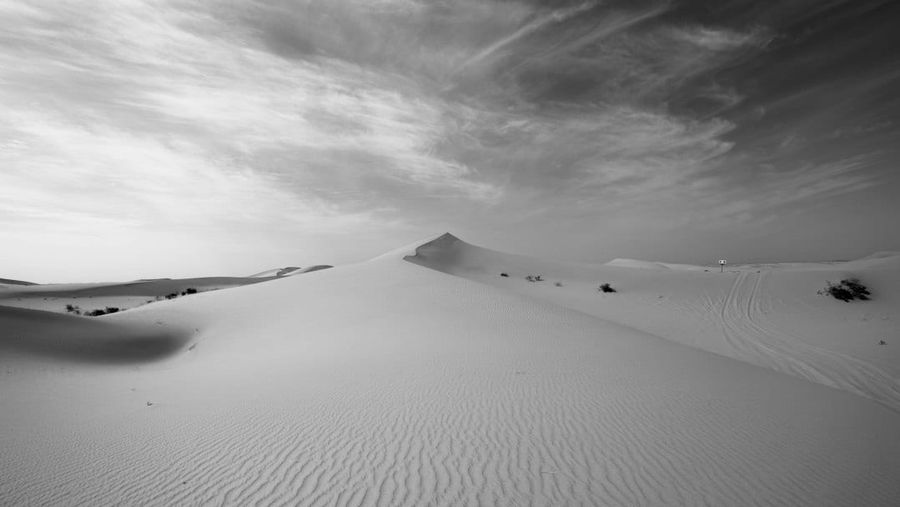
Driving south from Ulaanbaatar, you watch the landscape change in stages:
- Capital outskirts to open steppe — the city falls away into rolling grassland and herding country.
- Granite rising from the steppe — formations like Baga Gazriin Chuluu and Ikh Gazariin Chuluu appear on the horizon long before you reach them, marking the transition zone.
- Desert proper — further south come the dunes, mud cliffs and canyons that define the region.
It also helps to know what you are driving into. The Gobi is one of the world's great deserts, spanning southern Mongolia and northern China — yet sand covers only a small fraction of the Mongolian Gobi. Most of what passes your window is gravel plain, dry valley and mountain ridge. Travellers expecting an endless sea of dunes are often surprised, and the gradual overland approach makes that geography intuitive in a way a flight cannot.
If your return leg goes overland via Central Mongolia, the transition works in reverse — and our published combined structure does exactly that: Ulaanbaatar to the Gobi by road or air, five to six days in the south, then three to four days in the Orkhon Valley and Kharkhorin region on the way back. Our Central Mongolia itinerary planning covers that routing in detail.
How many days should you budget for the Gobi once you arrive?
Our design team's recommendation is 5–6 days on the ground in Southern Mongolia for first-timers — enough to cover the core landmarks without rushing. 7+ days is relaxed; 3–4 days is possible only with flights both ways and a short target list. Here is how different budgets feel in practice:
- 3–4 days: compressed. Long transfers dominate the schedule and you will spend much of the trip in the vehicle. Workable mainly with flights both ways and a short list of targets.
- 5–6 days: balanced for first-timers. Enough room for the major landscapes with moderate driving days between them.
- 7+ days: relaxed. The pace photographers and families tend to prefer — two-night stays, rest days under 100 km, and time to let a place settle in.
How drive time shapes a 7-day versus a 10-day southern route
The arithmetic is simple once you plan the transfers in hours rather than kilometres. In a 7-day trip, the outbound and return transfers consume a meaningful share of your days, so we typically lean on a flight leg, trim the landmark list, and protect one genuinely light day. In a 10-day structure like Gobi Highlights, the transfers become staged experiences — the ~300 km first leg ends among granite formations you actually explore, the ~380 km Khongor leg is followed by recovery time, and the flight home on Day 8 returns a day to your schedule. Same desert, very different rhythm. For a fuller breakdown of route structures and camp standards, see our Gobi Desert itinerary planning guide, and if children are travelling, our family pacing guidance applies the same logic to younger passengers.
Season matters too: track conditions and daylight hours shift month by month, which we cover in our month-by-month Gobi routing guide.
What about road conditions — should the variability worry you?
Honestly: the roads vary, and pretending otherwise would not serve you. Graded dirt and gravel tracks change character after rain; some sections become impassable; a river crossing that was trivial in June can give pause in August. But variability is a planning input, not a hazard you manage alone. Here is how our system absorbs it:
- Vehicles and drivers. Private journeys use robust four-wheel-drive vehicles suited to desert tracks. Our drivers know the seasonal route variations and the sections that turn impassable after rain, and they build buffer time into every leg.
- Pacing as insurance. Because heavy days are never stacked and buffers are built in, a slow section usually costs an afternoon stroll rather than a whole day — though after heavy rain we may re-route or re-time a leg, which is exactly what the buffer is for.
- 24-hour coordination. Our Ulaanbaatar team is contactable around the clock and can adjust camp bookings, timing or routing when a road is washed out or a flight is delayed. You are not left to improvise on your own.
This is a large part of why we design staged transfers rather than pushing straight through: in our experience, a journey with slack in it handles Mongolia's unpredictability gracefully, while a maximally compressed one has nowhere to absorb a surprise. After more than ten years designing Southern Mongolia routes as a women-led local team, that lesson shapes every itinerary we build.
Gobi transfer: frequently asked questions
Can I visit the Gobi as a day trip from Ulaanbaatar?
No — not meaningfully. The first staging point on our published route is already about 300 km from the capital, roughly six to eight hours of driving, much of it on dirt and gravel tracks, and the signature dunes lie several hundred kilometres beyond that. Plan a multi-day journey — see our day-count guidance below.
Is it better to fly to Dalanzadgad or drive from Ulaanbaatar?
It depends on your total trip length. With ten or more days, staged overland driving gives you the steppe-to-desert transition and worthwhile stops. With a tighter schedule, flying one or both legs via Dalanzadgad preserves your days for the Gobi itself. We confirm flight schedules for your dates and arrange the domestic flight legs, coordinating them with your camp transfers; your proposal states clearly which flight costs are included in your package and which are quoted separately.
How long does a 300 km driving day actually take?
As a planning rule, we budget six to eight hours depending on track conditions, river crossings and weather, plus breaks. Distances on graded dirt and gravel simply do not translate to highway speeds.
How many days do I need in the Gobi for a first visit?
Five to six days on the ground is our balanced recommendation for first-timers, within a total trip of roughly eight to ten days once transfers are included. Seven or more days is relaxed and suits photographers and families who want two-night stays and rest days; 3–4 days is possible only with flights both ways and a short target list.
Ready to size your Gobi journey?
Mongolia is vast, and the Gobi rewards travellers who respect its distances. Decide your total days first, choose drive, fly or a blend second, and let the pacing rules do the rest — we will handle the tracks, the timing and the surprises. Tell us your dates and travel style, and we will shape the transfer around the journey you actually want.
Let's design your Gobi transfer
Share your dates, group and pace preferences, and our Travel Design Team will propose a route with honest driving days — or explore a fully tailor-made journey built around you.
Start your trip inquiry


