


Give the Orkhon Valley two to four days, not a single stop. That is our working rule when we design central Mongolia routes: enough time for Kharkhorin and Erdene Zuu at the head of the valley, the waterfall and canyon further along, and at least one unhurried day with a herding family in between. The valley sits a full day's drive west of Ulaanbaatar, so it slots naturally into a loop that returns to the capital — or continues toward White Lake or the Gobi.
This guide is about routing, not activities. By the end you will know how the valley is laid out as a journey, how many nights each style of visit needs, where to base yourself, and how the season changes the pace. For the wider region — Terelj, Khustai, the sand dunes and hot springs — see our Central Mongolia destination page.
Orkhon Valley planning at a glance
- 2–4 days in the valley itself, plus a transfer day each way from Ulaanbaatar.
- Route it as a line: Kharkhorin / Erdene Zuu → river steppe → Orkhon Waterfall → Tuvkhun Monastery (optional).
- Two nights at one base beats nightly moves for families and older travellers.
- Combine with Terkhiin Tsagaan (White) Lake for a 10–12 day central loop, or with the Gobi on the return leg.
- Summer allows fuller days; autumn and shoulder seasons call for shorter transfers.
How is the Orkhon Valley laid out as a route?
Think of the valley as a corridor rather than a single viewpoint. The Orkhon River runs down from the Khangai foothills through open grassland, and the sights are strung along it. Our Central Mongolia page describes the Orkhon Valley Protected Area as inscribed by UNESCO on the World Heritage List, rich in rock engravings, monastery ruins and archaeological remains. That spread is exactly why a quick photo stop undersells it.
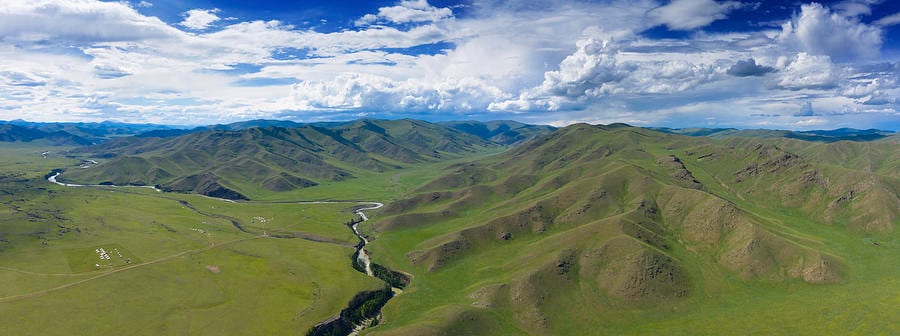
The head of the valley: Kharkhorin and Erdene Zuu
Most routes from Ulaanbaatar reach Kharkhorin first. This is the site of Karakorum, the 13th-century capital of the Mongol Empire, and of Erdene Zuu, Mongolia's oldest surviving Buddhist monastery. The interactive Karakorum Museum beside it gives context before you walk the monastery walls — we build that pairing into our family routing because it turns "old stones" into a story children can follow.
In our Central Mongolia – 10 Days / 9 Nights itinerary, this is Day 3, roughly 300 km of driving from the previous night's camp, with a ger camp near Kharkhorin town. In the deluxe Central Harmony – 12 Days / 11 Nights, the same leg is about 290 km with a deluxe ger camp overnight.
Down the river: steppe, herders and the waterfall
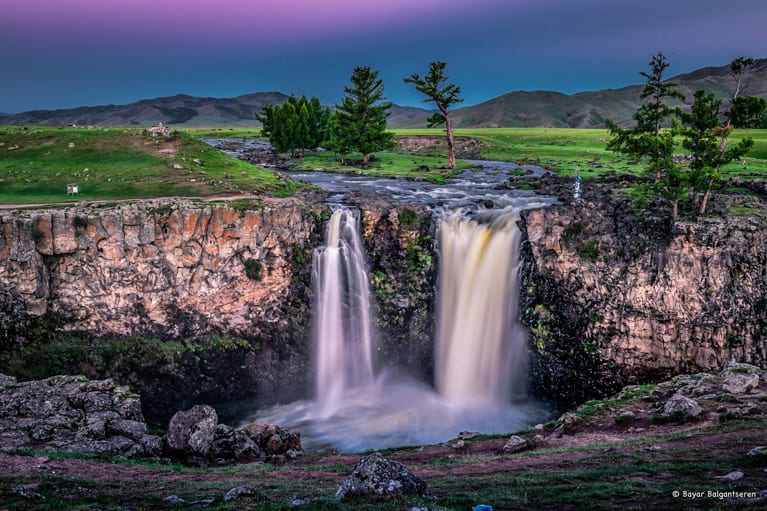
From Kharkhorin the route follows the river south-west into wider, emptier grassland. This is the stretch where a nomadic family visit belongs — not squeezed between two monuments, but given its own morning or afternoon. Further along, the Orkhon Waterfall drops through basalt canyons; the site's own description calls it a thundering fall carving through the rock.
On the 10-day route, Day 4 covers about 180 km to the waterfall and a deluxe ger camp, and Day 5 is a full valley day — horse riding and a herding family visit — from the same camp. Two nights, one set of unpacked bags.
The optional climb: Tuvkhun Monastery
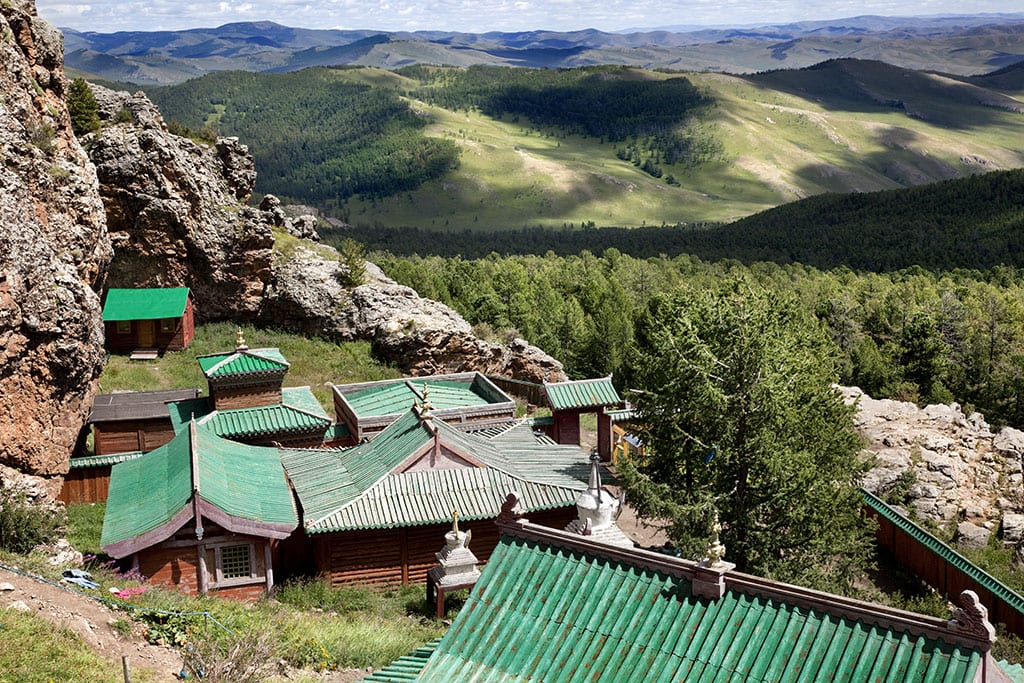
Tuvkhun Monastery, founded by Zanabazar, sits on a mountain top above the valley with panoramic views. It is an add-on, not a requirement: it needs half a day and some ascent. In the Central Harmony routing it fills Day 9, reached on horseback with a walk back down, returning to the same resort for a second night.
Turkic-era memorials and older ruins also lie along the valley floor. We treat them as guide-led stops depending on your interest and the day's driving, rather than fixed checkpoints — ask us to weight the route toward archaeology if that is what draws you.
Overnight-stop logic
The valley works best with one base for two nights near the waterfall or at Khujirt, plus one night at Kharkhorin. Every extra hotel change on steppe roads costs you an hour of packing, loading and settling in — time that could be spent in the landscape.
How many days do you need in the Orkhon Valley?
The honest answer depends on what you want the valley to be: a highlight on a longer loop, or the heart of the trip. Here is how we size it.
A two-day taste
Two days lets you see Kharkhorin and Erdene Zuu, drive down to the waterfall, and spend a few hours in the canyon. It works when the valley is one segment of a bigger Mongolia journey and your dates are tight. What it does not allow is a slow day — the herding-family visit tends to become a short call rather than a shared meal, and Tuvkhun usually drops off.
If you choose this, we would rather you arrive already acclimatised to the road: put a steppe or Terelj night before the long transfer, so the drive west is not your first day in the country. Our 10-day Mongolia itinerary guide explains why the valley lies a full day's drive from the capital and how transit days can be trimmed to buy valley time.
Three to four unhurried days
This is the version we recommend for most travellers. Three to four days gives you:
- A proper half-day at Kharkhorin, Erdene Zuu and the museum
- The waterfall and canyon without watching the clock
- A full day with a herding family and on horseback across the open valley
- Room for Tuvkhun, or a second slow morning by the river
In practice this means two nights at a valley base plus one at Kharkhorin, or two nights at a Khujirt resort with day trips out. Both shapes appear in our published routes below.
Longer combinations: White Lake or the Gobi
The valley is a natural hinge in a longer loop. Continuing north-west into Arkhangai brings you to hot springs and the volcanic Terkhiin Tsagaan Nuur (White Lake); heading back toward Ulaanbaatar lets you pick up the mini-Gobi dunes at Elsen Tasarkhai, or join a full Gobi segment. Our Gobi itinerary planning guide sets out the reverse logic: Ulaanbaatar to the Gobi, five to six days in the south, then home via central Mongolia and the Orkhon Valley.
| Route shape | Valley time | Onward routing (from our published itineraries) | Total trip |
|---|---|---|---|
| Central Mongolia – 10 Days / 9 Nights | Kharkhorin Day 3 (~300 km); waterfall Day 4 (~180 km); full valley day 5 — two nights at deluxe ger camps | Tumt Hot Spring (~180 km) → Khorgo Volcano & White Lake (~250 km) → Mini Gobi camel ride (~200 km) → Ulaanbaatar (~280 km) | 10 days / 9 nights |
| The Central Harmony – 12 Days / 11 Nights | Kharkhorin & Erdene Zuu Day 4 (~290 km); waterfall Day 8; Tuvkhun Monastery Day 9 — two nights at Khan Khujirt wellness resort | White Lake & Khorgo earlier in the loop; Tumt hot spring; mini dunes; Ulaanbaatar (~280 km) | 12 days / 11 nights |
| Mongolian Horizons: A Family Journey | Waterfall canyon picnic & hike Day 6 (~170 km); Kharkhorin, Erdene Zuu & Karakorum Museum Day 7; nomadic family day 8 — two nights at Khujirt Wellness Resort Hotel | Mini dunes camel ride on the way in (~210 km); return to Ulaanbaatar (~270 km) | 10 days / 9 nights |
Distances are the approximate per-day driving figures from our own itineraries; they shift with the camp chosen and the road conditions on the day.
Want the valley inside a balanced loop?
Our 10-day Central Mongolia journey gives the Orkhon Valley two nights and a full day, then continues to White Lake and the mini-Gobi before returning to Ulaanbaatar.
See the Central Mongolia routeWhat does the valley reward beyond the sights?
The Orkhon Valley is a cultural landscape, which means the people and animals in it are part of what you came to see. In our experience designing these routes, three things repay slow travel here.
Layered history. Travellers often arrive expecting one story — the Mongol empire capital — and find several. Turkic-era memorials, the ruins of Karakorum, and later Buddhist monasteries sit within the same river corridor. Reading them in sequence, with a guide who can place each layer, is more satisfying than ticking them off. It is also why we prefer a Kharkhorin overnight to a lunch stop: the museum and monastery make more sense when you have slept in the landscape they belong to.
Nomadic life at its own pace. The valley is working pasture. Herds move across the river flats, gers stand where the grazing is good, and a family visit is a visit to someone's home rather than a show. We schedule it as a standalone block — the 10-day route gives it a whole day alongside riding; the family journey gives children hands-on tasks and a traditional barbecue cooked with hot stones.
Soft adventure with a soft landing. Riding across open valley, walking the canyon rim, or climbing to Tuvkhun are all moderate efforts followed by a warm camp or resort. That combination is the valley's real appeal for mixed-ability groups: effort in the morning, a proper bed and a hot meal at night. Activity technique and kit are outside this guide's scope — we cover those elsewhere — but at routing level the point is simple: keep the active day next to the rest day.
How does the season change the pacing?
Season affects the Orkhon Valley less through access than through daylight and mood. We plan around three broad characters.
- Summer green. The grass is at its fullest, the river flats are busy with livestock, and long evenings let us stretch a driving day and still arrive before dark. This is when a fuller itinerary — Kharkhorin, waterfall, family day, Tuvkhun — fits comfortably into three or four days.
- Autumn gold. The steppe turns yellow-brown and the light gets lower and warmer. Our Central Mongolia in Autumn journey is built around this palette, using the Khujirt wellness resort as a base and keeping days shorter. It is a quieter, more contemplative valley.
- Shoulder-season quiet. Late spring and early autumn bring fewer visitors and a stillness that some travellers prefer. Days are shorter, so we shorten transfers, drop optional climbs, and lean on two-night bases so nobody is packing in the dark.
Pace to the light, not the map
A distance that feels easy in July can feel long in September. When we route shoulder-season trips we cut the optional stop rather than the meal break, and confirm camp opening dates for your specific weeks before anything is booked. Ask us for the current season's camp availability when you inquire.
We do not publish month-by-month temperature or daylight tables for the valley, and we would rather not guess. What we can tell you is how the day will be shaped: summer routes carry more, autumn routes carry less, and both keep the driving honest.
Which collection or bespoke route fits your valley stay?
Every collection can include the Orkhon Valley; the difference is where you sleep and how much slack the schedule has.
Families and older travellers: two-night bases
For families with children and for older travellers, we consistently favour a resort or camp held for two nights over a new bed every evening. The reasoning is practical: rough steppe roads are tiring, and a fixed base lets you choose your effort each day rather than being committed to a transfer.
- Family Collection — Mongolian Horizons uses the Khujirt Wellness Resort Hotel for two nights, with the waterfall canyon as a picnic-and-hike day and Kharkhorin's museum as the history day.
- Deluxe Collection — The Central Harmony holds the Khan Khujirt wellness resort for two nights, adding Tuvkhun on horseback and optional spa treatments in the afternoon.
- Standard Collection — the 10-day Central Mongolia route uses deluxe ger camps for two nights in the valley, with a full riding and family-visit day between transfers.
Explorer, Signature and Festival framings
If you want the valley under your own steam, the Explorer Collection includes a fully supported horseback journey that camps along the Orkhon River, and a cycling route through the valley. Signature journeys fold the valley into longer cross-country arcs. The Festival Collection places the valley at the centre of its July yak-herding celebration — event details are covered by our festival specialists, not here. For help choosing between collections, our first-time visitor recommendation is a useful companion.
Bespoke: set the valley as the anchor
When the valley is the reason for your trip, we design outward from it through our bespoke service: fix the two or three nights you want in the valley first, then decide whether the approach comes via Terelj and Khustai, and whether the exit goes to White Lake, the Gobi, or straight back to the capital. Tell us your dates, your group's walking and riding comfort, and whether history or landscape leads — those three answers shape most of the route. Our tailor-made design process explains how that conversation runs.
As a women-led, entirely Mongolian team with more than ten years of local travel expertise and membership of the Mongolia Tourism Association, we build these routes on locally owned camps and suppliers, with 24-hour trip assistance behind every departure.
Is two days enough for the Orkhon Valley?
Two days covers Kharkhorin, Erdene Zuu and the waterfall, and works when the valley is one part of a longer Mongolia trip. It leaves little room for a herding-family day or Tuvkhun Monastery. If the valley is your main interest, plan three to four days.
Where should we stay in the valley — ger camp or resort?
Both work. Deluxe ger camps near the waterfall put you in the landscape; the Khujirt wellness resorts give families and older travellers a fixed base with hot water, spa options and shorter day trips. Our Standard, Deluxe and Family routes each use one of these patterns for two nights.
Can we combine the Orkhon Valley with the Gobi in one trip?
Yes. The natural shape is Ulaanbaatar to the Gobi, five to six days in the south, then a return through central Mongolia with the Orkhon Valley on the way back to the capital. Alternatively, continue north-west from the valley to White Lake for a purely central loop.
Do we need to be fit to visit the valley?
No. The waterfall viewpoint, Kharkhorin and a family visit involve modest walking. Tuvkhun Monastery requires an ascent, on foot or horseback, and is optional. We match the active days to your group and keep a rest day beside them.
Ready to route your valley stay?
The Orkhon Valley rewards travellers who give it room: two nights in one place, a full day without a transfer, and a guide who can read its layers. Decide whether it is a highlight or the heart of your trip, pick the base that suits your group, and let the season set the pace. We will handle the rest.
Tell us how many days you have
Share your dates, group and interests, and our Travel Design Team will propose a valley routing — with the right nights, the right base and the onward loop that fits.
Start your inquiry


