


Autumn in Mongolia means larch and birch forests turning gold, comfortable daytime warmth in the Gobi, noticeably thinner crowds on the trails, and shorter days — with early cold snaps always possible, especially in the north. If you are weighing a September or October private journey, this guide walks you through what each landscape does in autumn, how we shape a well-paced central Mongolia route, and where the season's edge lies. By the end, you will know which region suits your dates, how many days to allow, and how far ahead to plan.
By the Mongolianstar Adventures Travel Design Team — itinerary architects for our six collections and bespoke private journeys across Mongolia.
September or October?
Choose September if…
- Khuvsgul Lake is a priority.
- You want peak larch colour.
- You want a Gobi + north combination.
Choose October if…
- Central Mongolia or the Gobi is your only anchor.
- Your fixed leave falls outside summer.
- You accept shorter days and a firm finish before the season ends in late October.
Autumn planning at a glance
- September is the sweet spot: golden larch forests in the north, warm Gobi days, most main roads in good condition.
- October still works beautifully in central Mongolia and the Gobi — but northern routes become weather-dependent.
- From late October, winter conditions arrive and we switch to winter-designed itineraries.
- Build in a rest day and never two long driving days back to back — our standard pacing rule matters even more as daylight shortens.
- Autumn trips can usually be arranged at shorter notice than summer and festival dates — though earlier is better if you want specific camps.
What Is Mongolia Like in September and October?
In September, Mongolia is warm by day in the Gobi, golden in the northern larch forests and quiet on the trails, with early frost on high ground. October stays comfortable in central Mongolia and the Gobi but turns weather-dependent in the north, and ger camps begin closing in late October.
Mongolia is vast, and autumn does not arrive everywhere at once. The colour moves through the country week by week — earlier on high northern ground, later across the southern desert fringe. Here is how we read the season region by region when we design routes.
Central Mongolia: valleys and forests in gold
Central Mongolia is our anchor region for autumn, and for good reason. The grasslands turn a deep golden yellow under sunlit days, the forested hills around Terelj and the Eight Lakes shift through amber and rust, and the UNESCO-listed Orkhon Valley takes on a quiet grandeur that summer's green cannot match. Karakorum's ruins at Kharkhorin, Tuvkhun Monastery on its forested ridge, the Elsen Tasarkhai dunes and the Tsenkher Hot Spring all sit within one coherent loop — varied terrain without the long hauls of a cross-country crossing.
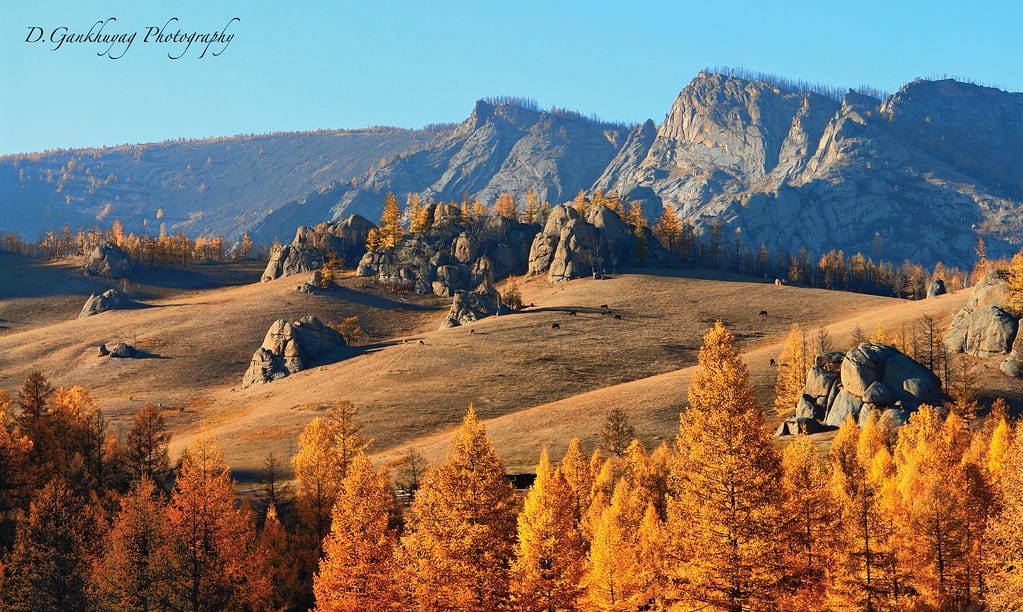
The exact week the larch peaks varies with altitude and each year's weather, so we treat colour as a moving target rather than a fixed date — and build flexibility into the route so you are in the right valley at the right moment.
The Gobi: warm days, cold nights, empty horizons
In our experience routing the southern desert, autumn is one of the most agreeable times to travel the Gobi. In our own routing experience, crowds thin after the first week of September, temperatures settle into a comfortable range — warm days, cool ger nights — and road conditions are generally still favourable through October, though rain, early snow or a damaged track can change a leg at short notice. The dunes at Khongor shift from honey gold to burnt amber as the day cools, and you may walk a ridgeline with no other group in sight.
One lesson from our own operating seasons shapes every autumn Gobi itinerary we write: camps begin to close in late October. We route desert extensions to finish before shutdowns and confirm each camp's operating dates and heating before we book, so your last night is in a camp that is open and staffed. For a month-by-month view, see our Gobi season guidance.
Northern Mongolia: catch the lakes before winter closes in
Northern Mongolia offers autumn's most dramatic colour — the larch forests around Khuvsgul Lake turn solid gold — but it also has the season's shortest window. Our routing policy is simple: we route lake journeys in September, when roads are generally good with early frost on higher ground; from October we switch to winter-designed itineraries, because roads become variable, snow and ice are possible, and short daylight and cold nights limit access.
If Khuvsgul is your priority, aim for September and consider flying one leg: a four- to five-day lake loop works best flying one or both ways, while seven to eight days allows a taiga and reindeer-herder detour. We typically recommend flight north, overland return — our northern duration guidance explains the trade-offs in detail.
| Region | September | October | Our routing approach |
|---|---|---|---|
| Central Mongolia | Golden grasslands, good roads | Still comfortable; days shorten | Anchor region; 10-day loop with rest day |
| Gobi Desert | Crowds thin after first week; warm days | Usually passable; weather-dependent | Finish desert legs before camp shutdowns |
| Northern Mongolia | Larch gold, lake routes normally open, early frost | Variable roads, snow/ice possible | We route lake journeys in September; from October we switch to winter-designed itineraries |
How Should an Autumn Route Through Central Mongolia Be Paced?
Mongolia's distances surprise first-time visitors. The Orkhon Valley lies a full day's drive west of Ulaanbaatar, and on unpaved roads a long driving day can stretch to most of a daylight period, depending on track conditions, river crossings and weather. In autumn, with daylight shortening through September and October, that arithmetic matters more than ever: we plan shorter driving days and earlier camp arrivals so you reach your ger while the valley is still lit, not after dark.
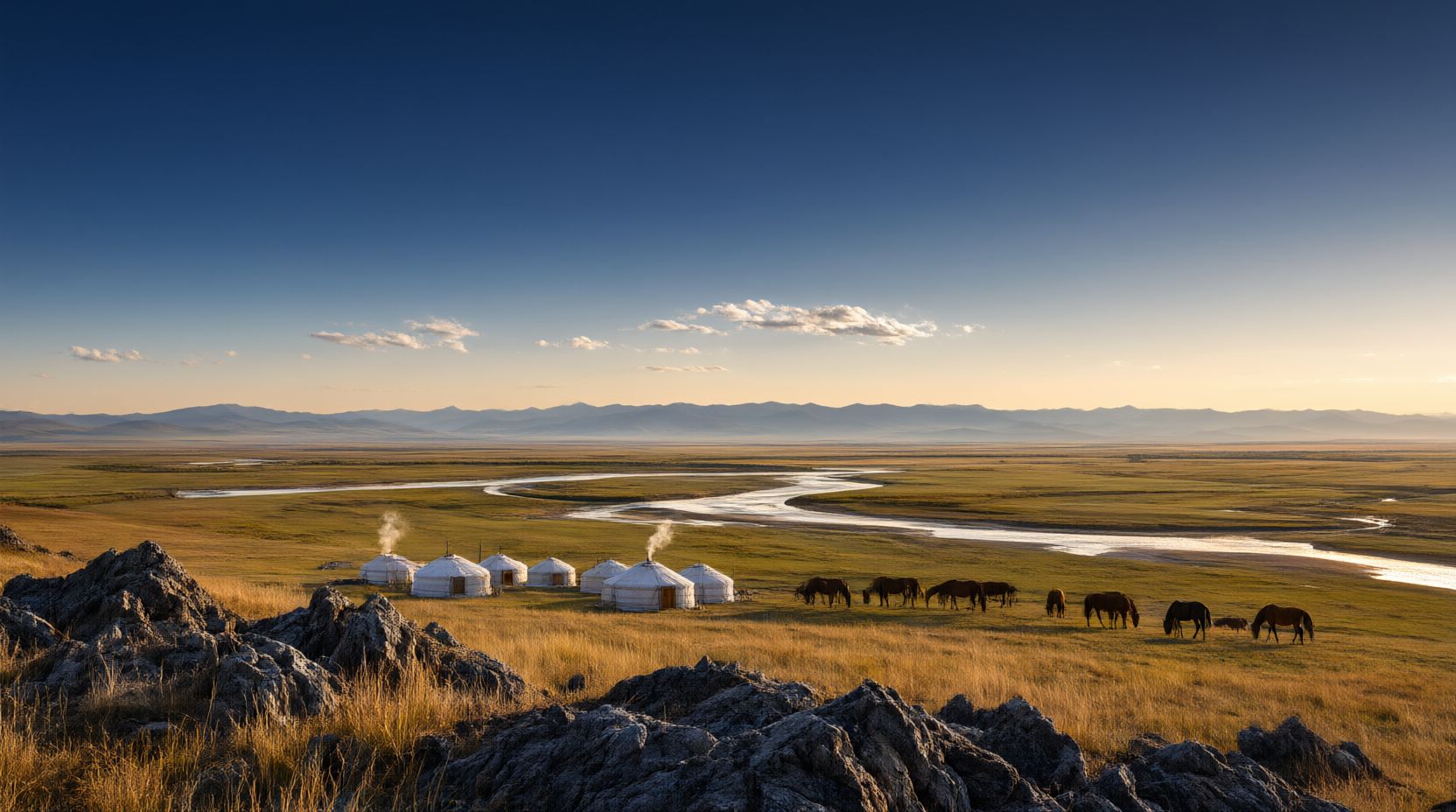
The framework we build from
Our 10-day balanced route follows a simple arc — Terelj, Kharkhorin, the Orkhon Valley and the Mini Gobi — staying closer to Ulaanbaatar while covering forest, steppe, canyon and dune. Two pacing rules we use on our 10-day balanced route govern every version we design:
- A rest day with only light local driving — a morning walk, a nomadic family visit, an afternoon that belongs to you rather than the road.
- Never two long driving days back to back — long hauls are separated by lighter legs, and a fly-back option can replace the full overland return when time is tight.
A design example: ten autumn days in central Mongolia
Here is how we would shape ten autumn days: arrival and city time in Ulaanbaatar, Terelj, the Elsen Tasarkhai dunes, two nights at a hot-spring resort with a full leisure day, then Kharkhorin's Erdene Zuu Monastery and the return to the capital. Nights would alternate between a city hotel and ger camps, and the hot-spring interlude is exactly the kind of warm, unhurried rest stop autumn routing calls for.
Adding a Gobi extension
If your dates fall in September or early October and you have additional days, a southern extension toward the Gobi is feasible — provided the desert leg is routed within the autumn operating window. We treat this as a tailor-made adjustment rather than a fixed add-on, because the right shape depends on your arrival date, pace and how much driving you want between highlights.
Autumn journeys, shaped around your dates
Any of our six collections can be routed for September and October — quieter trails, with the same all-inclusive support and 24-hour trip assistance as summer.
Explore our collectionsHow Does Autumn Change Practical Planning?
Autumn does not require a different kind of traveller — it requires a differently shaped itinerary. Three adjustments do most of the work.
- Day length drives the schedule. As daylight shortens through September and October, we shift departures earlier, cap daily distances, and schedule arrivals so camp check-in, dinner and any evening walk happen in daylight. Photography time is built into mornings and late afternoons rather than squeezed between transfers.
- Accommodation is layered deliberately. Cool ger nights are part of the autumn charm, but comfort should never depend on luck. We sequence city hotels and well-run ger camps so that colder, more remote nights are balanced with warmer, better-equipped stops — hot-spring resorts and town hotels act as recovery points on longer loops.
- Drive-time balance replaces distance-counting. A 200 km day on a good paved road and a 200 km day across river-crossed tracks are entirely different experiences. We plan in hours, not kilometres, and keep the rest-day rule intact even when a traveller asks to "fit in one more place."
If you are reading this in mid-October and thinking about next September, you are comfortably early.
Reading this in October?
For travel this year, late October is the practical edge of the autumn window: camps begin closing and northern roads turn weather-dependent. For journeys from November onward, we design within our winter routing instead — and next September is already open for planning.
Who Is Autumn Best Suited To?
Autumn rewards a particular kind of traveller. Three traveller profiles shape how we design an autumn route:
- Photographers and slow lookers. September and early October suit photographers, because low golden light lasts longer and viewpoints are quieter. We build in dawn and dusk time at the same location rather than moving camp every day.
- Quiet-landscape seekers. If your idea of a good day is a valley to yourself, autumn's thinner crowds deliver it. Trails, monasteries and dune ridges that share space with several groups in July are often yours alone in September.
- Shoulder-season planners. Travellers with fixed leave windows outside summer, or returning visitors who have done the classic loop and want it in a different key, find autumn both easier to book and gentler on the itinerary.
Families travelling with children can absolutely travel in early autumn — the shorter driving days suit younger travellers well — though we steer family routes toward central Mongolia's shorter hops rather than the far north as October progresses.
Any of our collections can be tuned to the season. The Signature and Deluxe Collections layer in higher-comfort accommodation, which pairs naturally with cool nights; the Explorer Collection suits photographers wanting time in fewer places; the Family Collection adapts its pacing to shorter daylight. If you are unsure where to start, every collection can be reshaped as a bespoke journey around your dates.
When Does Autumn Tip Into Winter — and How Do We Adjust?
Our site FAQ puts Mongolia's core travel window at mid-May to the end of October, with spring and autumn as transitional seasons — beautiful colour, more variable weather. That transition is not a single date. It arrives first on high northern ground, where our routing guidance flags early frost even in September, and reaches the Gobi last, where roads generally stay passable through October, weather permitting.
The practical markers we watch:
- Northern access: we route lake journeys in September; from October we switch to winter-designed itineraries, as snow and ice become possible and short daylight limits what a day can hold.
- Camp operations: ger camps begin closing in late October, so autumn routes are built to finish before shutdowns, with confirmed alternatives held in reserve.
- Early cold snaps: any autumn week can turn sharply colder. Because every journey is private and backed by 24-hour trip assistance, our on-the-ground team can reorder days, swap a camp for a hotel, or shorten a leg without unraveling the whole trip.
This is the reassurance at the heart of autumn travel with us: the season's variability is real, and it is precisely what a women-led local team with over ten years of routing experience plans for. You experience the golden steppe; we carry the contingency map.
Is September or October better for a first autumn visit?
September is the safer all-round choice: northern lake routes are normally still open, the Gobi is warm by day, and most main roads are in good condition. October suits central Mongolia and Gobi-focused routes, with shorter days and a weather-dependent north.
How far ahead should I book an autumn journey?
Autumn and shoulder-season trips can usually be arranged at shorter notice than summer and festival dates — though earlier is always better if you want specific camps or a photographer-friendly pace.
Can I combine the Gobi and Khuvsgul Lake in one autumn trip?
Only within a narrow September window, and it demands careful pacing — the two regions pull in opposite directions from Ulaanbaatar. Most travellers get a better journey by choosing one anchor region and adding a shorter contrast, such as the Mini Gobi's Elsen Tasarkhai dunes on a central loop.
What happens if an early cold snap hits during my trip?
Your itinerary is private, so days can be reordered, a ger camp night swapped for a hotel, or a driving leg shortened. Our 24-hour trip assistance and local coordination handle these adjustments while you keep travelling.
Ready to Plan Your Autumn Route?
Autumn is when Mongolia feels most golden and least crowded to us — if the route respects the season's rhythm. Choose your anchor region, protect your rest days, and travel within the season's window. Tell us your dates and pace, and we will shape the rest.
Let's design your September or October journey
Share your travel window and interests, and our Travel Design Team will propose a paced, all-inclusive route — with the season's contingencies already planned in.
Start your autumn inquiry


