


Is Mongolia a good trip for teenagers?
Yes — Mongolia works well for teenagers, provided the route gives them a real activity most days, caps driving at roughly half a day and builds in genuine downtime. The design brief for Mongolia travel with teenagers is simple: something to do most days, rather than treating every hour as sightseeing. Teens are not small children: they can usually handle a longer transfer than a seven-year-old, but they need challenge, ownership and space to switch off. This guide walks through how we design that balance — activity intensity, driving-day pacing, ger-camp comfort and connectivity, meals, and when a tailor-made route beats a curated collection.
What makes a Mongolia route work for 13–18-year-olds
- Active most days — riding, dune walking, canyon hiking and kayaking, not a chain of photo stops.
- Driving capped and agreed in advance — around half a day at most on family routes, agreed with you before the route is confirmed.
- Two-night bases and a light day after a long transfer — the rhythm matters more than the total distance.
- Honest expectations about gers and signal — private ger, shared or ensuite facilities depending on collection; limited coverage in the countryside.
- A hotel night in Ulaanbaatar before the flight — shower, wifi, decompression.
- Teens involved in the choices — we design with them, not just around them.
Why do teenagers need a different route from younger children?
Because the failure mode is different. Younger children tire physically; teenagers disengage. A day of long vehicle legs with short lookout stops leaves a 15-year-old restless and unconvinced, even when the scenery is extraordinary.
There is a physiological reason to keep them moving. The U.S. Centers for Disease Control and Prevention guidance published in 2018 states that children and adolescents aged 6–17 should do 60 minutes or more of moderate-to-vigorous physical activity daily. A route built entirely around driving and viewpoints under-serves that age group; a route with a ride, a dune climb or a canyon walk most days moves much closer to it than a week of driving and viewpoints.
The other half is attention and mood. In an experimental proof-of-principle study published in Scientific Reports in 2023, adolescents briefly exposed to a virtual nature scene reported beneficial effects on stress, relaxation, mood and attention, along with increased nature connection. That was a short virtual exposure in a lab, not a week on the steppe, so we do not treat it as a promise about your trip. It does support the direction we design in: genuinely immersive outdoor time, rather than scenery viewed through a windscreen.
Our own design view — and it is a view, not a research finding — is that the trip lands better when teenagers help choose it. Give them the shortlist of activities and let them pick two things they want to be able to say they did. Ownership changes how they arrive at each day.
Which activities do teenagers actually embrace?
The ones with a skill, a bit of effort and a story attached. On our Family Collection routes through Central Mongolia, the pattern that works is one substantial activity per day, with an opt-out available.
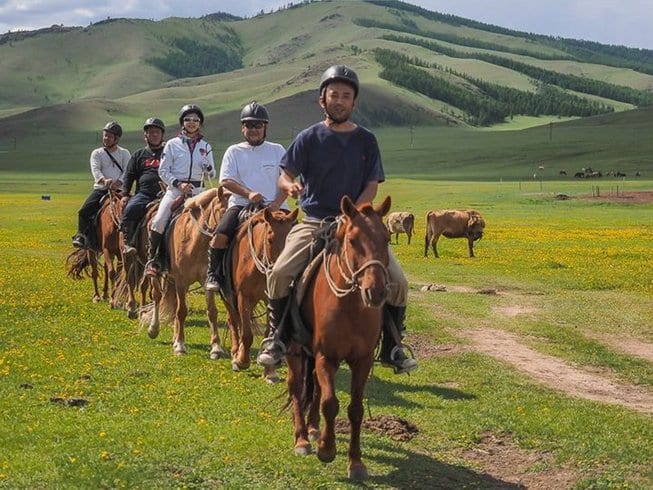
Activities that tend to land well with this age group
- Horseback riding — usually the first thing teenagers pick from the shortlist. Riding across open grassland with a local guide is a skill they can feel themselves learning, not a passive experience.
- Dune walking and camel trekking — climbing a sand ridge is harder than it looks and rewards the effort immediately. Bactrian camel riding at the Elsen Tasarkhai sand dunes is a highlight on our family journey.
- Canyon and valley hiking — the rocky canyon at the Orkhon Waterfall gives a proper walk with a picnic at the end of it.
- Kayaking — on the water in Terelj, a different muscle group and a different perspective on the same landscape.
- Wildlife watching with a purpose — an evening walk to see wild Przewalski's horses come to the river at Hustai National Park works because there is something to look for. Sightings are never something we promise.
- Hands-on cultural time — a day with a nomadic family cooking traditional Mongolian barbeque tends to work better with teens than a museum-only afternoon, because they are participating rather than being shown.
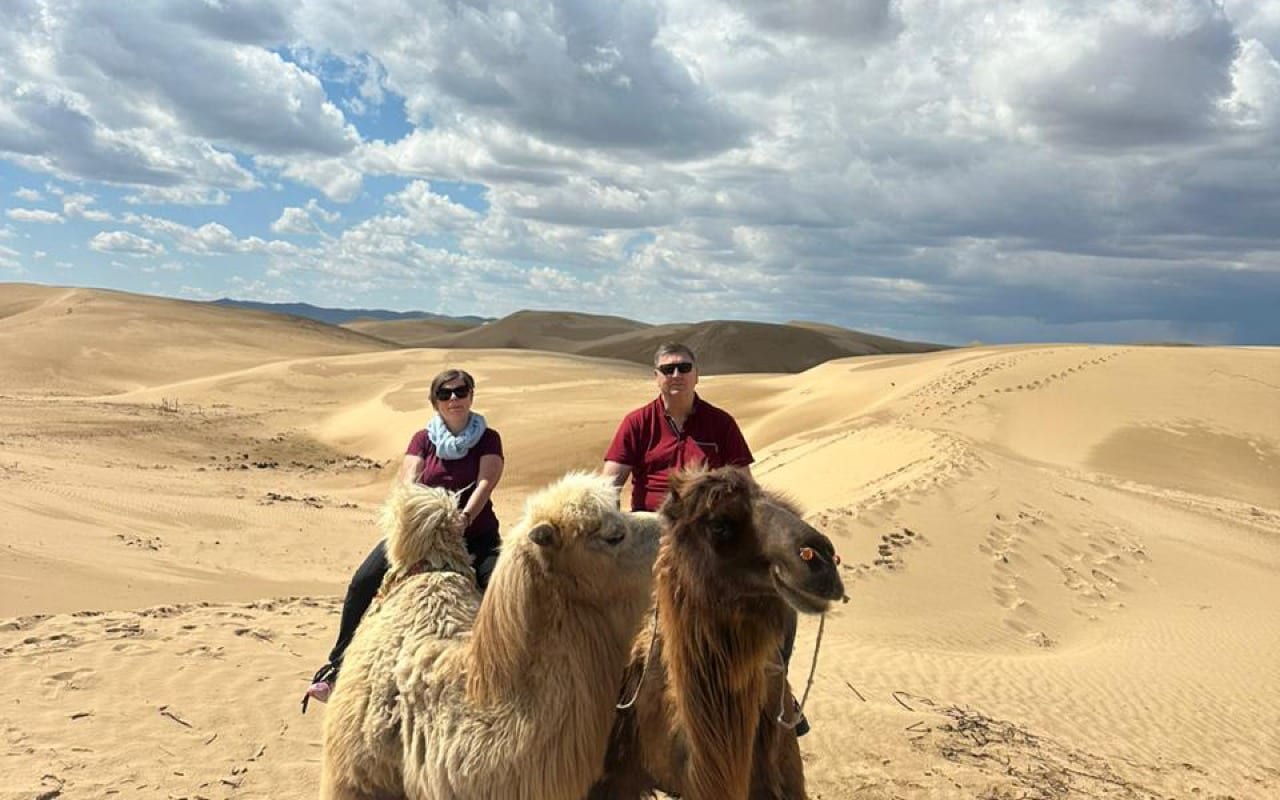
Rides and walks are guide-led and matched to the rider on the day; tell us your teenager's riding experience when you enquire and we will confirm what each camp can arrange. We do not publish a fixed minimum age — we ask, then plan. Our packing checklist covers the footwear and layers that make those days comfortable.
History still has a place — Erdene Zuu Monastery and the interactive Karakorum Museum at Kharkhorin are on the published family itinerary — but we position those on a shorter-driving day, ideally paired with an optional ride or hike so the day is not purely indoors.
How we balance active days with genuine downtime
Downtime is scheduled, not leftover. Three habits do most of the work:
- One anchor activity per day. Not three. A morning ride plus an afternoon of unstructured camp time beats a full programme.
- A light day after a heavy one. If a transfer runs long, the next day stays near camp.
- Opt-outs without negotiation. Our Family Collection is built at moderate activity intensity with opt-outs, so a teenager who wants to stay at camp with a book can, without it becoming a family debate.
For mixed-age groups, a split day is possible: grandparents resting at camp or joining a gentle nomadic visit while teenagers take a longer ride or walk with a guide, everyone reuniting for lunch. That is a bespoke arrangement we set up in advance — not a fixed feature of the Family Collection.
If you want to compare intensity across our collections in more depth, ask us how each one is pitched — we will talk you through the activity level and the driving on the route you are considering.
How do we design driving days for teenage tolerance?
Mongolia is vast, and the distances are real. The design question is not "how do we avoid driving?" but "where do we put the driving so it does not eat the trip?"
On the Family Collection, driving days are kept short with regular breaks, and the route often uses two nights per camp. Standard and Explorer collection routes cover more ground each day and usually stay one night per camp — a rhythm better suited to adults or older, keen travellers than to a family wanting time together.
Our working rule for families is to keep driving days to around half a day at most, with a stop roughly every hour, and to agree the exact cap with you before the route is confirmed. In our experience teenagers can usually manage a longer transfer if the following day is light — that is a planning judgement from designing these routes, not a measured threshold, which is why we agree it with you rather than assume it.
Three pace tiers we plan around
These are rules of thumb for shaping a bespoke route, not guarantees:
- Gentle — 2–4 hours driving, short walks near camp.
- Moderate — 4–6 hours driving, optional walking, riding or camel trekking.
- High — full active days on foot or horseback, with tent nights.
Most families with teenagers sit at Gentle-to-Moderate, with one or two deliberately bigger days.
What a published family route looks like on the map
Mongolian Horizons: A Family Journey runs 10 days / 9 nights through Central Mongolia. Its published daily driving distances show the shape we aim for — short legs clustered around the activity days, with the longest transfers at the ends. The table is distance only — ask us for the driving time on each leg, including the days not listed here:
| Day | Route focus | Approx. driving distance |
|---|---|---|
| 1 | Arrival → Terelj National Park | 110 km |
| 2 | Terelj — kayaking and horse riding | 10 km |
| 4 | Hustai National Park — wild horses | 80 km |
| 5 | Elsen Tasarkhai dunes → Khujirt | 210 km |
| 6 | Orkhon Waterfall — picnic and canyon hiking | 170 km |
| 7 | Kharkhorin — Erdene Zuu and Karakorum Museum | 70 km |
| 8 | Nomadic family day | 60 km |
| 9 | Return to Ulaanbaatar | 270 km |
Days 5 and 9 are the two deliberately bigger transfer days on this route; day 9 ends with the Ulaanbaatar hotel night rather than another early start, and we agree those exceptions with you before confirming.
Two structural details matter for teenagers. First, the itinerary uses consecutive nights at the same base — two consecutive nights at the same base in the Orkhon region on days 5–6 — so nobody unpacks and repacks every morning. Second, the longest leg is the return to the capital, and it is followed by a hotel night, not another early start.
Where buffer days earn their place
We design our family routes to end with a night in an Ulaanbaatar hotel before the flight out: a hot shower, hotel wifi, and a chance for teenagers to reconnect with their own world before a long flight. Where a domestic flight is included, we protect a free morning in the capital as recharge time rather than filling it with one more sight.
Family routes use well-maintained 4x4 vehicles with drivers experienced on steppe tracks and river crossings, and we space the driving days so children arrive at camp with energy left. The Central Mongolia destination page shows the places these legs connect. If ten days is more than your school holidays allow, our seven-day northern Mongolia and Khuvsgul week is a shorter alternative shape.
See the family routes as published
Browse the Family Collection itineraries, then tell us which days you would lengthen or shorten for your teenagers.
Explore the Family CollectionWhat should teens expect from ger camps, privacy and connectivity?
Honest expectations here head off much of the friction we see on family routes. A ger is a comfortable, warm, circular felt dwelling — and it is not a hotel room with a door that locks against a sibling.
Comfort levels, plainly
| Camp standard | Bathroom and shower | Heating and dining | Typical on |
|---|---|---|---|
| Standard ger camp | Private ger for your party, shared bathroom and shower facilities | Shared facilities block | Standard and Explorer routes |
| Deluxe ger camp | Private ensuite bathroom | Heating and on-site dining | Deluxe Collection routes |
En-suite gers are standard on Deluxe Collection routes; shared-facility gers are the norm on Standard and Explorer routes. If a private bathroom is the thing that will make the trip work for your teenager, that is a legitimate reason to choose Deluxe — and worth saying to us at the outset. Facilities vary from camp to camp, so ask us to confirm the standard at each stop on your route.
Sleeping arrangements for siblings are worth raising with us directly when you enquire, so we can confirm what each camp on your route can set up rather than assume it.
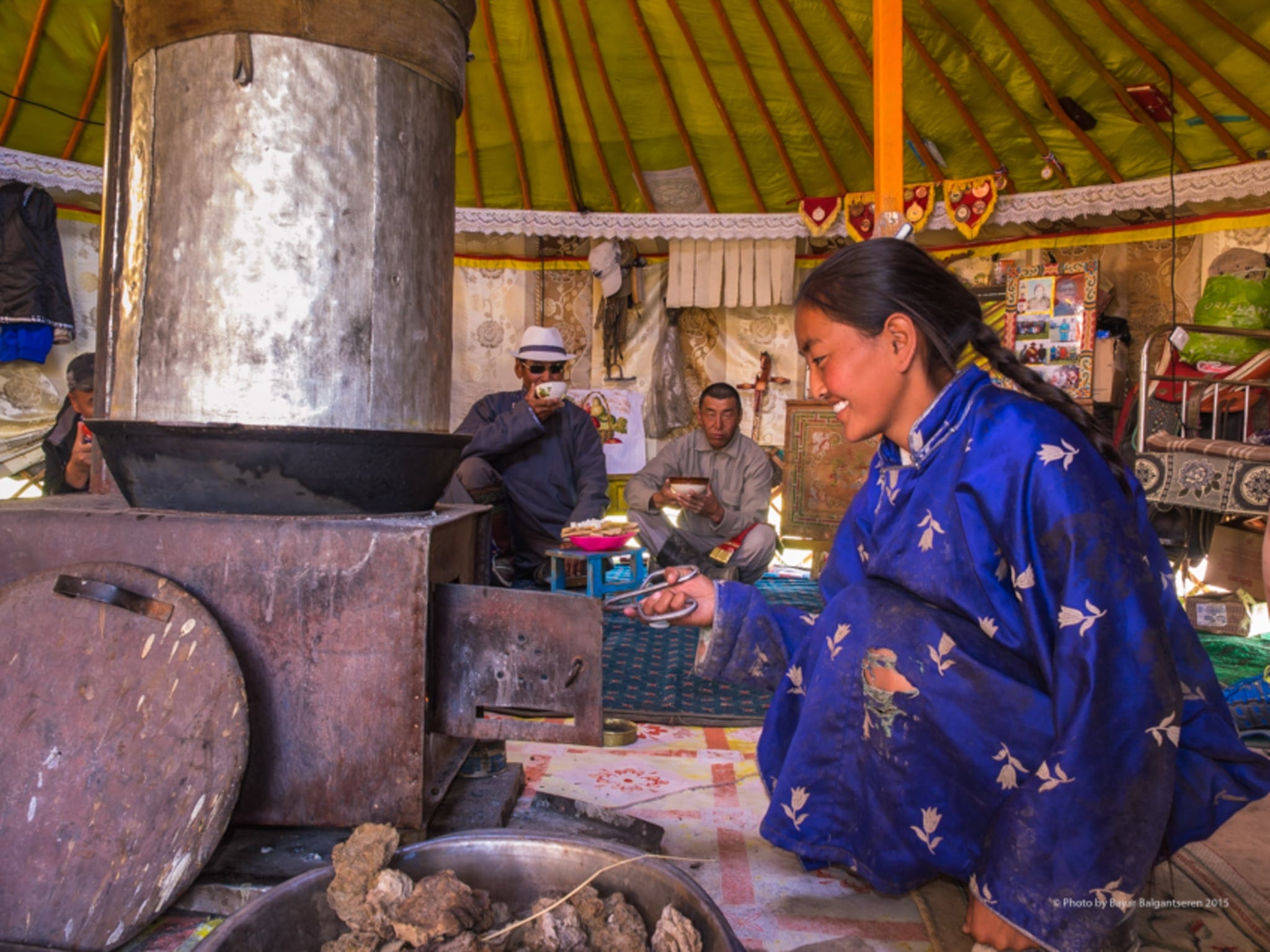
Camp life: the stove is the centre of the ger — warmth, meals and conversation all happen around it.
Connectivity: what to tell your teenager before you fly
Mobile coverage is good in cities and towns and limited in remote countryside. At the countryside camps on this Central Mongolia route — Terelj, Hustai and the Orkhon region — electricity is often generator-based during set hours, and signal or data should not be counted on. Bring a power bank, and ask us which camps on your specific route have coverage — we will tell you rather than guess.
This is not unique to our routes. The U.S. Department of State Mongolia country information page states plainly: "Cell phone and emergency services may not exist in rural areas."
Framing screen-free days as a gain, not a punishment
Announce it before departure, in positive terms, and give it a shape. "Two evenings with no signal, and the Milky Way overhead" reads very differently from "no wifi for a week". Practical framings that work:
- Name the offline days in advance so nobody discovers them mid-transfer.
- Give them a job — camera, route notes, spotting wildlife on the Hustai evening walk.
- Point at what replaces the screen — stars, a fire, a horse, a family cooking alongside them.
- Promise the reconnect — the Ulaanbaatar hotel night with wifi is part of the design, and telling them so upfront tends to take the edge off the offline days.
Meals, dietary requests, and when bespoke beats a collection
Dietary requests: flag them at booking
Tell us about allergies, vegetarian needs or religious requirements at the time of booking. We flag them before departure and communicate them to each camp on the route. Our Terms and Conditions ask guests to inform us of special requirements when booking and state that we will do our best to accommodate them but cannot guarantee fulfilment — remote camps have real supply limits, and we would rather be straight about that than over-promise.
For older children specifically, portion sizes and preferences vary enormously between 13 and 18. Rather than assume, tell us what your teenager actually eats — whether they will try dairy-heavy traditional dishes, whether they need a familiar fallback — and we will pass it down the route with the rest of the dietary notes.
When a tailor-made family route is the better answer
A curated collection is the right starting point when your family's rhythm fits the published shape. Go bespoke when:
- Your teenagers want more riding or hiking than the published days allow.
- You need shorter drives or more two-night stays than the itinerary has.
- You are travelling with mixed ages and want split mornings.
- Your dates are fixed by school holidays and the collection departures do not align.
- One specific interest — photography, wildlife, a particular region — should drive the route.
Most collections can be softened through bespoke design: shorter drives, more two-night stays, subject to route and camp availability. Bespoke routes have no fixed published daily driving number — we agree it with you before booking. To make that first conversation efficient, send us your dates, your teenagers' ages and the two activities they most want, and we will shape the bespoke route from there. For a bigger cultural hook, an Altai extension around the Golden Eagle Festival can be built into a bespoke journey.
If you are also travelling with younger siblings, our companion piece on Mongolia travel with children covers the younger end of the age range. For general pre-trip questions — visas, timing, what happens on arrival — our FAQ page answers the most common ones.
Can teenagers handle the driving in Mongolia?
Usually yes, with design — we agree the driving cap with your family before the route is confirmed. Ask us for the driving time on each leg, not just the distance, before you book.
Will there be wifi and phone signal at the camps?
Coverage is good in cities and towns and limited in the countryside; at the camps on this Central Mongolia route electricity is often generator-based during set hours, so signal and data should not be counted on. Bring a power bank and ask us which camps on your itinerary have coverage.
Do teenagers get their own ger?
Your party gets a private ger; bathrooms are shared on Standard and Explorer routes and ensuite on Deluxe routes. Tell us how you would like siblings arranged and we will confirm what each camp can set up.
Is a curated collection or a bespoke route better for a family with teens?
Start with the Family Collection if its published pacing suits your family, and go bespoke for more riding, shorter drives, split mornings or school-holiday dates. Ask us which parts of a published collection can be softened before you commit to it.
Can you cater for a fussy or vegetarian teenager?
Tell us at booking so allergies, vegetarian and religious requirements are flagged to each camp before departure. Our Terms and Conditions say we will do our best to accommodate them but cannot guarantee fulfilment, because remote camps have supply limits.
Mongolia travel with teenagers: where to go from here
Teenagers do not need a softened Mongolia — they need a route with real activity, honest driving limits, decent sleep and a say in the plan. Start from the Family Collection, decide which two experiences your teenager wants to own, and tell us where the pace should change. We will shape the rest around it, with 24-hour trip assistance behind you on the road.
Tell us about your teenagers
Send us your dates, your teenagers' ages and the activities they care about. We will come back with a paced route and a clear picture of each driving day.
Start planning your family journey


