


By Mongolianstar Adventures Guest Care Team · Published October 9, 2026
Pack layers, not expedition gear. For Mongolia's core travel season — mid-May to the end of October — a base layer, a mid layer, a warm evening jacket, proper sun protection and sturdy closed-toe shoes cover almost everything a first-time traveler needs on an all-inclusive private journey. On our curated routes, camps provide proper beds with bedding and hot meals, so your own sleeping bag can stay home. Below is the full checklist, what ger camps already provide, and the few things worth confirming with our desk before you zip the bag.
The short version
- Layer for the day–night swing: base + mid + a warm evening jacket, even in July.
- Sun kit matters on the open steppe: hat, sunglasses, SPF 30+ broad-spectrum sunscreen.
- Closed-toe, treaded shoes or boots — not sandals — for grass and dunes.
- No sleeping bag needed: camps on our curated routes provide beds, bedding and hot meals.
- Confirm towels, heating and charging per camp with the desk before you pack.
Why is layering the whole game in Mongolia?
Because the climate is dry, sunny and continental, with big differences between daytime and nighttime temperatures — our FAQ recommends layering for exactly this reason. Mongolia is the "Land of Eternal Blue Sky," with around 250 sunny days a year, and even in the warm high season of June–August, evenings turn cooler and often breezy.
The physics behind this is well understood in dry landscapes. The U.S. National Park Service explains that in dry desert conditions, roughly 90 percent of the day's accumulated heat radiates back toward the sky after sundown, versus only about 50 percent in moister climates. That is a US-desert example rather than a Mongolia measurement, but the mechanism is the same one that makes a July evening on the steppe feel nothing like a July afternoon. We don't publish a single "degrees of swing" number for Mongolia because it varies by region, month and night — what we can tell you is that a warm evening layer earns its place in your bag every month of the core season.
The season itself has moods worth packing for: May can be slightly windy, June–August brings warm or hot days, and September–October delivers crisp air and autumn colors. One bag of layers handles all three.
What should go in your bag? The core-season layering checklist
Think in three working layers plus a sun-and-wind kit. This is practical packing logic rather than technical mountaineering advice — the goal is to add or shed a layer in seconds as the day changes.
Base layers
- Two or three breathable tops per week of travel, mixing short and long sleeves.
- Quick-drying fabrics are convenient on a moving itinerary; ordinary cotton T-shirts are fine for town and vehicle days.
- Long sleeves do double duty as sun cover on open terrain.
- Enough underwear and socks for your route, plus a spare pair of warm socks for evenings.
Mid layers
- One light fleece or wool sweater — the layer you'll wear most mornings and in the vehicle.
- A zip front makes it easy to vent when the sun comes out.
- Comfortable long trousers for travel days; shorts are optional for warm afternoons.
A warm evening layer — yes, even in July
- An insulated jacket (a down or synthetic puffy) is the single most important item on this list. Summer evenings are cooler and often breezy, and you'll want it for dinner outside the dining ger and for stargazing.
- A light beanie and thin gloves are sensible comfort extras for May and the September–October shoulder months, when the air turns crisp.
- If you run cold, add a lightweight thermal top and bottom for sleeping — a preference, not a necessity.
Wind and sun protection
On the open steppe and Gobi dunes there is little shade, so sun protection belongs in the same category as warmth. The World Health Organization recommends broad-spectrum (UV-A and UV-B) sunscreen of at least SPF 30, applied liberally, and notes that protective clothing, sunglasses and hats alongside sunscreen provide the best defense against UV radiation.
- A lightweight windproof shell — May's breezes and open-ridge viewpoints make this useful all season.
- A wide-brimmed hat or a cap with a neck cover.
- Sunglasses you actually like wearing all day.
- SPF 30+ broad-spectrum sunscreen and an SPF lip balm.
- Long sleeves and long trousers as your default for full days outdoors.
Footwear for steppe grass and Gobi dunes
Your feet will meet uneven grass, gravel tracks and soft sand — not paved paths. National Park Service hiking guidance recommends closed-toed footwear with a treaded sole, and sturdy rubber-soled hiking boots with ankle support for dirt and gravel trails. The same logic applies here.
- Broken-in, closed-toe walking shoes or light hiking boots with a treaded sole.
- Boots with ankle support if you plan longer walks on rough ground.
- Sandals or camp slip-ons for downtime only — not for walking the dunes.
- Break in anything new before you fly; a blister on day two is avoidable.
Small extras that earn their place
- A daypack for water, layers and camera on daily outings.
- A power bank and spare camera batteries — countryside camp electricity is typically generator-based and available during set hours, so overnight charging isn't always possible.
- A reusable water bottle; ask us about drinking water and refill arrangements on your specific route.
- Your personal medications and a small basics kit (plasters, pain relief you normally use). For anything health-specific, talk to your own clinician before departure — our guides and the assistance line handle logistics, not medical advice.
Do you need expedition gear for a private journey?
In our experience supporting core-season journeys, guests rarely need expedition equipment — the trips people picture when they hear "Gobi" and "steppe" are not what an all-inclusive private journey actually looks like. You sleep in a bed, eat hot meals, and travel in a private vehicle with a guide; the checklist above is about comfort across a long day outdoors, not survival.
Here is the reality on our curated routes:
- Camps offer proper beds with bedding — not sleeping bags on the floor — with clean, changed linens.
- Central dining gers serve hot meals, so no camping stove, cook set or expedition food.
- In Ulaanbaatar you stay in centrally located 4–5 star hotels with full amenities, private bathrooms and Wi-Fi.
- Your guide and driver handle the logistics between stops; you carry a daypack, not a rucksack of survival kit.
What a comfortable trip actually requires is the layering checklist, your personal items, and a willingness to add or shed a layer as the sky changes. If you're traveling outside the core season, that's a different conversation — cold-season packing is covered in a separate guide, and we're happy to walk you through it for your dates.
What do ger camps already provide — and what should you bring?
Camp standards shape your packing more than any other factor, and ours are documented plainly. Here is what each stay type provides, based on our FAQ answers:
| Stay type | Bathroom | Sleeping setup | Heating |
|---|---|---|---|
| Deluxe ger camp | Private ensuite | Comfortable beds with bedding | Heating provided |
| Standard ger camp | Shared bathroom and shower facilities | Private ger for your group, proper beds with bedding | Confirm per camp and season |
| Ulaanbaatar hotel | Private bathroom | 4–5 star hotel, full amenities, Wi-Fi | Hotel standard |
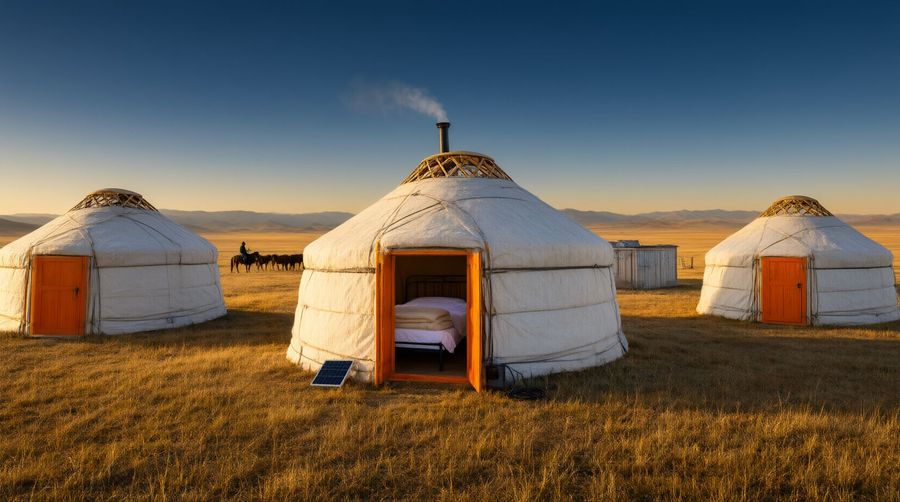
Deluxe ger camps are our signature experience: traditional gers with private ensuite bathrooms, comfortable beds, heating and on-site dining serving local and international meals — similar to 4-star level. Standard ger camps give your group a private ger with shared bathroom and shower facilities: simple, clean and more traditional. For a fuller picture of the difference, read our guide to ger camp comfort levels, and for the deluxe end, what deluxe comfort really means.
Two practical details affect what you pack:
- Showers: at selected camps shower facilities are provided, with hot water usually available morning and evening; pressure can vary, and arrangements are confirmed at each stop. A quick-dry travel towel is a reasonable just-in-case item until we confirm what your camps supply.
- Charging: generator-based electricity runs during set hours at countryside camps. Bring a power bank and spare batteries, and we'll confirm the charging pattern for each camp on your route.
Confirm these with the desk before you pack
A few details vary by camp and season, and we'd rather check than guess:
- Whether towels and toiletries are provided at your specific camps
- Heating at Standard ger camps if you travel in May or October
- Laundry options during your route
- Drinking water and refill arrangements at each stop
Message us on WhatsApp (+976 99995941) with your dates and route — we reply within 24 hours.
How does the Guest Care Team help with packing?
We are a women-led local team with over ten years of expertise running all-inclusive private journeys, and packing questions are some of the most common we field. Before departure, the desk confirms the camp-by-camp details that shape your bag — heating at Standard camps for your season, charging patterns, shower arrangements — so you pack for your actual route rather than a generic idea of Mongolia. Enquiries get a reply within 24 hours, and once you're traveling, our 24-hour trip assistance means a forgotten item or a change in weather is a message away from a practical answer, not a problem you solve alone.
If you're still at the planning stage, our first-time Mongolia travel guide walks through how a supported journey comes together — packing is the last step, not the first.
Do I need to buy special outdoor clothing before I fly?
No. Ordinary layered clothes you already own will work: breathable tops, a fleece or sweater, an insulated jacket, a windproof shell and broken-in closed-toe shoes. If you're buying one thing, make it the warm evening layer — it's the item travelers are most glad to have when the sun drops.
Can I charge my phone and camera every night?
Usually, but not always overnight. Countryside camp electricity is typically generator-based and available during set hours, so charging windows vary by camp. A power bank and spare camera batteries cover the gaps, and we confirm the charging pattern for each stop on your route before you travel.
Is the packing list different for children?
The same layering principles apply — kids feel the evening chill just as adults do. Pack extra changes of clothes, their own warm evening jacket and sun hat, and a familiar comfort item for nights away from home. For pacing, camps and family-specific planning, our family travel guides cover the journey itself.
Not sure what your travel month means for your list? Ask us — that's what the desk is for. Reach us on WhatsApp, call +976 99995941, or email uyanga@mongolianstar-adventures.com; enquiries get a reply within 24 hours, and guests on tour have 24-hour trip assistance.
Ask us before you zip the bag
Send us your route and travel month, and we'll confirm the camp details that shape your packing list — so your bag holds exactly what your journey needs.
Plan my trip