


A multi-day horse trekking itinerary in Mongolia is built as a supported riding block inside a longer journey — not as a ride from the first day to the last. Our published Horseback Riding Tour runs 15 days and 14 nights, of which six days and five nights are spent in the saddle around Khuisiin Naiman Nuur (Eight Lakes), with ger camps and city hotels on either side. That shape is the template we work from.
This guide explains how we choose the region, set the length of each riding stage, decide where you sleep, and match intensity to the people actually travelling — including groups where some members ride and others would rather not. By the end you will know what a realistic riding route looks like and what we need from you to design one.
What shapes a riding itinerary
- Region first. Central Mongolia's Orkhon Valley and the Eight Lakes area are where our published multi-day riding route sits.
- Stages, not marathons. Published riding days range from 8 km to 20 km, with the shortest stage placed mid-block.
- Comfort alternates with trail. Tent nights during the riding section; ger camps and hotels before and after.
- Riding is never compulsory. Participation is settled when the itinerary is designed, not on the trail.
- Season decides feasibility. June to August is the reliable window; September is the quieter compromise.
Which regions suit a multi-day riding route?
Central Mongolia: the Orkhon Valley and Eight Lakes
Central Mongolia is the base we return to for riding journeys, and in our experience it is the most forgiving place to build one: open valley country, established ger camps within reach, and a road network that lets a support vehicle stay close to the route.
The riding loop itself sits in the Eight Lakes reserve — 11,500 hectares in Uvurkhangai province, about 70 km south-west of the Orkhon waterfall, and described locally as one of Mongolia's nine wonders. The loop starts and ends at Ulaan Tsutgalan (Orkhon) waterfall, which makes it a clean circuit: you ride out, you ride back, and your vehicle-based days resume where they left off.
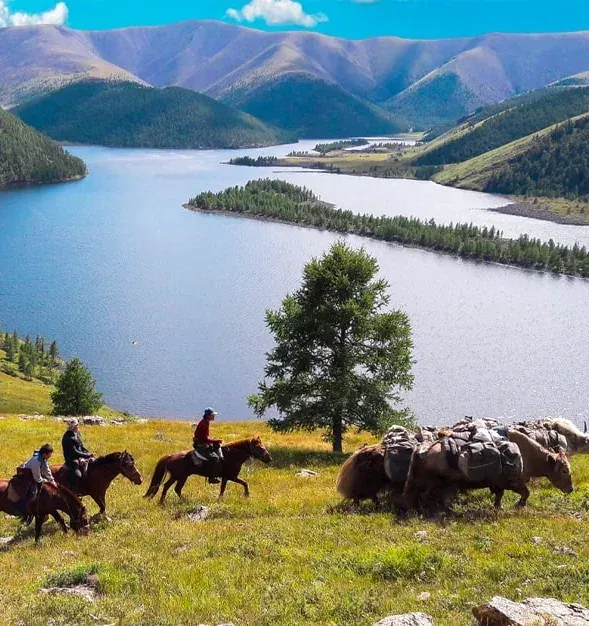
Here are the published stages of that riding block, exactly as they appear in the itinerary:
| Day | Riding stage | Distance | Overnight |
|---|---|---|---|
| 5 | Eight Lakes → Bituut River | 20 km | Tent |
| 6 | Bituut River → Khuis Lake | 15 km | Tent |
| 7 | Khuis Lake → Shireet Lake | 8 km | Tent |
| 8 | Shireet Lake → Duruu Lake | 13 km | Tent |
| 9 | Duruu Lake → Hyatruun | 18 km | Ger camp |
| 10 | Hyatruun → Ulaan Tsutgalan | 10 km | Ger camp |
Notice the shape: the longest stage comes first, the shortest lands in the middle, and the block closes gently. That is deliberate sequencing rather than an accident of geography, and it is the pattern we reuse when we adapt a riding section for a private group. For the wider valley context — how many days the region deserves and how to route it — see our Orkhon Valley travel guide.
Khuvsgul and the northern taiga margins
Northern Mongolia draws riders who want forest edges and lake country rather than open steppe. Two practical facts govern any plan here. The usable Khuvsgul season runs June to September, and the road north from Ulaanbaatar typically takes a full day or more each way — which is why we recommend six to eight days for a northern segment rather than trying to squeeze it into a long weekend.
We do not publish a fixed multi-day riding route with defined stages in the north. If the taiga margins are what you have in mind, treat it as a bespoke design conversation: tell us the dates and the pace you want, and we will confirm what can be routed and supported there before anything is promised.
The Altai: read the product carefully
Western Mongolia is the region riders ask about most, and it deserves a precise answer. Our Altai Tavan Bogd Trekking Tour is camel-supported trekking on foot, with tent nights and a stage over the Takhilt Mountain Pass at 3000 m. Horseback riding appears there as part of a nomadic Kazakh family visit — a highlight, not the mode of travel.
So if your goal is several consecutive days in the saddle, the Altai is not currently a published option with us. If your goal is a demanding western expedition with riding woven in, it fits well. We would rather clarify that at the design stage than let a mismatch surface at 3000 m.
How do we pace saddle time and rest?
Riders often ask for hours per day. We plan in stages and terrain instead, because the same distance can feel very different across a lake basin, a river crossing and a climb — and we do not publish hour figures we cannot stand behind. What we can show you is the distance rhythm above, and the planning tiers we use around it.
Our design team works with three pace tiers as a rule of thumb, not a guarantee:
- Gentle — two to four hours of driving, short walks near camp.
- Moderate — four to six hours, with optional walking, riding or camel trekking.
- High — full active days on foot or horseback, with tent nights.
A multi-day riding block sits at the High end while it runs, which is exactly why the days around it should not. In the Orkhon Valley we match active days to the group and keep a rest day beside them; the ascent to Tuvkhun Monastery, on foot or horseback, stays optional. In our routing practice a rest day is what makes the second half of a riding block enjoyable rather than endured.
Support legs get the same arithmetic. A 300 km day on unpaved roads takes roughly six to eight hours depending on track conditions, river crossings and weather, so heavy driving days of 250–380 km are followed by a lighter day or a two-night stay. We would rather arrive rested than arrive early and start a riding block tired.
Ask for the stage plan, not just the day count
When you compare riding itineraries, request the day-by-day distances and the overnight type for each night. A "six-day ride" tells you very little; six stages of 8–20 km with four tent nights tells you almost everything about how the trip will feel.
What does "fully supported" actually mean on the trail?
Our riding tour is sold as fully supported horseback riding, and the published commitments are specific:
- Scenic campsites and good food throughout the riding section.
- Quality expedition gear, with all camping gear provided by us.
- A horse matched to your riding level.
- A professional English-speaking guide accompanying the group.
The overnight pattern matters as much as the kit. On this route the trail nights are tent nights, while the approach and exit days use ger camps and Ulaanbaatar hotels — comfort alternates with wilderness rather than disappearing for two weeks. Many riders tell us that alternation is what makes a longer journey sustainable, and it is a lever we can adjust in a private design: more ger-camp nights around a shorter riding block, or a longer tent section for a group that wants it.
The finer operational details — how camps move, how luggage travels, what backup transport sits behind the group — are confirmed for your specific route and dates rather than described generically here. Ask us for them in writing when you enquire; a supported trek should be able to answer those questions plainly. Every private journey we run also carries 24-hour trip assistance.
Read the published route day by day
Our 15-day Horseback Riding Tour shows the full sequence — approach days, the six-stage Eight Lakes loop, and the valley days that follow.
See the riding itineraryCan a mixed-ability group share one itinerary?
Yes, and it is one of the most common briefs we receive. Two principles make it work.
First, riding is never compulsory in our journeys. Most of our curated collections sit at a gentle-to-moderate activity level; only the Explorer Collection and Altai trekking routes are genuinely demanding. Who rides, on which days, is settled at itinerary design — not negotiated at the trailhead.
Second, we design the shared parts of the day to be worth everyone's time. In our experience the Orkhon Valley suits mixed-ability parties precisely because moderate effort in the morning is followed by a proper bed and a hot meal at night. Forcing an entire family into one collection's fixed intensity rarely serves the group well; a valley base with optional riding usually does.
If some members want to ride while others travel by vehicle and rejoin at camp, raise it explicitly when you enquire. Whether that can be arranged depends on the route, the tracks and the camp locations for your dates, so we confirm the arrangement for your itinerary rather than assume it. Tell us the split in your group and we will design around it. Our guide to matching intensity to your collection covers the grading in more detail.
When should you ride, and what do we need to build the route?
Season windows
| Window | What our site guidance says | Design implication |
|---|---|---|
| June–August | Best for a first trip; July and August most reliable for northern roads and camp operations | The default window for a multi-day riding block |
| September | The quieter compromise | Fewer travellers; confirm camp operations for your dates |
| October–April | Variable, with snow and ice | Not a window we would plan a supported riding route around without a specific conversation |
For month-by-month detail across regions, see our season and region guide.
The four things we ask for
- 1
Riding background — how recently you rode, how long your typical rides are, and whether anyone in the party is a beginner or a non-rider. This is what lets us match horses to riders.
- 2
Dates and total length — your arrival and departure, and how many days you can give Mongolia. The riding block is one part of a longer journey, so the total frames everything.
- 3
Preferred pace — which of the three tiers describes your ideal day, and how many consecutive tent nights feel appealing rather than taxing.
- 4
Group makeup — ages, who wants to ride, who would rather walk or drive, and any mobility considerations we should design around.
With those four answers we can propose a route, name the region honestly, and show you the stage plan before you commit. Our note on what to tell us for a private itinerary goes deeper on the briefing itself.
How many days of riding are in a typical Mongolia itinerary?
On our published Horseback Riding Tour, the riding section is six days and five nights within a 15-day, 14-night journey. The remaining days cover Ulaanbaatar, the approach through the valley, and visits such as Tuvkhun Monastery, Kharkhorin and Hustai National Park. A private design can shorten or lengthen the riding block.
Do I need to be an experienced rider to join?
Riding participation is settled when we design your itinerary, and your horse is matched to your riding level. Rather than quote a blanket experience requirement, we ask about your recent riding history and build the stages around it — and riding is never compulsory in our journeys.
Where do we sleep during a multi-day ride?
On the Eight Lakes route the trail nights are tent nights, with all camping gear provided by us. The approach and exit days use ger camps and Ulaanbaatar hotels, so comfort alternates with trail nights across the journey.
Is the Altai a horse trekking destination with you?
Our Altai Tavan Bogd product is camel-supported trekking on foot, including a stage over the Takhilt Mountain Pass at 3000 m, with horseback riding featured during a nomadic Kazakh family visit. It is not a published multi-day riding route.
Ready to design your riding route?
Mongolia rewards riders who arrive with a route built for their own pace. Choose the region honestly, keep the stages short enough to enjoy, alternate trail nights with real beds, and settle who rides before departure. Send us your dates, riding background and group makeup, and we will return a stage-by-stage plan you can read and question.
Tell us how you want to ride
Share your dates, preferred pace and group makeup, and our design team will map a supported riding route around them.
Start your itinerary


