


By the Mongolianstar Adventures Festival & Culture Team · Updated October 15, 2026
If you are weighing Naadam vs Golden Eagle Festival in Mongolia, the choice comes down to season and scale: Naadam fills the country with wrestling, horse racing and archery over the traditional July 11–13 holiday (dates confirmed annually); the Golden Eagle Festival gathers Kazakh eagle hunters in the Altai foothills of Bayan-Ulgii for two days each October. One is a nationwide celebration of herding and warrior skills; the other is one community's showcase of a working partnership between a hunter and his eagle. After more than ten years of running festival journeys around both, our honest answer to "which one?" is that they offer very different experiences — and this guide helps you work out which one matches how you like to travel.
The short version
- Naadam is Mongolia's biggest shared holiday: the Eriin Gurvan Naadam ("Three Manly Games") of wrestling, horse racing and archery, celebrated in the capital and in provinces and districts across the country.
- The Golden Eagle Festival is a Kazakh community competition near Ulgii each October, where judges score the bond between hunter and eagle — no hunting takes place.
- Naadam suits travelers who want to feel a whole country celebrating; the eagle festival suits those who want intimacy, patience and a relationship up close.
- Families with children are welcome at both; the same respectful-visitor etiquette works at either.
Which festival fits you at a glance
| Travel style | Best fit | Why |
|---|---|---|
| Families with young children | Naadam, in July | Summer warmth and community games children can watch at ground level in the countryside — easier than long, cold viewing blocks in the Altai. |
| Photographers and wildlife lovers | Golden Eagle Festival, in October | Fewer subjects but far closer access: Kazakh dress, horse ornaments and a golden eagle at close range, mountains behind everything. |
| Travellers who dislike crowds | Golden Eagle Festival — or a private Mini Naadam in July | A smaller community competition; for July, a Mini Naadam arranged on reservation for our own tour groups. |
| Repeat visitors | Golden Eagle Festival in the Altai | A different region and community: Kazakh heritage in Bayan-Ulgii rather than the nationwide July holiday. |
What does each festival actually celebrate?
Naadam celebrates the skills herding and warrior life demanded — horsemanship, strength and aim — which is why the games themselves are the holiday. Its formal name, Eriin Gurvan Naadam ("Three Manly Games"), names them directly: wrestling, horse racing and archery, with a fourth contest of ankle shooting alongside. The NYU Institute for the Study of the Ancient World describes the festival in exactly these terms — eriin gurvan naadam, the "three games of men" — in its 2015 account of Mongolian wrestling. Despite the name, women compete in archery and girls ride as jockeys; the games belong to everyone.
The Golden Eagle Festival celebrates something narrower and, in its own way, deeper: the Kazakh tradition of hunting with golden eagles, kept alive in Bayan-Ulgii, the province where Kazakh language, music and custom most visibly shape daily life. Organised with the local eagle hunters' association, it brings together dozens of hunters from across the Altai — some riding for days from remote valleys — to competition grounds near Ulgii town. Different peoples, different histories, different meanings: Naadam is the majority Mongolian nation's holiday; the eagle festival is a Kazakh minority community affirming its own heritage within Mongolia.
That distinction matters more than any itinerary detail. At Naadam you are watching a country look at itself. At the eagle festival you are watching a community introduce its most prized relationship — and, if you come respectfully, letting you look too.
What are you actually watching at each one?
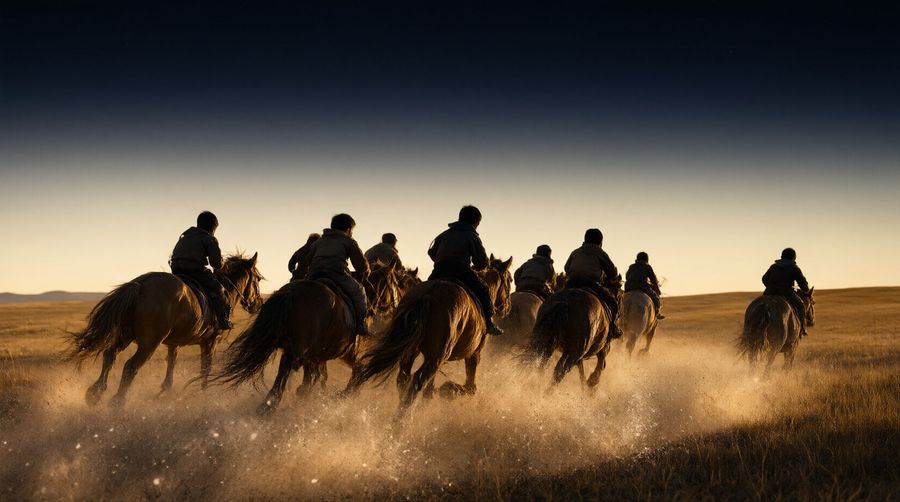
At Naadam, you are watching competition stripped to its essentials. State Naadam wrestling is a knockout bracket of several hundred wrestlers with no weight classes — as NYU's Institute for the Study of the Ancient World confirmed in 2015, there are no age limits or weight divisions, so a small man can face someone twice his weight. The overall champion earns the title Avarga ("Titan"). The horse races run cross-country over long open-steppe courses, ridden by child jockeys — and here is the detail that changes how you watch: the crowd's praise goes to the horse, its bloodline and training, and the family that raised it, not the rider. When spectators sing to the finishing horses, they are honoring an animal and a household.
At the Golden Eagle Festival, you are watching trust being scored. The hunters parade on horseback in traditional Kazakh dress, eagles on their right arms, and judges assess the eagle-to-lure bond trials alongside clothing, horse ornaments, archery and agility. Between trials come Kyz Kuar (a chasing game on horseback), Kykbar (horseback tug-of-war over a goat skin), coin-grabbing from the saddle, races and a Kazakh concert. And one thing is worth knowing before you go: no hunting takes place. In the festival's competitions the eagles fly to a dragged stuffed lure, not live prey. A fast, willing flight back to the hunter's arm is what the crowd reads as proof of years of daily trust — the SIT Graduate Institute's 2016 study of Kazakh falconry in Bayan-Ulgii documents the working tradition behind what the festival displays.
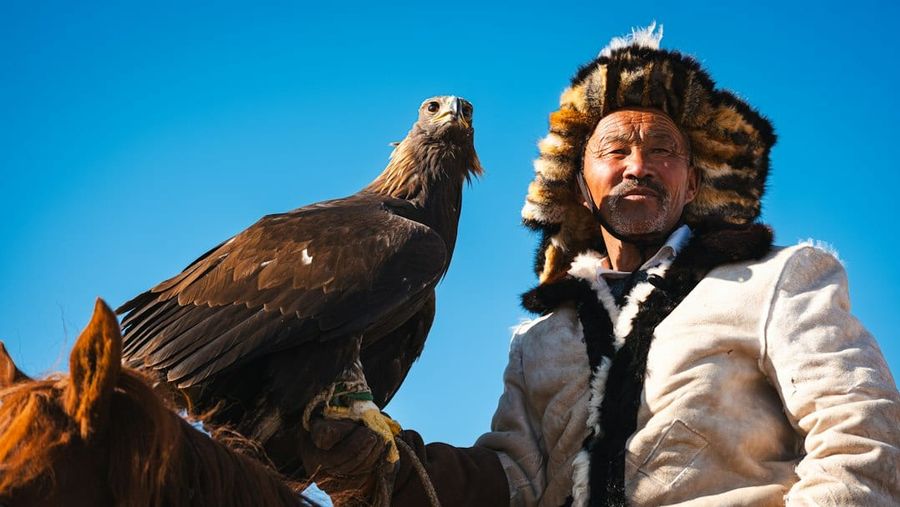
There is one more layer worth knowing before you go. Kazakh berkutchi (eagle hunters) work with wild-caught female golden eagles — larger and more adept hunters, as our own cultural guide to the festival explains, drawing on that research. Eagle handling and capture in Mongolia is subject to local permits, and our visits are arranged with the families themselves. The partnership is temporary by design: the eagle is worked for a span of years and then released back to the cliffs to breed. You are not watching a man and his possession. You are watching a wild partner who will return to the wild — which reframes every flight you see.
What does each festival mean to the people celebrating it?
Naadam is not one festival. It is hundreds. The State Naadam opens in Ulaanbaatar on July 11, but by our team's account, provinces and soums (districts) across the country hold their own Naadams — sometimes on different dates, chosen around local anniversaries, pasture and the condition of the animals. A village Naadam is a homecoming: families who scattered to summer pastures gather, wrestlers compete for local pride, and the races honor horses everyone knows by lineage. For the people there, it is the year's clearest statement of who they are. We go deeper into the games and their local meaning in our guide to Naadam's Three Manly Games.
The eagle festival means something similar at a smaller radius. In Bayan-Ulgii, with Ulgii city as its cultural hub, the festival is where a dispersed community of hunters compares craft, dresses its horses and children in their finest, and hears its own music played loudly in public. When a hunter's eagle hesitates on the lure and the crowd groans, that is neighbors judging a neighbor's year of patient work — not performers missing a cue. In our experience these are celebrations that exist for their own people first; visitors are welcome guests at something that would happen whether or not anyone came to watch.
That is also why we build our festival journeys around homes, not just grandstands. On our Golden Eagle Festival & Central Mongolia journey, guests meet eagle hunters at home in Ulgii and spend time with a nomadic Kazakh family during the festival itself. The morning tea inside a family's home tells you more about what the weekend means than any single flight to the lure.
What does each festival ask of you as a visitor?
Naadam asks for stamina and good humor in summer heat and big crowds. July in the capital is loud, dense and joyful; the stadium ceremony draws the largest gatherings, while countryside Naadams unfold on open community grounds where spectators are generally welcome. If you draw energy from being one face in a celebrating nation — if you want your children to see a whole country at play — Naadam rewards you.
The eagle festival asks for patience and warm layers. October in the Altai is cold, the gatherings are smaller, and the drama arrives in bursts: a long wait along the ridge, then seconds of an eagle crossing the valley floor. You stand outdoors for long stretches; you watch hunters greet each other and prepare birds at close range. If you are the traveler who will happily wait an hour for one perfect moment — camera or no camera — this is your festival.
A few honest fits, from the questions travelers actually ask us:
- Families: both work — see the FAQ below for age and weather considerations.
- Photography-minded nature lovers: the eagle festival gives you fewer subjects but far closer access — dress, horse ornaments, the eagle's hooded calm, mountains behind everything. Naadam gives you volume and motion: dust, finishing horses, a wrestler's leap.
- Travelers wanting family-level intimacy: the Altai wins, almost by design. Smaller crowds, a host family, conversations instead of announcements. If even Naadam's scale feels like too much, see the FAQ below.
Naadam vs Golden Eagle Festival: how do they compare culturally?
Here is the head-to-head on meaning and participation only — the dimensions that decide which celebration fits you. Both sit within the wider range of things to do in Mongolia, and neither is a show staged for visitors.
| Cultural dimension | Naadam | Golden Eagle Festival |
|---|---|---|
| Season | Mid-July (traditionally July 11–13 for the State Naadam, dates confirmed annually); summer warmth | Two days each October, announced year by year; Altai autumn cold |
| Whose celebration | Nationwide Mongolian holiday — the capital, provinces and soums across the country | Kazakh community of Bayan-Ulgii, centered near Ulgii |
| Setting | Stadium ceremony in Ulaanbaatar; open community grounds in the countryside | Competition grounds in the Altai foothills just outside Ulgii town (venue confirmed each year) |
| Scale | The capital's biggest public celebration of the year; local Naadams run nationwide through July | Dozens of competing hunters; smaller, closer crowds |
| What you witness | Wrestling, cross-country horse racing, archery, ankle shooting | Eagle-to-lure bond trials, Kazakh dress and horse ornaments, Kyz Kuar, Kykbar, concert |
| The heart of it | Skills of herding and warrior life; praise for the horse and its family | Years of trust between hunter and a wild female eagle |
| Your role as a visitor | Welcome spectator on open grounds; ticketed stadium ceremony | Welcome spectator along the ridge at a genuine community competition |
How do you attend either one respectfully?
The reassuring news: our pre-departure rules are the same at both festivals. Learn them once and you are a welcome guest in July or October.
- Stay out of the competition space — the wrestling circle, the race finish, and above all the eagle's flight path.
- Ask before close-up photos, especially of an eagle hunter's family or a child jockey.
- Give eagles a working radius. A hooded bird is calm, not tame; never reach toward one.
- Never interrupt greetings or preparation. The snuff-bottle exchanges and the settling of a bird on the arm are part of the event, not delays before it.
- Accept offered tea and food with thanks, even a sip and a bite.
- Receive a snuff bottle with your right hand — a small gesture locals notice immediately.
One mindset, two festivals
In our experience, the respectful-visitor mindset matters more than which celebration you pick. Both communities can tell the difference between a guest watching their life and an audience consuming a show — and both open up warmly to the former.
So which one should you choose?
Choose Naadam if you want to feel a whole country celebrating in July and are happy with crowds; choose the Golden Eagle Festival if you want a small Kazakh community event in October, close access and patience over spectacle. For a first trip with children, July's Naadam is usually the easier fit. You can't choose wrong — you can only choose differently. If you want to feel Mongolia as a whole, come in July and let Naadam's nationwide energy carry you; our Wonders of July Naadam journey is built around exactly that. If you want one relationship, one family, one valley in the Altai, come in October and let the eagle festival slow you down. Neither is a performance put on for you, and that is precisely why both are worth the trip.
Can children really enjoy both festivals?
Both festivals work well for families, provided the children are comfortable outdoors for long stretches. At the eagle festival, bring proper cold-weather layers and plan shorter viewing blocks for younger children, keep to the spectator edges, and make sure children are comfortable with noise and large animals. Naadam offers a nationwide summer celebration kids can join at ground level in the countryside.
Is any hunting involved at the Golden Eagle Festival?
No. In the festival's competitions the eagles fly to a dragged stuffed lure, not live prey. Judges score the bond between eagle and hunter — the speed and willingness of the bird's flight — alongside dress, horse ornaments, archery and agility.
Do I need a ticket to watch Naadam?
The State Naadam stadium ceremony in Ulaanbaatar is a separate ticketed event. Countryside Naadams are community events on open grounds where spectators are generally welcome. In our experience, the countryside Naadams are where you feel the holiday most directly.
Are the festival dates fixed?
The State Naadam is traditionally held July 11–13 (dates confirmed annually). The main Golden Eagle Festival runs two days each October, with exact dates announced year by year, plus smaller community eagle gatherings earlier in the autumn, announced locally each year — so an October trip is planned around those announcements.
What if crowds aren't my thing at all?
The eagle festival is the naturally quieter choice. And for Naadam's games without the stadium scale, we arrange a private Mini Naadam for our tour groups on reservation — wrestling, horse racing, archery and folklore performances at conversational scale.
Whichever celebration is calling you, we would love to help you hear it clearly. Our women-led local team has been designing festival journeys for over ten years, with 24-hour trip assistance throughout — plan your trip with us or message us on WhatsApp, and tell us which part of Mongolia you want to feel.
