


By the Mongolianstar Adventures Festival & Culture Team · Updated November 6, 2026
The Naadam festival in Mongolia is the country's national holiday, falling on 11–13 July and built around Eriin Gurvan Naadam — the "Three Manly Games" of wrestling, horse racing and archery. The State Naadam in Ulaanbaatar is the biggest version, but all 21 provinces and 333 soums (districts) hold their own. We're a local team that has built journeys around this festival for over ten years, and the thing we most want you to understand before you take a seat in the stadium: you are not watching a show put on for visitors. You are watching Mongolians celebrate their own holiday — and once you know what each game means, the crowd's reactions start to make sense.
Naadam at a glance
- What: Eriin Gurvan Naadam, the "Three Manly Games" — wrestling, horse racing, archery — plus ankle shooting.
- When: July 11–13 nationally; some provinces and soums celebrate on different dates.
- Where: Everywhere. The State Naadam in Ulaanbaatar gathers the strongest competitors; every province and soum holds its own.
- Wrestling: A knockout bracket of several hundred wrestlers, no weight classes, no time limits; the champion earns the title Avarga (Titan).
- Racing: Long cross-country courses ridden by child jockeys; the horse is the star.
- Archery: Men and women both compete with traditional Mongolian bows.
Naadam Festival Mongolia: what is it, and why does it matter to Mongolians?
Naadam is a national holiday built around three traditional sports — wrestling, horse racing and archery — that test the skills Mongolian life has always demanded: strength, horsemanship and a steady aim. The games are traditionally traced back to the time of Genghis Khan, when warriors are said to have competed to show their strength and skill; today Naadam is the biggest celebration in the country.
The name itself tells you what to expect. Eriin Gurvan Naadam translates as the "Three Manly Games," though the modern festival is broader than the name suggests — women compete in archery, and girls ride as jockeys alongside boys. A fourth contest, ankle shooting, also sits on the program beside the three main games.
The festival opens with a colorful parade of athletes, monks, soldiers and musicians — a deliberate picture of the whole society, not just its sportspeople. Mounted riders carry tall standards topped with golden tridents and white horsehair tassels, which are among the most recognisable images of the opening ceremony. When you see the crowd's attention shift from the field to the procession, that's the moment: the games are about to begin, but the ceremony comes first.
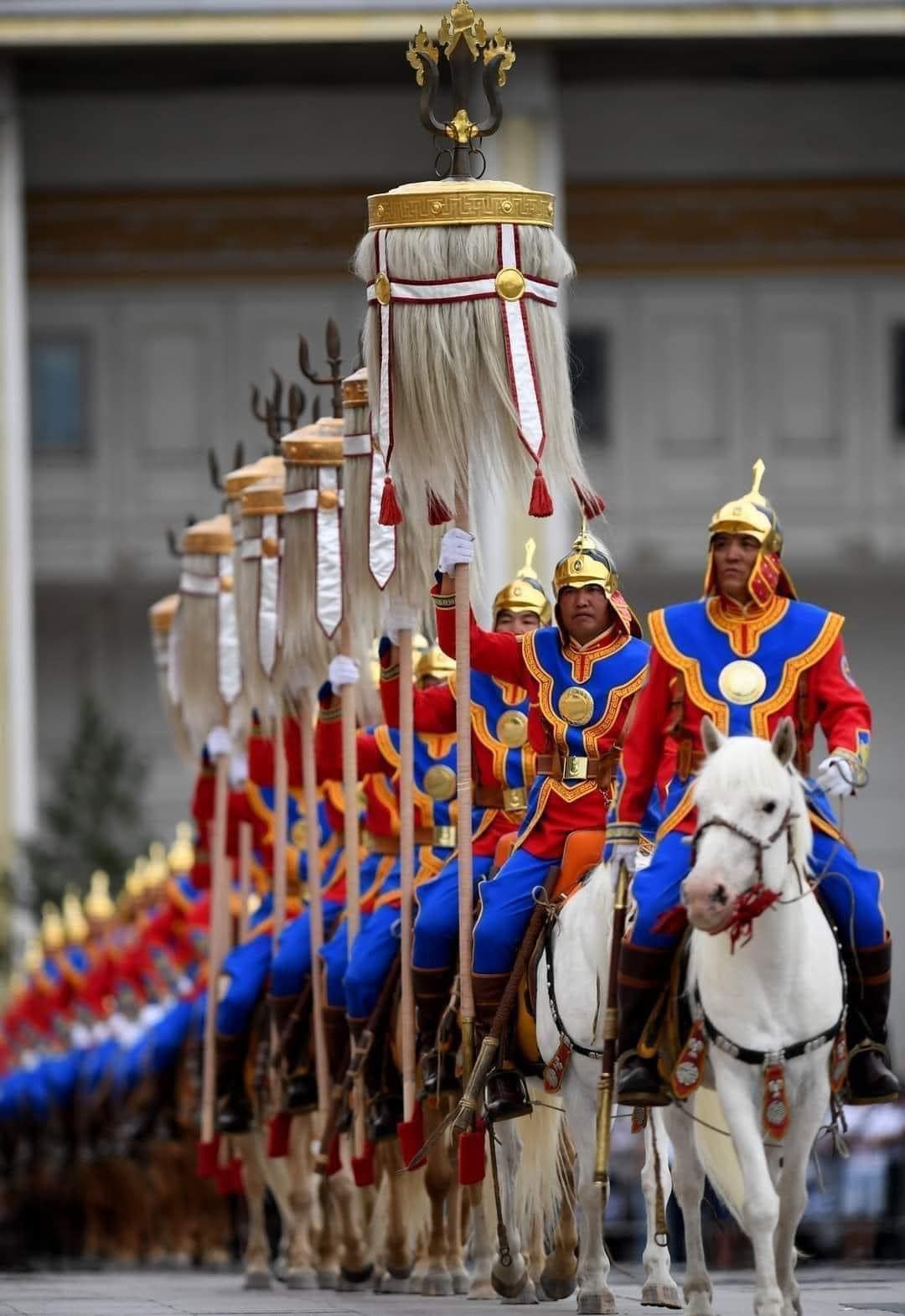
Look around the stands, too. Families arrive in their brightest deel (the traditional long robe), and people who own horses bring their most beautiful ones to be seen. That framing changes how you watch: the wrestlers on the grass are competing for their province, their family and their own name.
What am I actually watching in Mongolian wrestling?
You're watching an open-weight knockout tournament where a bout ends the instant one wrestler's back, knee or elbow touches the ground — nothing else stops it. The State Naadam fields a knockout bracket of several hundred wrestlers, and according to NYU's Institute for the Study of the Ancient World, Mongolian-style wrestling at the main national tournament has no weight classes, no time limits and no ring boundaries. A small man can throw a giant. A bout can end in two seconds or grind on until someone's balance finally breaks.
That rule set explains almost everything the crowd reacts to:
- The grip-fighting. Wrestlers wear a small open-front jacket and briefs with sturdy boots, so there is cloth and leather to grab but no uniform sleeves to control. Much of a bout is a patient battle for grips — the sudden roar usually means someone has finally secured the hold they wanted.
- The stillness, then the explosion. With no clock, neither man is forced to engage. Long circling standoffs are normal, not boring — locals read them as each wrestler testing the other's balance and patience.
- The touch of the ground. There is no pin and no count. A knee brushes the grass and the bout is over, which is why finishes can look abrupt to first-time viewers. Watch the loser's knee, not the winner's face.
- The slow, wide-armed movements between bouts. Winners move around the field with deliberate, soaring arm gestures before returning to their corner — part of the sport's ritual language, and worth watching as closely as the throws themselves.
What does the title Avarga mean?
Avarga means "Titan": it is the title given to the overall winner of the State Naadam wrestling tournament. It is the summit of the sport: out of a field of several hundred men, one walks away with the word that Mongolians will attach to his name for the rest of his life. Wrestling is a game travelers often ask us about, and when the final bout ends, the stadium's reaction is closer to a national result than a sporting one. If you remember one thing to watch for, it's this: every earlier round is elimination, but the last match decides who the country will call Titan.
Watch like a local
- Follow the grips, not the faces — the bout is usually decided when one man wins the hand-fight.
- A finish can come from a single knee touching down; don't wait for a dramatic slam.
- Give the between-bout arm movements your attention — they're ceremony, not showing off.
Why do children ride in Naadam horse racing?
Because in Mongolian racing culture the contest belongs to the horse — light, experienced young riders let the horse do what it was bred and trained to do. At the State Naadam the races are run in several categories by horse age, ridden by young jockeys — children who have grown up on horseback — and these are not lap races: our Wonders of July — Naadam Festival journey page describes long-distance courses across open country of up to 30 kilometers.
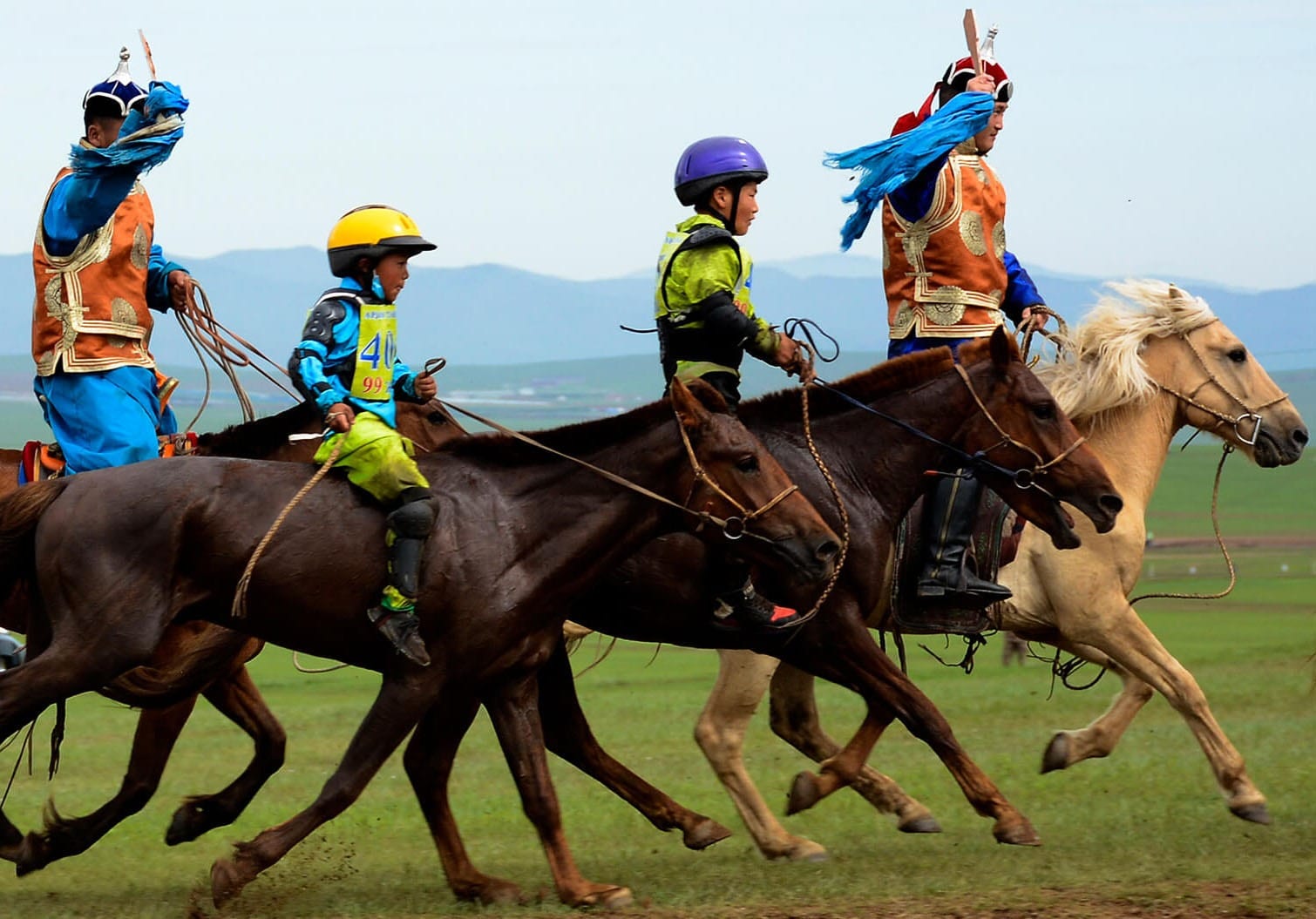
Here is the perspective shift that matters most for a visitor. In most Western racing, the trophy goes to connections and the applause goes to the jockey. At Naadam, as we explain it to our travelers, the admiration flows to the animal — its bloodline, its training, its heart over a long cross-country course — and to the family and region behind it. The child on its back is respected as a skilled partner, not treated as the champion. When you hear the crowd erupt at the finish, they are cheering a horse.
This is also why the races feel different to watch. There is no visible track for most of the course; the field simply appears on the horizon as dust and then thunder. Families position themselves near the finish, and the minutes before the horses arrive — everyone standing, scanning the steppe — are part of the experience. Racing sits at the center of a horse culture that runs through the whole holiday; you can see how it connects to the wider landscape of things to do in Mongolia, from riding the steppe yourself to visiting herding families whose year revolves around their animals.
If the idea of young jockeys gives you pause, that's a fair reaction to have — it's a question travelers often ask us. We share the cultural context, not a judgement on the sport's safety rules. What we can tell you is what the sport is: a centuries-shaped partnership between children who grow up on horseback and horses bred for distance, judged as one unit. Watching it with that context is very different from watching it without.
What happens in Naadam archery — and do women really compete?
Yes — both men and women compete in Naadam archery, shooting traditional Mongolian bows, and it is the calmest and most quietly tense of the three games. Where wrestling roars and racing thunders, archery is watched almost in held breath.
The rhythm is unhurried: archers take their turns in sequence, and the crowd tracks every arrow's flight toward the targets down the range. Results are announced back to the stands, and the applause — or the groan — tells you how each end went. The appeal for locals is precision under social pressure: an archer represents a club, a workplace, a province, and everyone watching knows exactly which arrow mattered.
Women's participation is not a side exhibition — women's archery is part of the competition program itself, and it has its own committed following — the results are announced and cheered just as the men's are. It's one of the clearest places where the festival's old name ("Three Manly Games") lags behind its living reality.
There is also a fourth traditional contest worth knowing about: ankle shooting, which sits on the program beside the three main games. It has a smaller, specialist following of its own.
Stadium or countryside — which Naadam should I see?
Both, if you can: the State Naadam in Ulaanbaatar shows you the games at their highest level, while a provincial or soum Naadam shows you what the holiday means inside ordinary community life. The official celebration runs throughout the country, and all 21 provinces and 333 soums hold their own festivals — the capital's version simply involves the widest range and most outstanding competitors.
| State Naadam (Ulaanbaatar) | Provincial & soum Naadam | |
|---|---|---|
| Scale | The biggest — a bracket of several hundred wrestlers, several racing categories | Local fields of wrestlers, archers and racehorses |
| Competitors | The country's most outstanding | Community members, often known personally by the crowd |
| Atmosphere | National ceremony, full stadium, formal opening parade | The games sit inside a community gathering |
| Dates | The national July celebration | Often different dates, chosen locally |
Those different local dates are not random. Some provinces and soums schedule their Naadam around anniversaries, pastureland and the condition of their animals — and deliberately so their local wrestlers, archers and racehorses can also travel to compete in the big Ulaanbaatar competitions. The calendar bends around the herding year, which tells you again whose holiday this is.
At a countryside Naadam the distance between spectator and participant nearly disappears. The wrestler you watched in the morning may be serving tea in the afternoon; the racehorses belong to families camped nearby. For many travelers this is the version they remember — not because it is more "authentic" in some staged sense, but because it is simply the holiday happening at community scale, with you welcome at the edge of it.
How do I attend either one respectfully?
The good news: being a respectful guest at Naadam is mostly ordinary courtesy, done with attention. Concrete habits we share with our own travelers:
- Ask before close-up photos of people — a wrestler resting between bouts, a jockey's family, an archer mid-preparation. A smile and a gesture toward your camera is usually enough; accept a "no" gracefully.
- Stay out of competition space. The wrestling field, the archery range and the race finish are working areas, not photo backdrops. Watch from where locals watch.
- Let ceremony finish before you move. During the opening parade and formal moments, stay seated or standing with the crowd rather than walking the aisles for a better angle.
- Dress modestly and comfortably — you'll be outdoors in July sun for hours. Wearing something in the spirit of the occasion is welcome; treating traditional dress as a costume joke is not.
- Cheer with the crowd, not at the competitors. Applause for a good throw or a brave horse is shared joy; mocking a losing wrestler or a fallen jockey lands badly.
- At a local Naadam, follow your host's lead on where to sit, when to eat and how to greet elders — the etiquette of a ger visit applies to the festival grounds around it.
A gentler first taste: a private Mini Naadam
For travelers who want to understand the games before facing a full stadium, we arrange a private Mini Naadam for our tour groups on reservation — Mongolian folklore performances together with wrestling, horse racing and archery at a scale where you can ask questions between events. You see all three games at close range, with a guide explaining each bout and each end of archery as it happens — so the stadium version makes sense when you get there.
FAQ
When is Naadam held in Mongolia?
The national holiday falls on 11–13 July, with the State Naadam opening in Ulaanbaatar on 11 July; local festivals may run on other dates. All 21 provinces and 333 soums also celebrate locally, and some choose different dates based on anniversaries, pastureland and animal conditions — so a July trip can catch more than one Naadam.
What are the Three Manly Games?
They are wrestling, horse racing and archery — together called Eriin Gurvan Naadam, the "Three Manly Games." Despite the name, women compete in archery and girls ride as jockeys, and a fourth contest, ankle shooting, is also part of the program.
What does the title Avarga mean?
Avarga means "Titan": it is the title given to the overall winner of the State Naadam wrestling tournament.
Is Naadam staged for tourists?
No — it is Mongolia's national holiday, which Mongolians celebrate by competing in and watching traditional sports. Visitors are welcome spectators at a real community event, which is exactly why attending with basic etiquette matters.
Why are the horse-race jockeys children?
Mongolian racing honors the horse over long cross-country courses of up to 30 kilometers, and light young riders — children who have grown up on horseback — are the horse's partners in that test. The crowd's praise goes to the animal, its training and the family behind it.
Can I see Naadam outside Ulaanbaatar?
Yes — every province and soum holds its own Naadam, often on different dates, with local wrestlers, archers and racehorses. Countryside festivals are smaller and more personal, and many travelers find them the more memorable way to meet the holiday.
If you'd like to watch the Three Manly Games with someone beside you who can explain every roar of the crowd, our women-led local team would love to design that journey — our Wonders of July — Naadam Festival journey is built around exactly this, with 24-hour trip assistance throughout. Tell us what you're curious about and we'll shape the rest: plan my trip.

