


By the Mongolianstar Adventures Festival & Culture Team — the local team that operates our Central Mongolia and festival departures · Updated October 30, 2026
Erdene Zuu Monastery ("Hundred Treasures") stands beside Kharkhorin in Central Mongolia, founded in 1586 by Abatai Qan with materials taken from the ruins of Karakorum, the Mongol Empire's capital. It was closed during the twentieth-century purges, reopened as an active monastery in 1990, and today it is two things at once: a preserved monument and a working house of worship. We bring travelers here because it explains the country around it — the festivals, the family camps, the steppe itself all make more sense once you have stood inside these walls.
Erdene Zuu at a glance
- Founded 1586 by Abatai Qan, built partly from the stones of ruined Karakorum
- Sits within the Orkhon Valley, a UNESCO World Heritage cultural landscape
- Closed during the communist-era purges; reopened as a monastery in 1990
- Both a heritage site and an active place of Buddhist practice — visit as a guest, not a spectator
- The Karakorum Museum stands beside it, holding artifacts excavated from the imperial city's ruins
Is Erdene Zuu still an active Buddhist monastery?
Yes. Erdene Zuu has been a working Buddhist monastery again since 1990, while also being preserved as a heritage monument — some halls hold daily worship, others are museum spaces.
Why did a monastery rise beside the ruins of an empire?
Because that was the point. When Abatai Qan founded Erdene Zuu in 1586, he built it deliberately beside — and partly from — Qar-a Qorum, the capital the Mongol Empire had raised in the thirteenth century, as documented in Agata Bareja-Starzyńska's study of the monastery (University of Warsaw, 2013). The architecture blends Mongolian and Tibetan styles, and the location carries the message: a Mongolian ruler adopting Tibetan Buddhism chose to anchor it at the very seat of Chinggisid power.
Think about what that means as you walk in. Karakorum had been the administrative heart of the largest contiguous land empire in history; by the late sixteenth century its palaces were ruins under grass. Building a monastery there was not nostalgia — it was a claim. The new faith and the old dynasty were being woven together in one place, stone by reused stone. Some of the stone you walk past is older than the monastery itself — reused from the imperial city that stood here first.
This is also why Erdene Zuu reads differently from other monasteries you may visit in Mongolia. It was never simply a remote retreat. It was a statement about who Mongolians were after the empire — and that question, answered again in each century since, is the thread running through everything you will see here.
What did Erdene Zuu survive?
More than most buildings should have to. In the twentieth century, Mongolia's socialist government moved against Buddhist institutions with a severity that is hard to absorb. According to the Oxford Research Encyclopedia of Religion (2017), the monastic community was cut back sharply through the 1920s and the purges of the late 1930s struck the monasteries directly. Scholars' estimates of the scale differ widely, so we quote no single figure here. This was not a policy of closing doors. Monastic Buddhism in Mongolia was nearly erased — its scholars, its lineages, most of its buildings.
Erdene Zuu lost nearly everything. Only a handful of its temple buildings endured, and for decades the site functioned as a museum rather than a monastery — preserved, in part, precisely because it had been emptied of religious life. When you stand in the quiet courtyard today, it is worth holding both facts at once: the walls survived, and the community that gave them meaning was destroyed.
We say this plainly because visitors deserve the truth of the place, not a softened version. But the second half of the story matters just as much, and it is the half most travelers never hear.
How did Buddhism come back after 1990?
Through people, not decrees. When Mongolia transitioned to democracy and religious freedom returned, Erdene Zuu reopened as an active monastery in 1990, part of the first wave of revival documented in the study cited below. A comparative study in Asian and African Studies (2002) records that about 120 monasteries had restarted nationwide by 1994, with further monasteries and temples restored across Mongolia in the years that followed.
What strikes us about that figure is the speed. Within a single decade, communities that had lost their teachers, their texts and their buildings were chanting again. Elders who had practiced in secret taught young monks; families contributed labor and money; damaged halls were repaired and new ones raised. The revival was not a government restoration project with a ribbon-cutting — it was thousands of local decisions to rebuild something that had been taken away.
So when you see a monk in a maroon robe crossing the courtyard, or an elderly woman moving slowly along the wall with her prayer beads, you are not looking at a costume or a continuity that was never broken. You are looking at the result of deliberate rebuilding within living memory. That is the difference between Erdene Zuu and a ruin: the practice came back.
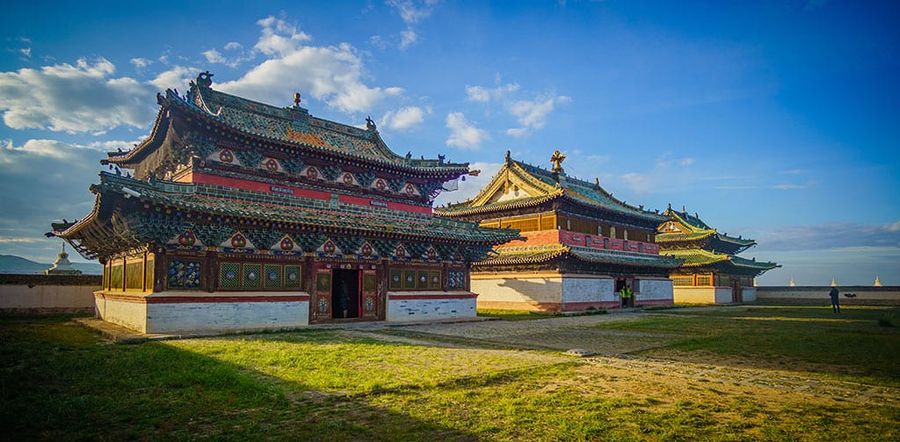
What are you actually looking at inside the walls?
Three layers, superimposed. Read them in order and the site stops being a collection of pretty roofs.
- The stupa wall. The perimeter is lined with white stupas — reliquary monuments, each one an object of devotion in its own right, not decoration. The wall is meant to be walked, clockwise, and you will often share it with worshippers doing exactly that. Walk it yourself and the monastery reveals its angles slowly.
- The surviving temples. A small number of original temple buildings endured the purges. Their tiered roofs and painted timberwork show the Mongolian–Tibetan blend the monastery was founded on. Look for the reused fabric of older Karakorum in the grounds — the imperial city is literally underneath the story.
- The living monastery. Since 1990 this has again been a place where monks practice and laypeople worship: butter lamps, prostrations, murmured recitation, offerings left at altars. Some spaces function primarily as museum exhibits; others are active halls where devotion happens daily. Signage and your guide will indicate which is which — and where signs are absent, treat any hall with lit lamps, cushions or fresh offerings as a place of worship first.
| Place | What it is | What you see | Rough time needed |
|---|---|---|---|
| The stupa wall | Perimeter wall lined with white stupas | Reliquary monuments, walked clockwise alongside worshippers | A slow walk of the full circuit |
| The surviving temples | Original buildings that endured the purges | Tiered roofs, painted timberwork, reused Karakorum stone in the grounds | A few minutes per open building |
| The active worship halls | Working spaces of the monastery since 1990 | Butter lamps, offerings, murmured recitation | A short, quiet visit from the edge |
| The Karakorum Museum | Museum beside the monastery | Artifacts excavated from the thirteenth-century imperial capital | A separate stop added to the monastery visit |
Beside the monastery, the Karakorum Museum holds artifacts from excavations of the imperial capital's ruins — the clearest window into the thirteenth-century city whose stones built the monastery. Our Orkhon Valley travel guide covers how the museum and monastery pair together in a visit, along with pacing and routing for the wider valley.
And zoom out one more layer: Erdene Zuu sits within the Orkhon Valley, inscribed by UNESCO on the World Heritage List as a cultural landscape. The listing recognizes what nomadic and settled Mongolians have long known — that this valley, with its pastures, ruins and living monastery, is one continuous cultural document, not separate attractions.
Monument and monastery at once
The hardest thing for first-time visitors is remembering that the "exhibit" is someone's church. If a ceremony is underway, you are a guest at a service — lower your voice, stay at the edge, and let worship take precedence over your camera.
What does Erdene Zuu mean locally today?
For Mongolians, this is not primarily a tourist site. It is where a severed thread was retied. Families come from across the region to make offerings, to have a monk read for a sick relative, to walk the wall on an auspicious day. Across Mongolia, the generation that kept its faith in private before 1990 is now the grandparents' generation — the revival described in the sources below happened within living memory.
That layered meaning is why we treat Erdene Zuu as the threshold into Mongolia's story rather than one stop among many. Understand the monastery and the rest of the country stops being scenery and starts being a narrative you can follow. It is the same reason our journeys through Central Mongolia keep returning to the Orkhon Valley: the landscape and the history are inseparable here.
There is also a quieter local meaning worth noticing. Watch who visits, and when. A grandmother circling the wall at dawn and a school group arriving at midday are using the same site for different purposes, and both belong. A respectful visitor slots into that rhythm rather than interrupting it.
How do you visit respectfully?
None of this is complicated, and no one expects you to know Mongolian Buddhist customs in advance. What matters is visible attentiveness. Concretely:
- Walk the circumambulation clockwise — around the wall and around stupas, keeping them to your right. If you lose track, follow the direction the worshippers around you are moving.
- Ask before photographing people. Monks, worshippers, ceremonies: ask first, accept a refusal gracefully, and never photograph someone mid-prostration. Architecture and landscape are generally fine; faces and rituals call for permission first.
- Dress modestly inside halls — shoulders and knees covered, hats off. Step over thresholds rather than standing on them, a courtesy shared with ger etiquette across Mongolia.
- Keep voices low and phones silent in worship halls. If chanting or a reading is underway, stay near the entrance and do not cross between worshippers and the altar.
- Don't touch ritual objects — lamps, offerings, bells, texts — unless invited. Move around seated worshippers rather than in front of them.
- Follow your guide's lead on which halls are open to visitors that day; access changes with the monastic calendar, so a closed door simply means that hall is in use — your guide will find you another way to see the site.
The simplest rule
Behave as you would in a cathedral during Mass — because functionally, that is where you are. Curiosity is welcome; treating worship as a photo opportunity is not.
If you are unsure about anything, ask. In our experience guiding visitors through Mongolia's sacred sites, a sincere question is received far more warmly than confident rule-breaking — people here are glad you want to understand.
Visiting Erdene Zuu Monastery: getting there and practical notes
Erdene Zuu stands beside Kharkhorin in the Orkhon Valley, Central Mongolia — an overland journey from Ulaanbaatar that we build into multi-day itineraries rather than a day trip. Leave time for both layers of the site: the stupa wall and the surviving temples inside the walls, and the Karakorum Museum beside them. Entry fees, opening hours and hall access change with the monastic calendar; we confirm them for you before your visit.
Is Erdene Zuu the oldest monastery in Mongolia?
Founded in 1586 beside the ruins of Karakorum, Erdene Zuu is one of Mongolia's oldest surviving Buddhist monasteries. Earlier monasteries existed, but Erdene Zuu is the great survivor — its surviving original buildings and the return of worship in 1990 make it a rare place where Mongolia's imperial and Buddhist histories overlap.
Can visitors attend prayers or ceremonies?
Visitors are generally welcome to observe quietly from the edge of a hall when services are happening, though access varies with the monastic calendar and your guide will know what is open that day. Stay silent, keep phones away, and leave if asked — observation is a courtesy extended to guests, not a scheduled show.
What is the difference between Erdene Zuu and the Karakorum Museum?
Erdene Zuu is the monastery itself — walls, stupas, surviving temples and active worship halls. The Karakorum Museum beside it displays artifacts excavated from the ruins of the thirteenth-century imperial capital. Together they cover both layers of the site: the empire underneath and the Buddhist centuries above.
Do I need to be Buddhist to visit?
No. Erdene Zuu welcomes respectful visitors of any background, and worship and visitors have shared the site since it reopened as a monastery in 1990. What is expected is conduct, not belief: clockwise walking, modest dress, quiet voices and asking before photographing people.
Where Erdene Zuu fits in a journey
Our Golden Eagle Festival & Central Mongolia journey makes Erdene Zuu its first heritage anchor in the Orkhon Valley — paired with the Karakorum Museum — before the route turns west toward the Altai and the Kazakh eagle hunters. We sequence it that way on purpose: begin with the place where Mongolia's story of empire, loss and revival is written in stone, and every festival ground and family camp that follows lands with deeper meaning. For how the days flow and what the routing looks like, our Central Mongolia itinerary guide has the practical detail.
Stand inside the story
If you'd like to walk the stupa wall with a team that knows what it means — women-led, local, with over ten years of guiding Mongolia and 24-hour trip assistance on every departure — tell us what you're curious about and we'll shape the journey around it.
Plan my tripSources
- Agata Bareja-Starzyńska, Description of the Erdene Zuu Monastery Life (including čam) Based on Notes by Kotwicz, University of Warsaw (2013)
- Mongolian Buddhism in the Early 20th Century, Oxford Research Encyclopedia of Religion (2017)
- The Revival of Tibetan Buddhism in Inner Asia: A Comparative Perspective, Asian and African Studies, hosted by Case Western Reserve University (2002)