


By the Mongolianstar Adventures Festival & Culture Team · Updated October 19, 2026
Bayan-Ulgii (also written Bayan Ulgii), Mongolia's far-western province in the Altai Mountains, is home to a Kazakh-speaking Mongolian community with its own language, customs and craft traditions — and most of what you'll meet there has nothing to do with eagles. The music around a family table, the embroidery on a ger wall, the pace of a household's day: that is the culture travelers actually spend time with. We run festival journeys through this region every autumn, and for us the point of going west is the time inside a family's home — the pace of a household's day, the craft on the wall, the talk around the table.
This guide covers that broader culture of Ulgii and the Altai. For the eagle-hunting tradition and the festival itself, we've written a separate guide to what you're watching at the Golden Eagle Festival — here, we stay with the people.
Bayan Ulgii at a glance: what is it known for?
Bayan-Ulgii is Mongolia's far-western province in the Altai Mountains, known for its Kazakh-speaking community, golden eagle hunting, dombra music, and Kazakh felt and embroidery craft.
- Where: the far west of Mongolia, in the Altai Mountains; the provincial capital is Ulgii City, described in our Western Mongolia region guide as the region's cultural hub.
- Who: Mongolians of Kazakh heritage, whose everyday language at home is Kazakh rather than Mongolian.
- Best known for: eagle hunting and the Golden Eagle Festival — see our festival guide.
- Music and craft: the dombra (two-stringed lute) and song; the tus kiiz wall hanging and the tekemet and syrmak felt rugs documented by the Smithsonian Center for Folklife and Cultural Heritage in Kazakhstan.
- When we go: autumn, when our Golden Eagle Festival journeys run through the region.
Key points
- Bayan-Ulgii's Kazakhs are a contemporary Mongolian community — Kazakh language and distinct customs within modern Mongolian life, not a preserved past.
- The dombra (two-stringed lute) and song carry story and memory at family gatherings; listening well matters more than filming well.
- Kazakh textile work — embroidered wall hangings and felt rugs — furnishes the home and passes between generations of women.
- A family stay works best as participation: helping with chores when invited and following your host's lead.
Who are Bayan-Ulgii's Kazakhs?
They are Mongolians of Kazakh heritage — a community whose everyday language at home is Kazakh rather than Mongolian, with customs, music and craft traditions of their own. In Ulgii City, the provincial capital, that heritage is part of ordinary civic life: our Western Mongolia region guide describes it as the cultural hub where Kazakh culture comes alive through local markets and museums, alongside the eagle training the region is famous for.
It helps to know that Mongolia is not culturally uniform. Most of the country belongs to the Khalkha Mongolian majority, whose language, Buddhist-influenced traditions and festivals like Naadam shape the image of Mongolia most travelers arrive with. Bayan-Ulgii's Kazakh community follows a different thread of tradition — Kazakh-speaking and Muslim in faith — and neither culture is a "more authentic" version of Mongolia. They are two living ways of being Mongolian.
And living is the word we'd underline. The families we visit in Ulgii send children to school, follow the news, use smartphones and argue about football like anyone else. Some keep livestock and move with the seasons; some live in town. The embroidery and the dombra are not performances staged for visitors — they are things people genuinely do, woven into a contemporary life. Come expecting neighbors, not a museum.

What does the dombra carry at a Kazakh gathering?
The dombra — a long-necked, two-stringed lute — is the instrument most closely associated with Kazakh music, and in family settings it typically accompanies song rather than standing alone as a concert. Kazakh musical tradition places great weight on the voice and the words: pieces and songs passed down orally, carrying stories, history and a sense of who a family and a people are.
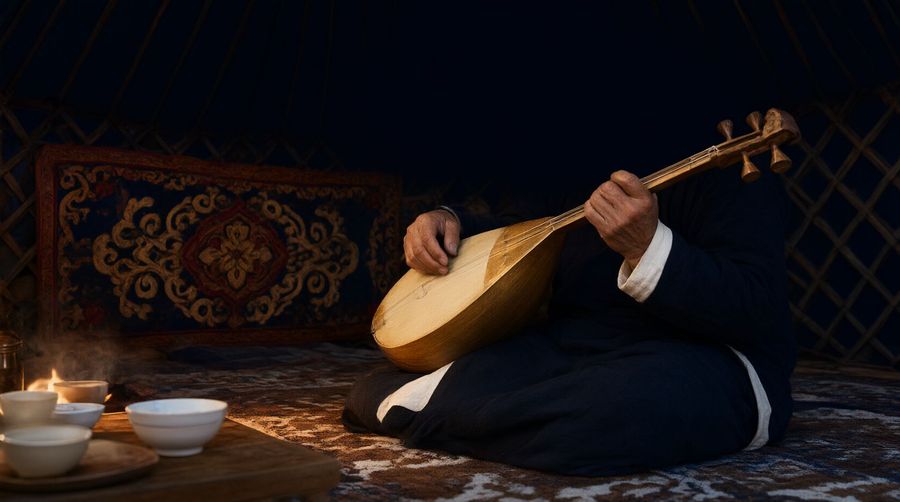
When might a guest hear it? Not on a schedule. Music at a Kazakh gathering tends to surface naturally — after a meal has settled, when conversation warms, when an elder or a teenager feels like picking up the instrument. It may be one song or an hour of them. Treat it as you would a friend singing in their own living room, because that is essentially what it is.
How to listen well:
- Put the phone down first. If you want a recording, ask — and only after the song, not during it.
- Let the song finish. Applause and thanks afterward are welcome; talking over the verse is not.
- Ask what the song was about. Through your guide's translation, this is often the moment the evening opens up — hosts frequently have a story attached to a piece.
- Don't request "something traditional." Let your hosts choose what they want to share; the choice itself tells you something.
A note on expectations
We don't promise music on a family visit. The dombra is part of Kazakh cultural life broadly, but when and how it appears varies by household. Go for the family; if a song comes, treat it as a gift.
What furnishes a Kazakh ger?
Textiles. Across Kazakh households they do much of the work furniture does elsewhere, and this craft tradition is one of the clearest expressions of Kazakh identity a visitor encounters. The Smithsonian Center for Folklife and Cultural Heritage documents the common forms: the tus kiiz (an embroidered wall hanging), the tekemet (a felt rug made by placing and pressing wool) and the syrmak (a stitched felt rug built from mosaic designs). That documentation comes from Kazakhstan rather than Bayan-Ulgii specifically, but it describes the same shared Kazakh craft tradition the Altai families belong to. What hangs in a particular home is that family's story; ask about it.
| Form | What it is | How it is made | Source |
|---|---|---|---|
| tus kiiz | Embroidered wall hanging | Embroidery worked on a hanging for the wall | Smithsonian Folklife — documented in Kazakhstan |
| tekemet | Felt rug | Wool placed and pressed into felt | Smithsonian Folklife — documented in Kazakhstan |
| syrmak | Stitched felt rug | Built from mosaic designs and stitched | Smithsonian Folklife — documented in Kazakhstan |
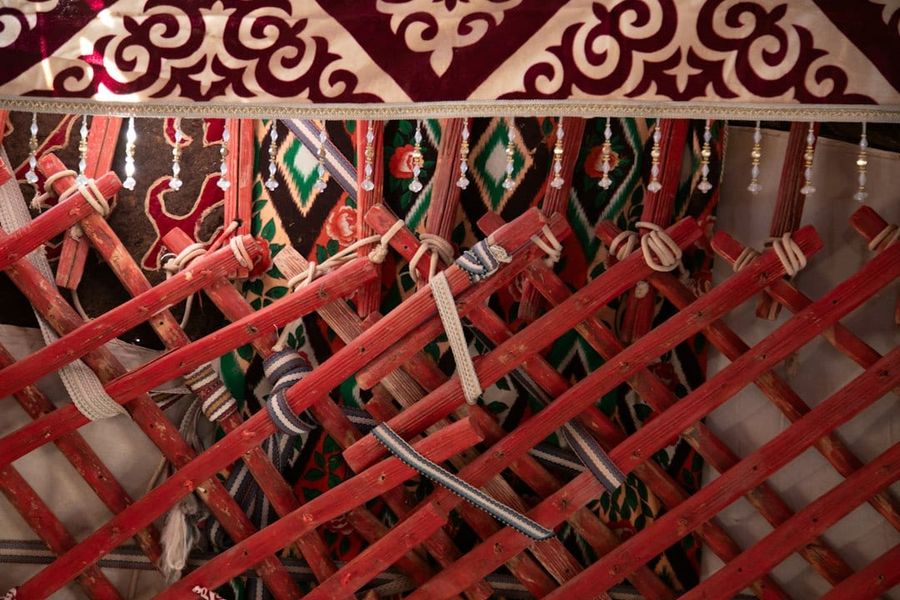
Our Golden Eagle Festival & Central Mongolia journey combines the Altai festival days with central Mongolia's monastery and steppe country. Kazakh textile work is a skill with social standing — the Smithsonian's profile of Kazakh women artisans describes pieces made within families and passed down through generations. We don't catalogue our hosts' homes; ask your host about the piece in front of you. Who made it, when, for what occasion.
The transmission is generational. The Smithsonian's profile of Kazakh women artisans describes felt making and flat weaving taught to the children of a family. Skills move from older women to younger ones inside the household — which is why the wall hanging in front of you may hold three generations of hands.
On pattern meanings, we'll be straight with you: you may read confident claims online about what each motif and color "signifies." We haven't verified those readings, and we won't invent them. What we can honestly suggest is the better question anyway — ask your host about the piece itself. Who made it, when, for what occasion. The answer will be specific to this family, which is worth more than a generic symbol chart.
What does a Kazakh family stay actually involve?
Living alongside a family, not watching one. On the family visits we arrange, guests are welcomed with traditional hospitality and can join in everyday household tasks when invited, following the family's lead rather than a set programme. Nothing is staged; you are joining work that would happen whether you were there or not.
Our Golden Eagle Festival & Golden Gobi journey builds this in directly: guests stay with a Kazakh family in their gers across the two festival days, and an earlier day in Ulgii pairs the local museum and market with a family visit — so you arrive at the homestay already knowing something of the town your hosts trade in. On the Central Mongolia version of the journey, the first family meeting happens in Ulgii, at an eagle hunter's home, before the two-night stay out with a nomadic family.
What participation looks like in practice:
- Say yes to small tasks. Carrying, holding, stirring, fetching — modest help offered sincerely lands better than grand enthusiasm.
- Follow the household's rhythm. Meals, chores and rest happen when the family needs them to; a guest slots in rather than setting the pace.
- Offer to help clear up. Ask where things go rather than assuming — quiet competence reads as respect.
- Let boredom happen. Unhurried hours count too — sitting with tea while the household goes about its evening. That is the stay working, not failing.
We won't pretend to give you a fixed hourly script or a menu — every family's day and table differ, and the honest answer to "what will we eat?" is: what this household eats, offered generously. Arrive curious rather than expectant, and the specifics take care of themselves.
How do you visit respectfully?
With a few concrete habits, most of which are simply good manners anywhere. Before every family visit we brief guests on the same simple habits:
- Follow your host's lead on where to sit, when to eat and how to greet elders. Watch what your hosts do and mirror it; defer to elders in greetings and seating.
- Accept offered tea and food graciously. Refusing outright can read as rejecting the hospitality itself; take a taste with thanks even if you're full.
- Ask before close-up photos of people — including children — and before photographing the inside of a home. Accept a "no" gracefully, without negotiating.
- Dress modestly in homes and in town — shoulders and knees covered is a safe default — and if religious practice is part of the household's day, give it space quietly and let your guide advise on any specifics.
- Don't touch textiles, instruments or family objects without asking. That wall hanging may be a grandmother's work; treat it accordingly.
- Let your guide translate more than words. A good local guide reads the room — when to stay, when to thank and step outside. Trust that reading.
If you'd like the fuller etiquette picture for nomadic homes across Mongolia, our ger etiquette guide covers the shared basics; the Kazakh-specific layer above sits comfortably on top of it.
Do I need to speak Kazakh or Mongolian to visit Bayan-Ulgii?
No. On our journeys your guide interprets during family visits and throughout the day's activities, and hosts are accustomed to guests who share no language. A few words of greeting learned in advance are warmly received, but curiosity and patience communicate more than vocabulary.
Is a Kazakh family stay comfortable for families with children?
For families, a homestay can be a highlight: there are animals to help with, chores to try and often other children to play with across the language gap. Comfort levels vary, so tell us your family's needs when planning and we'll match the arrangement honestly.
Will there definitely be dombra music during our stay?
Not guaranteed — and we don't promise it. Music surfaces naturally in Kazakh family life, but a stay is a visit to a household, not a scheduled performance. Go for the family; let the music be a gift if it comes.
Can I buy embroidery directly from the makers?
Ulgii's markets are a genuine place to look for Kazakh textile work, and buying locally supports the craft economy directly. On a family visit, ask your guide to broach it politely rather than treating a home like a shop — many families are glad to sell or point you to a maker, on their own terms.
How is Kazakh culture in Bayan-Ulgii different from what I'll see elsewhere in Mongolia?
The everyday language, music, textile traditions and household customs differ from those of the Khalkha Mongolian majority you'll meet in central Mongolia. Neither is more "real" — traveling west simply adds a second, equally contemporary Mongolian culture to your trip.
Is the far west "your" Mongolia?
If the reason you're drawn to Mongolia is its people rather than only its landscapes, then yes — Bayan-Ulgii rewards you with a culture you meet at kitchen-table distance, well beyond the festival weekend.. When you're ready to shape a journey around it, our women-led local team — over ten years of designing private trips, with 24-hour assistance throughout — would love to plan it with you.
Meet the Altai's Kazakh families with us
Tell us what you're curious about — music, textiles, family life, the festival, or all of it — and we'll design a private journey that gets you there as a welcome guest.
Plan my trip