


By the Mongolianstar Adventures Festival & Culture Team · Updated November 14, 2026
The core of Mongolian ger etiquette is simple: follow your host's lead on where to sit, when to eat and how to greet elders, accept what is offered with visible appreciation, and ask before taking close-up photos of people. That is the guidance our team gives every traveler before a family visit — and in our experience it covers most of what separates a welcome guest from an awkward one. You do not need to memorize a rulebook to be received warmly in a ger (the round felt dwelling herding families live in); you need a handful of concrete habits and a willingness to watch and copy.
We are a women-led local team that has been arranging nomadic family visits across Mongolia for over ten years, and we know the quiet worry many guests carry: what if I do something rude without knowing? Let us take that weight off first. Your hosts welcome visitors regularly, and a guest who is attentive, unhurried and grateful reads as polite in any culture. The details below help you go from "not rude" to genuinely welcome.
Ger etiquette in brief
- Follow your host's lead — where to sit, when to eat, how to greet elders.
- Accept offered tea and food graciously; a taste taken with thanks matters more than finishing everything.
- Ask before close-up photos of people, and accept a "no" gracefully.
- Treat the home as a home, not an exhibit — join in when invited, stay out of the way when not.
- Understand the working day you are stepping into: this is a livestock household, not a performance.
What are the rules of ger etiquette, and how do I avoid being a rude guest?
The rules that matter most are behavioral, not ceremonial: let your host direct you, receive hospitality with thanks, keep your camera manners gentle, and respect that the ger is a working household. Our team's standing advice to travelers is exactly this — follow the host's lead on where to sit, when to eat and how to greet elders — because it works even when you know nothing else.
Everything else in this guide builds on that principle. A ger visit is not a test you can fail; it is a social encounter, and the same instincts that make you a good guest anywhere — attentiveness, modesty, gratitude — carry most of the distance. Where local custom adds specifics, your host will usually show you rather than expect you to know.
What should I know before entering and moving around inside a ger?
Watch your host at the doorway and inside, and mirror what they do. Two pieces of widely shared traveler guidance are worth knowing in advance, though we present them as common practice rather than rules we can document: many guides to Mongolian customs advise stepping over the raised wooden threshold rather than on it, and travelers often report that guests are seated on one side of the ger while certain places are reserved for elders and honored visitors.
Rather than trying to reconstruct the household's seating map from a blog post, do what we tell our own guests: pause just inside, greet the elders as your host indicates, and take the seat you are offered. The layout of a ger does carry meaning for the family — where people sit reflects age and standing — which is precisely why letting the host place you is both the safest and the most respectful move. If you are unsure whether to move closer to the stove or shift seats, a small questioning gesture toward your host resolves it in seconds.
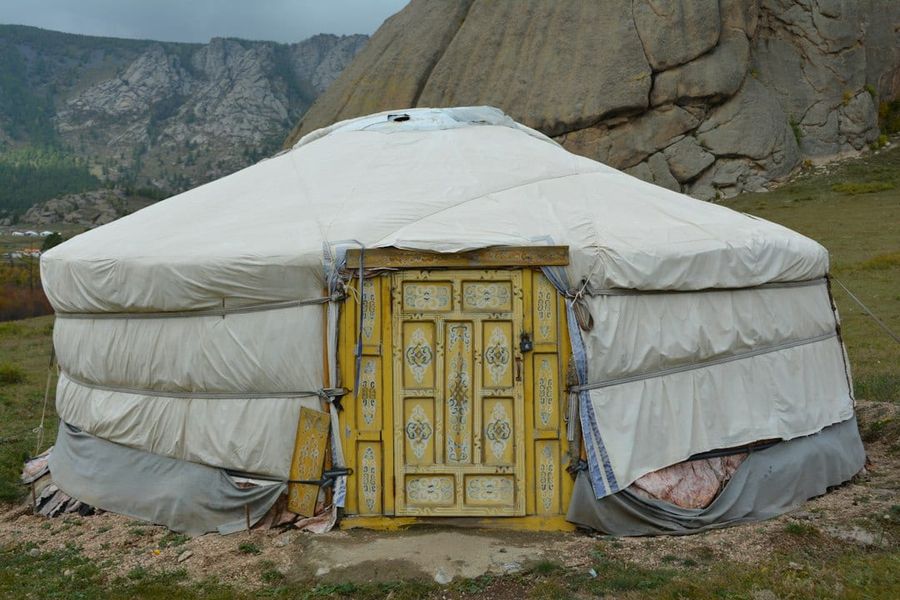
One practical note that is easy to overlook: a ger is compact. Move deliberately, keep bags and tripods out of walkways, and avoid stepping over bedding, food or people's outstretched legs. Courteous spatial awareness reads as good manners everywhere, and it matters more in a single-room home.
How do I accept tea and food graciously — and decline without offending?
Receive what is offered with both attention and thanks, and take at least a taste if you can. Guests on our family visits are typically offered suutei tsai (salted milk tea), airag (fermented mare's milk) and foods such as buuz (steamed dumplings) and dairy products — these are the everyday currencies of hospitality, and accepting them is how you acknowledge the welcome.
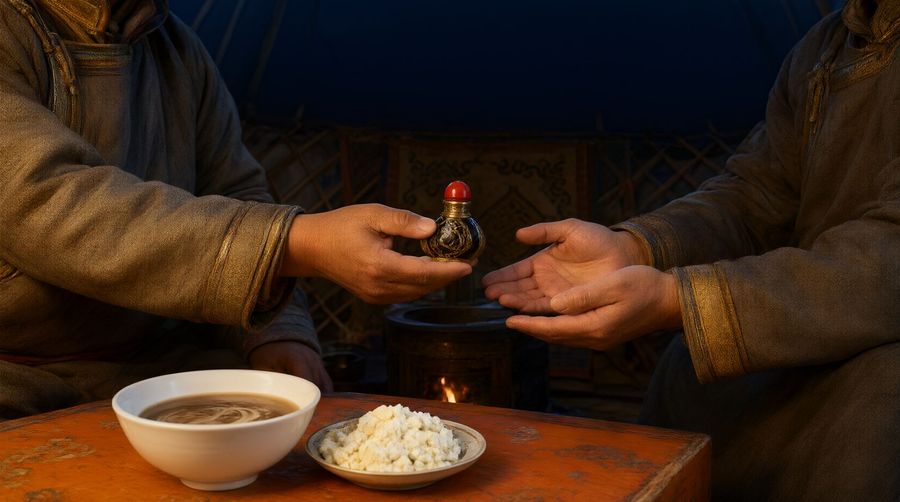
Here is how we suggest handling the table:
- Do accept the first bowl of tea when it is offered, even if you only sip it. Airag has a sour, fermented taste that surprises first-timers — a small, appreciative taste is a perfectly gracious response.
- Do receive bowls and passed items attentively, with a nod or word of thanks, watching how your host handles them and following suit.
- Do pace yourself. Bowls are refilled as a matter of course; you are not expected to drain everything instantly, and leaving a little is not an insult.
- Don't refuse abruptly or push a bowl away. If you truly cannot drink or eat more, a warm smile, a hand gently over the bowl and a clear "thank you, it was delicious" communicates better than any formula. If you have a dietary restriction, tell your guide beforehand so it can be conveyed gracefully — hosts would far rather know than watch you struggle.
You may also encounter the exchange of a snuff bottle — a small, often ornate bottle passed between host and guest as a formal greeting, especially among older men. One documented detail is worth knowing: a 2010 study of Mongolian customs in the Journal of Central Asian Studies notes that exchanging snuff bottles with one's deel (traditional robe) unfastened or sleeves rolled up is considered bad taste and not permitted. If you are wearing a deel for the visit, keep it properly fastened with sleeves down. Beyond that, the reliable approach is the same as everywhere else in the ger: watch how your host receives and returns the bottle, and mirror the gesture at an unhurried pace. Nobody expects a foreign guest to perform the ritual flawlessly; composure and respect are what register.
The one habit that covers every uncertainty
When you don't know the custom — where to sit, how to hold a bowl, whether to stand for an elder — look at your host and do what they do. This is our team's own guidance to travelers, and it extends beyond the ger to community events and festivals too.
How should I behave around the household — the stove, hats, and my camera?
Treat everything in the ger as you would in someone's living room, and treat the stove with particular care. In a herding household the central stove is the working heart of the home — heat, cooking and the kettle all depend on it — so give it space, don't lean over it or use it as a shelf, and never toss anything into the fire. Travelers' accounts of Mongolian custom often describe the hearth as a respected element of the household with taboos attached — you may hear advice about not putting rubbish in the fire, not whistling indoors, or keeping hats and feet positioned respectfully. We share these as customs you may encounter rather than rules we can document, and the safe behavior is identical either way: keep the fire clean, keep your voice calm, and follow your host's example with hats and seating.
On photography, our guidance is specific and it is our own: ask before close-up photos of people. A smile and a gesture toward the camera is usually enough — and accept a "no" gracefully, without negotiating. We give travelers this same advice at festivals, and it applies just as naturally in a family home, where the stakes feel higher because you are a guest at someone's table. Wide shots of the setting are usually less sensitive than portraits, but when in doubt, ask first — including before photographing children. A family that has said yes to a portrait will often pose happily; a family photographed without asking may say nothing and remember it.
- Do ask with a gesture before any close-up of a person, and thank them afterward — showing them the photo on your screen is a small pleasure worth sharing.
- Do put the camera away during greetings and while food is being served; be present first, photograph second.
- Don't photograph a refusal, and don't raise the camera again after a "no."
- Don't rearrange objects or ask people to repeat an action "for the photo" — you are visiting a home, not directing a scene.
What does participating in family life actually look like?
Participation means joining the household's real work when you are invited — not watching it staged for you. On the family visits we arrange, guests are welcomed with traditional hospitality and can take part in daily life: milking animals, making dairy products, herding, and helping with other chores. In Central Mongolia, where our journeys spend time with herding families on grasslands they still work today, that can mean anything from milking mares to helping craft dairy products.
The rhythm is invitational, and the trick is to read it. If a host hands you a bucket or waves you toward the churn, that is a genuine invitation — take it, laugh at your own clumsiness, and let them correct your technique. If the family is absorbed in a task and nobody beckons, watch quietly from where you were seated; hovering over someone's work with a camera is the opposite of helping. Ask your guide to translate a simple "can I help?" — the question itself is appreciated even when the answer is a friendly wave back to your seat.
Children tend to skip the etiquette anxiety entirely, and honestly, they model the right approach. On our family journeys, visiting a herding family is often the highlight for children: they watch goats being milked, help churn airag, and play with the family's own children despite the language barrier. These visits are unstructured and low-pressure — there is no script to get wrong. Adults can borrow that ease. Curiosity, a willingness to try, and good humor communicate across any language gap. For more on how these visits fit into a journey with kids, see our guide to traveling in Mongolia with children.
What kind of working home am I actually stepping into?
A herding household is a livestock business wrapped in a family home, and understanding its scale changes how you behave inside it. About 30% of Mongolia's population are nomads who live in gers and move their homes several times a year in search of better pastures — this is contemporary working life, not a preserved tradition performed for visitors. A 2024 study in Human Ecology, citing Mongolia's National Statistics Office, counted 248,296 herder households and over 71 million head of livestock in 2022 — roughly 286 animals per herder household. Those animals are the family's food, income and daily schedule.
Herding life rests on five kinds of animals, and each has a job:
- Horses — riding and racing, the backbone of movement across the steppe.
- Cattle — milk and dairy products, plus transport in some regions.
- Sheep — meat and wool, the household's staple stock.
- Goats — milk and dairy, and cashmere income.
- Camels — riding and carrying loads, above all in the Gobi.
What this means for you as a guest is practical. The family's day is organized around the animals — milking, herding, processing dairy — so your visit folds into that schedule rather than pausing it. If your host steps outside mid-conversation, it is probably an animal that needs attention, not a signal that you have offended anyone. Meals may come when the work allows. And the ger itself may be somewhere new next season: families move several times a year following pasture, which is why the dwelling is built to travel and why nothing in it is arranged purely for show. When you understand that you are a guest in a working home, the etiquette follows naturally — stay out of the workflow, join it when invited, and appreciate the hospitality as the generous interruption of a busy day that it is. Family visits like these sit alongside riding, hiking and festival days in our overview of things to do in Mongolia.
Do I need to bring a gift when visiting a nomadic family?
A small gift is a kind gesture but not an obligation, and your presence as a respectful guest matters more. Ask your guide what suits the specific family — they know the household and can advise, and can also handle anything you'd like to offer so it lands gracefully rather than awkwardly.
What if I can't drink airag or eat what's offered?
Take a small taste if you can, and receive it with thanks — that acknowledgment is the heart of the courtesy. If you genuinely cannot, decline warmly rather than abruptly, and let your guide convey any dietary restriction to the family in advance so no one is put on the spot.
Is it rude to take photos inside a ger?
Not if you ask first. Our team's guidance is to ask before close-up photos of people — a smile and a gesture toward the camera usually suffices — and to accept a "no" gracefully. Be present during greetings and meals, and keep the camera secondary to the conversation.
Will the language barrier make the visit awkward?
Far less than you'd expect. Milking, churning and herding are shared activities that need no translation, and children on our journeys routinely play with the family's kids despite having no common language. Your guide translates the key moments; goodwill carries the rest.
How long does a typical family visit last?
Visits are unstructured and low-pressure rather than timed performances — the family's working day sets the rhythm. Your guide will sense when the visit has reached its natural end; there is no fixed program you must sit through.
Come as a guest, leave as a friend
The travelers who tell us the visit was the highlight of their trip are rarely the ones who knew the most customs in advance — they are the ones who arrived relaxed, watched their hosts, said yes to the churn and the tea, and asked before the camera. If you would like a journey where family visits are arranged with households we know personally, our women-led local team designs private, all-inclusive trips with 24-hour assistance throughout — and we will brief you on everything in this guide before you ever reach a ger door. Plan my trip, or message us on WhatsApp with your questions, however small they seem.
Sources
- Journal of Central Asian Studies, University of Kashmir — "Customs and Traditions in Mongolia" (2010).
- Human Ecology (Springer) — herder-household and livestock figures citing Mongolia's National Statistics Office, 2022 data (2024).
