


By Mongolianstar Adventures Guest Care Team · Published November 1, 2026 · Updated November 1, 2026
Pack the same layering system you would use in summer — then make every layer heavier. Our FAQ defines winter in Mongolia as November–March: "cold and crisp with clear blue skies," with temperatures dropping significantly but a dry climate that makes the cold more manageable than many expect. What changes for your suitcase is weight and coverage: serious insulating layers, a windproof outer shell, insulated waterproof boots, and full protection for head, hands and feet. This guide to what to pack for Mongolia in winter covers the cold-weather checklist, what to confirm about your camps, and how travel days work — and where a number depends on your route and dates, we tell you exactly what to ask us.
The short version
- Same three-layer logic as the core season — heavier base, heavier mid layer, a genuinely windproof shell.
- Insulated waterproof boots, warm hat, gloves and spare socks are essentials, not extras.
- Sunscreen, sunglasses and lip balm still belong in the bag: snow reflects UV and the air is dry.
- Deluxe camps include heating in their stated standard; for November–March departures we confirm each camp's operating status and heating for your dates.
- We don't publish one temperature figure — message the desk with your dates and route for specifics.
Why is cold-season packing a different task?
Because Mongolia's dry continental climate produces both serious cold and large day–night swings — so the layering logic from our core-season packing checklist still applies, but every layer gets heavier. Mongolia's climate is very dry with big temperature differences between day and night, so layering is always recommended, as our FAQ notes.
Clear winter skies actually sharpen that swing. The NOAA National Weather Service glossary entry on radiational cooling explains radiational cooling: at night the ground loses heat to space, and this is "more pronounced when you have a clear sky" — with the strongest morning cold on nights that combine clear skies, light winds, long nights and dry air. That is precisely a Mongolian winter night. A sunny afternoon can feel pleasant while the pre-dawn hours demand everything you packed.
We deliberately don't publish a single temperature number: conditions vary by region, month and night. Before you pack, message our desk on WhatsApp with your route and dates and we'll tell you what to expect for your specific journey.
What about the shoulder seasons?
Late autumn and early spring sit between the two checklists. Winter runs November–March; the shoulder weeks are late October–early November and April. If you travel in March, pack the full cold-weather list below and keep the lighter mid layers accessible. In those shoulder weeks you may shed a layer at midday and want it back by four o'clock. Wind protection matters more than raw insulation in a windy April.
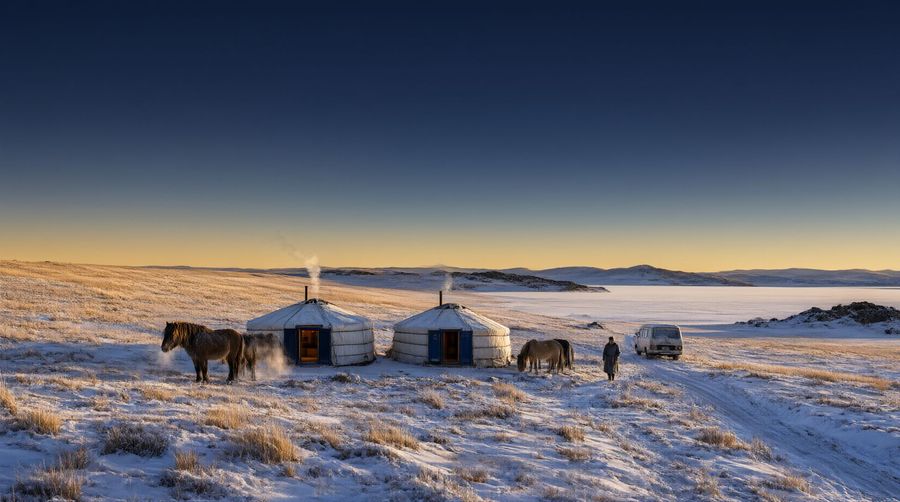
A cold-season camp on the steppe. Heating, facilities and vehicle arrangements are confirmed with the desk for your dates.
What to pack for Mongolia in winter: the cold-weather checklist
Several loose layers beat one heavy coat. The U.S. CDC Yellow Book recommends a moisture-wicking base layer (wool, silk or polypropylene), an insulating middle layer of fleece augmented with down or insulating microfiber for extreme cold, and a hooded, waterproof, breathable, windproof outer shell — worn as "several loose layers" rather than a single bulky garment. Loose layers trap warm air between them and let you adjust as the day changes.
Clothing
- Base layers: two or three sets of thermal tops and bottoms in wool or synthetic fabric — they wick moisture away from skin, which cotton does not.
- Mid layers: a heavy fleece or wool sweater, plus a down or synthetic-fill insulated jacket for the coldest hours and evenings.
- Outer shell: a hooded, windproof and waterproof jacket; windproof trousers or overtrousers for open-steppe stops.
- Warm hat that covers the ears, and a neck gaiter or scarf for face coverage in wind.
- Gloves: an insulated pair, plus thin liner gloves so you can handle a camera without bare hands.
- Socks: thick wool socks with spares — dry feet are warm feet, and a spare pair costs almost nothing in luggage space.
Footwear
Insulated, waterproof boots are non-negotiable. CDC/NIOSH guidance from 2021 states plainly that "boots should be waterproof and insulated" and that ears, face, hands and feet must be protected in extremely cold weather. Choose boots with room for a thick sock without squeezing your foot — a tight boot restricts circulation and feels colder. Break them in before you fly, and add a pair of lighter shoes for Ulaanbaatar hotels and vehicle time.
Skin and sun protection
Winter sun is not gentle sun. The World Health Organization notes in its UV radiation Q&A (accessed November 2026) that snow can reflect up to 80% of UV radiation — so on snow you receive UV from above and from the ground, which is why exposed skin needs protection even in freezing air — and recommends a broad-spectrum sunscreen of at least SPF 30 alongside a hat and sunglasses. On snow-covered steppe under those famous blue skies, you are getting sun from above and below.
- Broad-spectrum SPF 30+ sunscreen for face and any exposed skin.
- Sunglasses — essential on bright snow days.
- Lip balm and a rich moisturizer: dry air and wind are hard on skin, and both take up almost no space in your bag.
One bag, two kits
Keep a small day kit — hat, gloves, sunscreen, lip balm, spare socks — at the top of your bag or in your daypack, not buried in the suitcase. On travel days you'll reach for it at every stop, and in the cold you don't want to be unpacking on the roadside.
What should I confirm about my camps before packing?
A ger is Mongolia's traditional round felt-and-lattice dwelling; a ger camp is a small cluster of them run as guest accommodation, usually with a dining ger and shared or ensuite bathrooms. Confirm heating and bathroom arrangements per camp and season — that single answer decides several items on your list. Here is what our FAQ documents, and what remains a question for the desk.
| Standard ger camps | Deluxe ger camps | |
|---|---|---|
| Your accommodation | Private ger for your group | Traditional ger, private ensuite bathroom |
| Bathroom | Shared bathroom and shower facilities | Private ensuite |
| Heating | Confirm per camp and season | Included in the stated standard; for November–March departures we confirm each camp's operating status and heating for your dates |
| Dining | Central dining ger, hot meals | On-site dining, local and international meals |
| Character | Simple, clean, more traditional | Our signature countryside comfort — our own descriptor, not an official star rating |
What we provide vs what you bring
| Provided on your journey | You bring |
|---|---|
| Bed and bedding in your ger — confirmed per camp and season | Thermal base layers, insulating mid layers, windproof shell |
| Heating — included in the Deluxe stated standard, per camp and season at Standard; confirmed for November–March dates | Insulated waterproof boots, warm hat, gloves, spare wool socks |
| Hot meals at camp dining — confirmed per camp | Snacks and a thermos for travel days |
| Private vehicle with driver-guide — shelter between stops; vehicle type and heating confirmed per route | SPF 30+ sunscreen, sunglasses, lip balm and moisturizer |
| Camp electricity — typically generator-based during set hours, confirmed per camp | Power bank and spare camera batteries |
| 24-hour trip assistance while you travel | Personal medication and toiletries |
In Ulaanbaatar you stay in centrally located hotels with private bathrooms and Wi-Fi; we confirm the specific property and its category for your itinerary. In the countryside, a Deluxe camp's ensuite and included heating mean no night-time walk to a shared block in the cold — worth weighing carefully for a November–March journey, especially with children. Our FAQ explains both standards in full.
How gers stay warm, in general terms: a ger is usually heated by a small solid-fuel stove in the middle of the room, vented through the roof ring. The stove warms the space quickly while it burns, and the temperature drops once the fire is left to go out — so a ger that feels cosy at bedtime can be much colder before dawn. Stove type, fuel and whether the fire is kept in overnight differ by property, so we confirm the heating arrangement and overnight setup for each stop on your dates.
What we ask you to confirm with us rather than assume:
- Which camps on your route operate and stay heated in your travel month — camp availability changes outside the core season, and we confirm each property for your dates.
- How your ger is heated at Standard level, and whether extra bedding is provided — this varies per camp and season.
- Hot water, shower access and charging hours at each stop — countryside camp electricity is typically generator-based and available during set hours, so bring a power bank and spare camera batteries, and ask us for the pattern on your route.
Ask, don't guess
Send us your dates and we'll come back with what each camp on your itinerary provides — heating, bathrooms, bedding and charging — so you pack for what's actually there, not for what you fear might be missing.
How do travel days work in the cold?
You travel in a private vehicle with your driver-guide, so warm layers stay within arm's reach rather than in a luggage hold. Our FAQ lists Russian Vans (UAZ) for off-road terrain, Modern Vans with A/C for families and small groups, 4WD vehicles such as the Toyota Land Cruiser for smaller groups, buses for larger parties, and domestic flights on selected routes. Which vehicle suits your cold-season route — and how heating, tyres and en-route comfort are arranged for your dates — is something to ask the desk directly; we confirm it per journey rather than promise a blanket standard.
Every private journey carries 24-hour trip assistance — our operations team is contactable around the clock while you travel. Full protocols are on our Getting to Mongolia page.
Practical habits that make cold travel days easy:
- Keep your insulated jacket, hat and gloves on the seat beside you, not in the boot.
- Carry a thermos and snacks in your day bag — ask us what your vehicle arrangement provides so you know what to bring yourself.
- Dress in the layers you can shed inside the vehicle and restore in seconds at a stop; photo stops in winter are short, sharp exposures to the cold.
- Charge devices during the vehicle leg and at camp generator hours; a power bank bridges the gaps.
How does the desk help before you fly?
Once your itinerary is approved, we handle the logistics. Before you fly, we go through your itinerary with you and answer packing, camp and travel-day questions for your specific route. As a women-led local team with over ten years of expertise running private all-inclusive journeys, we would rather answer ten packing questions in October than have you wish for a warmer layer in January.
Here is how that conversation usually goes:
- 1
Message the desk with your dates and route — WhatsApp +976 99995941, phone +976 99995941 or email uyanga@mongolianstar-adventures.com. Message the desk any time — while you travel, our operations team is contactable around the clock.
- 2
We confirm your camps — which properties operate in your month, heating at each stop, bathroom arrangements and charging hours.
- 3
We flag anything to add or leave out — based on your actual itinerary, so your bag matches your journey.
- 4
We go through the final itinerary with you once it is approved, answering any last packing, camp and travel-day questions.
Frequently asked questions about packing for a Mongolian winter
Do I need expedition-grade gear for a Mongolian winter?
No — you need a proper cold-weather layering system, not mountaineering equipment. Heavy thermal base layers, a strong insulating mid layer, a windproof waterproof shell, insulated waterproof boots and full head-and-hand coverage are what the guidance calls for. Quality outdoor clothing you already own covers most of this list for vehicle-based sightseeing with short outdoor stops. For extended time outside, remote winter routes or photography sessions, upgrade to expedition-rated insulation and boots — tell us your plans and we'll advise.
Is the packing list different for children?
The same principles apply, with more spares. Children need their own heavy base layers, insulated jacket, warm hat, mittens or gloves, insulated boots and extra socks — wet or lost items happen faster with kids. Tell us their ages when you enquire and we'll factor camp heating and travel-day comfort into the plan.
Should I bring my own sleeping bag?
Ask us for your specific camps before buying one. Deluxe camps include heating in their stated standard; at Standard level, bedding and heating are confirmed per camp and season. For November–March departures we confirm each camp's operating status and heating for your dates. We'll tell you what each stop provides so you don't carry a sleeping bag you won't need — or arrive without warmth you expected.
Not sure what your dates mean for your suitcase? Ask us — that's what the desk is for. Message us on WhatsApp or email uyanga@mongolianstar-adventures.com and we'll come back to you with the conditions and camp details for your route. Ready to shape the journey itself? Plan your trip with us — and once you're travelling, our 24-hour trip assistance is with you the whole way.
Planning a November–March departure?
Tell us your dates and we'll confirm what your camps provide, what to expect on the road, and exactly what belongs in your bag.
Plan my tripSources
- NOAA National Weather Service — glossary: radiational cooling (accessed November 2026)
- U.S. CDC Yellow Book — Heat and Cold Illness in Travelers (accessed November 2026)
- CDC / NIOSH — cold-weather protective guidance (accessed November 2026)
- World Health Organization — Ultraviolet (UV) radiation Q&A (accessed November 2026)
