


By the Mongolianstar Adventures Festival & Culture Team · Updated October 22, 2026
About 30% of Mongolia's population lives nomadically — in gers (traditional felt dwellings), moving home several times a year to find better pasture for their animals. Their working year revolves around five kinds of livestock: horses, cattle, sheep, goats and camels. When you visit a herding family on the Central Mongolian steppe, you are stepping into that working year mid-stride — and once you understand its rhythm, everything from the meal times to the milking bucket makes sense. We arrange these family visits on our own journeys, and this is the context we wish every guest arrived with.
What are the five animals of Mongolian herding?
Mongolian herders traditionally keep five species — horses, cattle, sheep, goats and camels — and each one earns its place by providing something different. This is not a symbolic list. It is a working portfolio, and the scale of it is real: a 2024 study in Human Ecology, citing Mongolia's National Statistics Office, counted 248,296 herder households and over 71 million head of livestock in 2022 — roughly 286 animals per herder household.
Here is what each animal contributes to a family's life:
- Horses — riding and racing, the backbone of steppe transport and of the herding work itself; mares also give milk for airag (fermented mare's milk).
- Cattle — milk and dairy products, plus transport in some regions. In higher, colder country, families may keep yaks alongside or instead of cattle — worth asking your hosts about, since the mix changes with the land.
- Sheep — meat and wool; the everyday staple of the herd and of the winter table, and the felt that wraps the ger itself comes from this wool.
- Goats — milk and dairy, and cashmere, which is a significant cash income for many families.
- Camels — riding and carrying loads, most at home in the Gobi and desert-steppe margins rather than the green heartland.
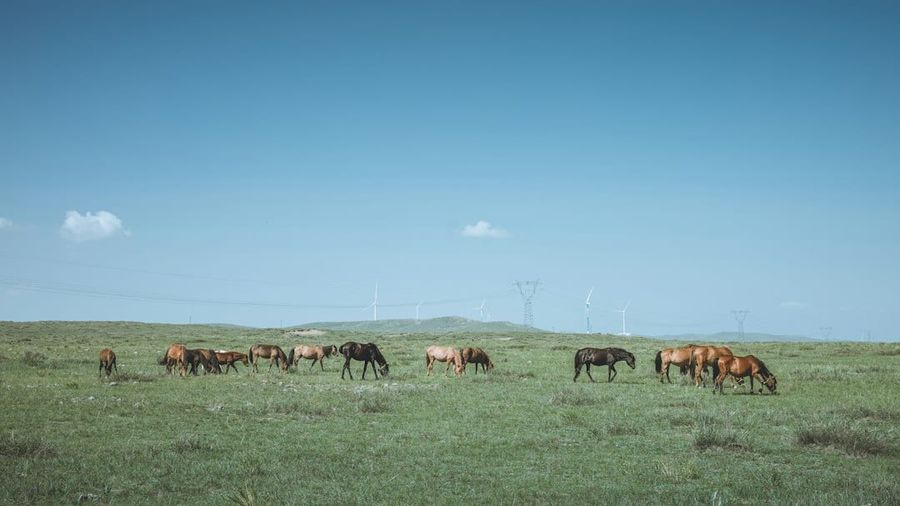
Why a mixed herd, not just one species?
It is tempting to read the five-animal mix as tradition for tradition's sake. The way herding families themselves talk about it, it is closer to risk management. Different species graze differently, weather hard seasons differently, and pay out differently — milk through summer, wool and cashmere at shearing, meat when the cold sets in. A family whose wealth walks on five kinds of legs has more ways to absorb a bad year than one betting everything on a single species. That is a common view among herders rather than something we can put a figure to, but it explains why a guest sees goats tangled among sheep, horses loose beyond the camp, and a few cattle near the river — all at once. The herd is not a postcard arrangement. It is a livelihood spread across options.
How does the herding year actually run?
The herding year splits, broadly, into a summer dairy season and a winter meat season, and the household's daily work follows that split. Mongolians eat a lot of meat in winter to stay warm and strong; dairy products are consumed mostly in summer, when the animals produce more milk. Once you know this, the food you are offered stops being random hospitality and starts telling you what month it is in the family's working calendar.
Why do families move camp?
Families shift pasture several times a year because the grass needs it and the animals need it. Grazing one patch until it is exhausted would undermine the very resource the herd depends on; rotating through seasonal pastures lets grass recover and keeps animals in condition. Mobility, in other words, is the logic of the system — not wandering, and not a quaint habit. The exact number of moves and the reasoning behind each varies by region, family and year, so we describe the pattern rather than pretend there is one universal schedule. On our Central Mongolia journeys, which run through Terelj, Kharkhorin, the UNESCO-listed Orkhon Valley and the Mini Gobi, guests sometimes witness a seasonal livestock migration in progress — a household in motion, ger poles lashed to a cart or truck, animals strung out across the valley. Pastoral traditions in this landscape span more than two millennia, and the movement you are watching is their living continuation.
Summer: the dairy months
Summer is white-food season. The animals are milking, and the ger becomes a small dairy workshop: milk arrives, and the women of the household turn it into curds, creams and fermented drinks faster than it can spoil. Work starts with the animals and ends with them; everything else — cooking, repairs, visitors — fits between. If you arrive in July or August expecting a leisurely household, you will instead find a busy one, and the busiest hours revolve around the buckets.
Winter: the meat months
Winter reverses the emphasis. Milk drops away, the herd's job shifts toward survival, and the family's diet leans on meat to carry everyone through the cold. The work is less about processing and more about protection — watching condition, managing shelter and feed, keeping animals alive through the hardest stretch of the year. A winter visit feels different from a summer one for exactly this reason: same family, same ger, different half of the working year.
Reading the seasons as a guest
If your bowl is full of dairy, you are visiting in the milking half of the year. If the meal centers on meat, you are in the other half. Neither is a menu chosen for tourists — both are the household eating what its own animals provide, when they provide it.
Is "helping with the animals" a real activity or a performance?
On the family visits we arrange, it is real work — because the family's day does not stop for you. The household's schedule is organized around the animals: milking, herding, processing dairy. A visit folds into that schedule rather than pausing it, and meals may come when the work allows. Nobody stages a demonstration; you are simply welcome to join what was happening anyway.
What guests genuinely take part in:
- Milking — mares or cows, depending on the family and the season, with someone guiding your hands the first time.
- Walking out with the herd — accompanying a family member as the animals are moved to pasture, which is also the best conversation you will have all trip.
- Dairy-making — watching and helping as milk becomes curd and other products, learning by standing next to someone who has done it ten thousand times.
- Everyday chores — the unglamorous tasks that fill a herding day, offered as they come up.
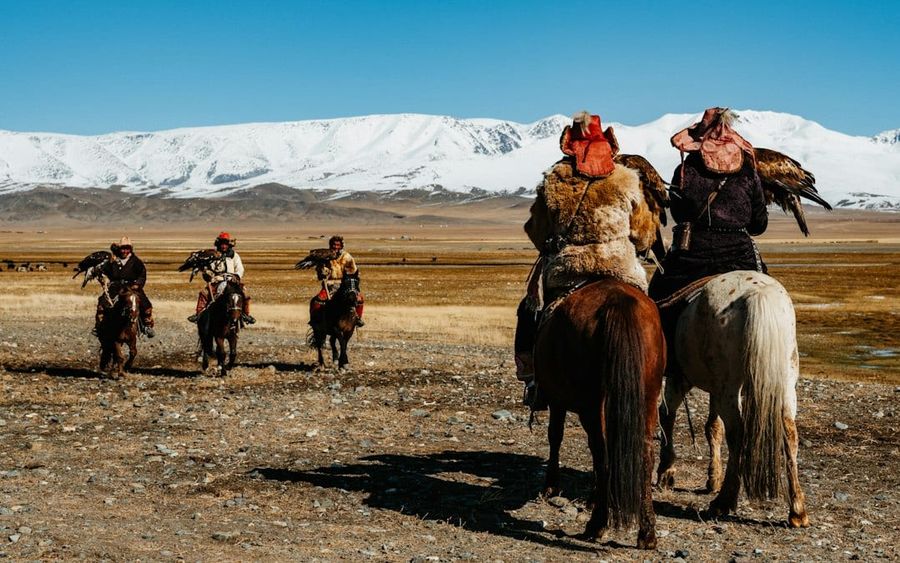
Children tend to slip into this most naturally. On our family journeys, kids watch goats being milked, help churn airag, and play with the family's own children despite the language barrier — the visits are unstructured and low-pressure, which is precisely why they work.
What a morning can teach — and what it can't
Be honest with yourself about the difference between participating and mastering. In one morning you can learn to sit beside a cow, feel the rhythm of milking, carry a pail, walk a flock's edge without scattering it. What you cannot learn in a morning is what your hosts know: reading an animal's mood from fifty meters, judging pasture by a glance, knowing which sky means move the herd tonight. That knowledge takes a lifetime, and the respectful posture for a guest is apprentice, not expert. Try things, laugh at your own clumsiness, and let the family's competence be impressive rather than something you perform back at them.
Is nomadic life frozen in time?
No — and it is worth dismantling this expectation before you arrive, because it quietly shapes how visitors see everything. Nomadic life today is contemporary working life. At the camps our travelers visit, it is ordinary to see a motorbike parked where a horse might once have stood, a solar panel keeping a phone charged, and a teenager checking messages between chores. None of this contradicts the herding year; it serves it. A phone coordinates a pasture move. A motorbike rounds up strays faster. The five animals and the seasonal round remain the organizing structure — the tools around them are simply the tools of this decade.
The families you meet are not preserving a museum diorama for your camera. They are running a livestock business under demanding conditions, raising children, and making choices about technology and trade like anyone else. Guests who arrive expecting "the past" often spend the first hour subtly disappointed and the rest of the visit genuinely fascinated — once they realize that watching a modern household master an ancient environment is far more interesting than any costume drama could be.
How does understanding the rhythm change your visit?
It changes what the hospitality means. When a family offers you suutei tsai (salted milk tea), airag, buuz (steamed dumplings) and plates of dairy — as guests on our visits typically are — they are sharing the output of the very work you just watched. The tea is this morning's milk. The dairy is this season's labor. The generosity is not a service laid on for visitors; it is the same hospitality the herding year itself runs on, extended to you because you are inside the ger.
A few behaviors follow naturally from that understanding — not a rulebook, just consequences of seeing the household clearly:
- Let the work set the pace. If lunch is late, the herd came first. Waiting cheerfully is participation too.
- Ask before joining a task, then follow your host's lead. Milking and herding have right ways that protect both you and the animals.
- Receive food as the gift it is. Even a small taste of what is offered honors the season's work behind it.
- Photograph the work, not a fantasy of it. The motorbike beside the horse is part of the true picture — include it.
For the full do-and-don't list of being a welcome guest inside a ger — thresholds, snuff bottles, seating and more — we keep a separate guide: Mongolian Ger Etiquette: How to Be a Welcome Guest in a Nomadic Home. This article's job is the why behind it all: a family whose year is shaped by five animals will treat a considerate guest as part of the day, not an interruption of it.
The herding year in brief
- About 30% of Mongolians live nomadically, moving camp several times a year for pasture.
- Five animals — horses, cattle, sheep, goats, camels — each provide something different: transport, milk, meat, wool, cashmere, carrying power.
- Summer is the dairy season; winter is the meat season. The food you're offered tells you where you are in the year.
- Guest participation is genuine household work folded into the family's schedule — real, but apprenticeship, not mastery.
- Nomadic life is contemporary life: phones, motorbikes and solar panels serve the same ancient seasonal logic.
Can I really milk a mare or cow as a visitor?
Yes — on the family visits we arrange, guests are welcomed into daily life including milking animals, making dairy products and herding. Someone will guide you, and the family's patience with beginners is part of the hospitality. What you gain in a morning is the feel of the work, not the skill of a lifetime.
Will the family change their routine for our visit?
No, and that is the point. The household's day is organized around the animals — milking, herding, processing dairy — so your visit folds into that schedule rather than pausing it. Meals may come when the work allows, which is exactly how the family itself eats.
What season is best for seeing dairy-making?
Summer, when the animals produce more milk and dairy products fill the household's table and workload. Winter visits lean toward the meat side of the herding year instead — equally genuine, just the other half of the cycle.
Is it intrusive to visit a working herding family?
Not when the visit is arranged properly and you arrive as a considerate guest. Families on our journeys welcome visitors with traditional hospitality and invite them into real chores; children often connect fastest, playing with the family's kids despite the language barrier. Ask before joining tasks or photographing people, and let the work set the pace.
If you would like to meet this working year firsthand — milking at a family camp in the Orkhon Valley, walking out with the herd, sharing the season's food — our women-led local team has been designing private journeys like this for over ten years, with 24-hour trip assistance throughout. Plan my trip and tell us which half of the herding year you'd like to see.
Sources
- Human Ecology (Springer) — 2024 study citing Mongolia's National Statistics Office on herder households and livestock numbers (2022).
