


By the Mongolianstar Adventures Festival & Culture Team · Updated October 26, 2026
Mongolian food is built on two ingredients above all others — meat and dairy — and the menu you'll meet follows the herding year: meat dominates in winter, dairy in summer, because that is what the animals give in each season. The dishes travelers ask about most are khorkhog (hot-stone barbecue), buuz (steamed dumplings) and airag (fermented mare's milk). We are the local team that sits down at these tables with our guests every season, and this guide explains what arrives, why it arrives, and how to receive it like a welcome guest rather than a nervous one.
Mongolian food in brief
- The diet follows the seasons: meat in winter for warmth and strength, dairy in summer when the herds give milk.
- Khorkhog is meat and vegetables steamed with fire-heated stones inside a sealed container — and the warm stones are passed among the guests.
- Buuz are steamed meat dumplings, at home on everyday tables and at big family celebrations alike.
- Airag is mildly alcoholic, not just sour milk — a small, appreciative taste is a perfectly gracious response.
- Accept the first bowl of tea, mirror your host, and tell your guide about dietary needs in advance.
Why does the Mongolian menu change with the seasons?
Because a herding kitchen cooks what the herd produces, and the herd's output changes with the calendar. Mongolian cuisine is based on meat and dairy products; the most common meats are mutton, beef and goat. As we explain on our things to do in Mongolia page, Mongolians eat a lot of meat in winter to stay warm and strong, while dairy products are consumed mostly in summer, when the animals produce more milk.
This is the thread that makes every dish make sense. A bowl of salted milk tea in July and a platter of boiled mutton in January are not random preferences — they are the same household eating from the same animals at different points in the year. Summer is often described locally as the season of "white foods," the dairy spread; winter belongs to meat. Once you see the menu as a calendar, nothing on a Mongolian table looks strange anymore.
What do the five animals each contribute?
The nomadic lifestyle rests on five types of animals, and each has its job. About 30% of Mongolia's population are nomads who live in gers (traditional felt dwellings) and move their homes several times a year in search of better pasture — this is contemporary working life, and the food is its most direct expression.
| Animal | What it gives the household | What it puts on the table |
|---|---|---|
| Horses | Riding and racing | Mare's milk, fermented into airag |
| Cows | Milk and dairy products | Milk tea, creams and dairy foods |
| Goats | Milk and dairy products | Milk for dairy; goat meat |
| Sheep | Meat and wool | Mutton — the everyday meat |
| Camels | Riding and carrying loads | Transport for the moving household |
Notice what's absent: very little depends on crops. When your home moves with the pasture, your pantry walks beside you. That single fact explains the short ingredient lists, the preservation-by-fermentation, and the generosity — a household that lives from its animals offers its animals' best to a guest.
What is khorkhog, and why is everyone passing a hot stone?
Khorkhog is Mongolia's traditional hot-stone barbecue: pieces of meat, potatoes and carrots layered in a large metal container with stones heated in the fire, then sealed and left to cook for several hours. The result is tender meat with a distinctive smoky flavour — cooked from the inside by the stones rather than over an open grill. It is usually eaten outdoors, which is half the pleasure: the container comes to the grass, not the table to a kitchen.
Then comes the part no photograph prepares you for. When the container is opened, the hot stones are passed around among the guests. People take a warm stone in their hands, turn it from palm to palm as it cools, and pass it on. It is believed locally that the stones have healing properties and can relieve pain and improve circulation — we share that as the belief it is, not as medicine. What we can tell you is what the moment does socially: everyone at the meal holds a piece of the same fire, and the circle of passing stones turns a plate of food into a shared event.
When the stone reaches you
Take it, juggle it gently between your palms as it cools — everyone does — and pass it along. You don't need to know any words for this; watch the person beside you and copy them. It is the easiest ritual in Mongolia to join.
On our journeys, khorkhog appears both at family tables and as a planned highlight — our Deluxe routes include traditional khorkhog barbecue alongside long lunches in a family ger. If you'd like to understand the setting it's served in, our Central Mongolia region is where many of these meals happen, among herding families in the Orkhon Valley and beyond.
What are buuz, and when will I eat them?
Buuz are steamed dumplings — a wrapper of dough around a seasoned meat filling, cooked in stacked steamers and eaten hot, often by hand. They are among the foods guests are typically offered on our family visits, alongside milk tea, airag and dairy products, and they are just as much an everyday city food as a countryside one.
It is commonly said that buuz anchor Mongolia's biggest family celebrations — households prepare them in great numbers for festive gatherings, folding hundreds together as a family task. We offer that as the shared local understanding it is rather than a documented claim; what we can say from our own tables is that buuz are the dish that signals someone made an effort for you. Steaming dumplings takes time and many hands. When they arrive, you are being treated as an occasion.
A practical note for the cautious eater: buuz are rich and juicy inside — bite a small opening first and let the steam escape before the whole dumpling goes in. Your host will find this entirely sensible; locals do the same.
What do airag and suutei tsai actually taste like?
Honestly? Both surprise first-timers, in opposite directions. Suutei tsai is salted milk tea — if your mouth expects sweet tea, the salt takes a sip or two to recalibrate, and then most guests find themselves reaching for the bowl again. Airag is fermented mare's milk, and its sour, fermented taste genuinely surprises people who were told it was "just milk."
Airag is also mildly alcoholic, and that's chemistry, not folklore. A 2016 peer-reviewed characterization of airag collected in Ulaanbaatar, published in the Journal of Animal Science and Technology, measured ethyl alcohol at 1.44–2.33% and lactic acid at 1.08–1.62% — the distinctive sour, slightly alcoholic flavour comes from both lactic-acid and alcohol fermentation happening together. So think of it as closer to a light, tangy fermented drink than to spoiled milk, and keep that modest alcohol content in mind before driving or for children.
Both drinks belong to summer hospitality, when the mares are giving milk and the churning is part of the household's daily work. In Central Mongolia our guests spend time with herding families through exactly this cycle — from milking mares to crafting dairy products — and taste airag and buuz where they are made. Our standing guidance has never changed: a small, appreciative taste of airag is a perfectly gracious response. You are not expected to finish the bowl, or to acquire the taste on schedule.
How do I accept — or decline — food gracefully at a family table?
Receive what is offered with attention and thanks, take at least a taste if you can, and mirror your host. Those three habits cover almost every situation. Guests on our family visits are typically offered suutei tsai, airag, buuz and dairy products — these are the everyday currencies of hospitality, and accepting them is how you acknowledge the welcome.
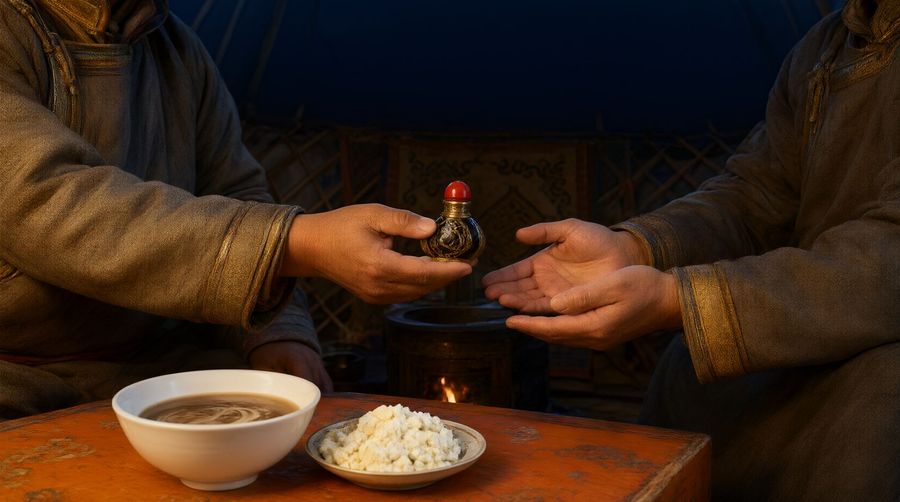
Here is the concrete guidance our team gives before every visit:
- Do accept the first bowl of tea even if you only sip it — the acceptance is the courtesy, not the volume.
- Do receive bowls attentively, with thanks, and mirror how your host handles theirs.
- Do try a little of what's offered; a small taste taken with visible appreciation reads as genuine respect.
- Don't refuse abruptly or push a bowl away — a hand gently over the bowl and "thank you, it was delicious" works far better.
- Don't worry about leaving a little: bowls are refilled as a matter of course, and an unfinished bowl is not an insult.
- Do tell your guide about any dietary restriction beforehand, so it can be conveyed gracefully to the family — hosts would far rather know than watch you struggle.
What do hosts read into your plate? In our experience, far less judgment than travelers fear. An abrupt refusal lands worse than leaving food; a warm, unhurried guest who tastes things and says thank you is simply a good guest. For the full picture of visiting a nomadic home — greetings, seating, cameras — see our companion guide to Mongolian ger etiquette.
What will cautious eaters and children actually eat on a journey?
More variety than the "meat and dairy" summary suggests — and we plan for the cautious eaters deliberately. On our all-inclusive journeys guests can expect hearty breakfasts, picnic lunches on driving days and hot dinners at camp, with dietary requirements accommodated given advance notice. Camp kitchens cook simple, hearty food: soups, stews, rice, noodles and bread. For cautious young eaters we notify camps ahead so they can prepare milder versions or familiar staples such as plain rice, eggs or pasta.
Deluxe camps go further, with on-site dining serving both Mongolian and international meals — so a traveler who wants to try khorkhog one evening and eat something familiar the next can do exactly that, without anyone making a fuss.
And here is the part that reassures parents most: on our family journeys, visiting a herding family is often the highlight for children. They watch goats being milked, help churn airag, and play with the family's own children despite the language barrier. The visits are unstructured and low-pressure — there is no script to get wrong, at the table or anywhere else. Children tend to model the right approach instinctively: curious, unhurried, happy to try one bite. Adults can borrow that ease.
Is airag alcoholic, and can children try it?
Yes, mildly. A 2016 study of airag collected in Ulaanbaatar measured 1.44–2.33% alcohol, produced alongside lactic acid during fermentation. Given that content, we suggest adults treat it as a light alcoholic drink; for children, the milking and churning are the fun parts, and suutei tsai or plain dairy foods are the natural things to offer them instead.
Is suutei tsai really salty?
Yes — it is salted milk tea, and the salt surprises guests who expect sweetness. Most people adjust within a sip or two. Accept the first bowl even if you only sip it; that acceptance is the heart of the courtesy.
What if I'm vegetarian or have a food allergy?
Tell your guide before the visit or the trip, and it will be conveyed gracefully to hosts and camps. On our all-inclusive journeys dietary requirements are accommodated with advance notice, and camps can prepare milder or simpler dishes. Hosts would far rather know in advance than watch you struggle at the table.
Do I have to finish everything I'm offered?
No. Bowls are refilled as a matter of course, and leaving a little is not an insult. A small taste taken with thanks reads as acceptance; an abrupt refusal or pushing a bowl away lands much worse than an unfinished plate.
Is khorkhog spicy or difficult for sensitive stomachs?
Khorkhog itself is not a spiced dish — it is meat, potatoes and carrots steamed with hot stones, valued for tenderness and a smoky flavour rather than heat. It is rich, though, so start with a modest portion. If you have a sensitive stomach or specific concerns, let your guide know so meals can be paced and adapted.
A quick glossary for your first Mongolian table
- Ger — the round felt dwelling herding families live in; the setting for most of these meals.
- Khorkhog — traditional hot-stone barbecue: meat, potatoes and carrots sealed in a metal container with fire-heated stones; the warm stones are passed among guests.
- Buuz — steamed meat dumplings, served at family visits and celebrations and as everyday food.
- Airag — fermented mare's milk; sour and mildly alcoholic, a summer hospitality staple.
- Suutei tsai — salted milk tea, the first thing usually offered to a guest.
- Deel — the traditional robe your hosts may wear; worth recognizing, not required eating attire.
Every one of these words stops being foreign vocabulary the first time it's placed in front of you with a smile. That is the real logic of the nomadic diet: it is not a cuisine of exotic ingredients but of close attention — to the animals, to the season, and to the person sitting down beside the stove.
If you'd like to taste all of this where it's made — at family tables and camp fires, with someone beside you translating the moments that matter — our women-led local team would love to design that journey with you, backed by 24-hour trip assistance throughout.
Eat Mongolia with the people who know its tables
Tell us who's traveling and how adventurous your eaters are — we'll shape a private journey where every meal is a welcome, not a worry.
Plan my tripSources
- Journal of Animal Science and Technology (PMC) — characterization of airag (2016).